


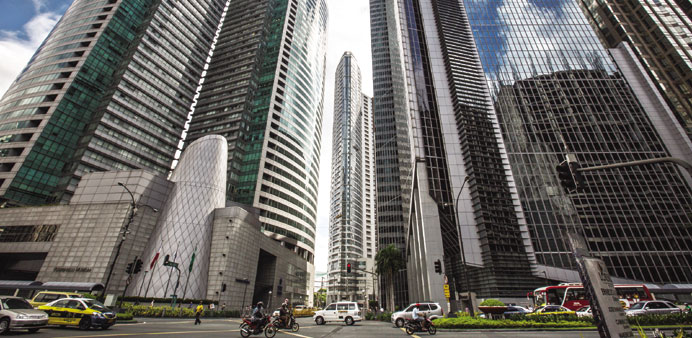
High-rise buildings stand along Ayala Avenue in the financial district of Manila. The Philippine central bank is set to introduce a residential property-price index in the first half of the year as it intensifies monitoring of asset-bubble risks, deputy governor Diwa Guinigundo said yesterday.
Bloomberg/Manila
The Philippine central bank is set to introduce a residential property-price index in the first half of the year as it intensifies monitoring of asset-bubble risks, Deputy Governor Diwa Guinigundo said.
The index initially will cover Manila and nearby provinces using data including building permits and wholesale prices of construction materials of new housing units from 2006 to 2012, Guinigundo, 59, said in an interview in his office in Manila late yesterday.
“While there’s no evidence of asset bubbles, we need to really monitor what’s going on,” he said. “It will provide us with a solid indicator of price movements of residential units. We want to see not just the big picture but its components.”
Increased scrutiny in the Philippines comes after Hong Kong and Singapore adopted measures to cool property prices. President Benigno Aquino said in an interview last month there is no danger of the economy overheating, downplaying the risk of asset bubbles forming.
“This strengthens the Philippines’ surveillance and regulatory framework and boosts its ability to spot risks much earlier,” said Jeff Ng, a Singapore-based economist at Standard Chartered. “While most of Asia including the Philippines have manageable exposure in the property sector, rising interest rates pose a key risk.” Philippine developers Ayala Land and Vista Land & Lifescapes declined yesterday while the benchmark index was little changed at 10.43 am in Manila. The peso slipped 0.3% to 44.837 against the US dollar. Policy makers in emerging nations from Turkey to Brazil have raised interest rates this year to contain inflation and bolster currencies as the US cuts monetary stimulus. The Philippine central bank will probably raise its benchmark to 4% by the end of the year, Bloomberg surveys show.
Real estate and construction activity together account for a fifth of the Philippine economy, the Oxford Business Group said in a report on February 27. Policy makers should closely watch the residential market as low interest rates and rising money supply may spur demand, Credit Suisse Group AG said last month.
The central bank last week said it is prepared to deploy necessary measures to ensure liquidity conditions are in line with its goals of price and financial stability, after money-supply growth reached a record in January. It has exceeded 30% every month from July.
“We are prepared to do whatever it takes to ensure liquidity is aligned with a growing economy and a deepening financial system without abetting any build-up in inflation pressures,” Guinigundo said on Monday. Singapore began introducing property curbs four years ago with some of the strictest measures implemented in 2013, including a cap on debt at 60% of a borrower’s income, higher stamp duties on home purchases and an increase in real estate taxes.
Hong Kong has raised the minimum mortgage down payment six times since 2010 and imposed taxes including a doubling of the stamp duty on deals of more than HK$2mn ($258,000), plus an extra 15% levy on non-resident buyers.
In the Philippines, property loans and investments rose 6.8% to a record 900.1bn pesos ($20bn) in the second quarter of 2013 from the previous three-month period, the central bank reported in November. Property made up 22% of the total loan portfolio at banks.
Bangko Sentral currently caps banks’ real-estate lending at 20% of total outstanding loans, with some exclusions.
The central bank is seeking the approval of the Philippine Statistics Authority before it can release the index, Guinigundo said. The index will gradually be expanded to include data on housing loans, existing homes, and other regions to come up with a nationwide index, he said.
More banks tightened lending standards for commercial real- estate loans for a sixth consecutive quarter in the three months through December, the central bank said in January. Lenders reported wider loan margins, reduced credit line sizes, stricter collateral requirements and loan covenants, increased use of interest-rate floors, and lower loan-to-value ratios, it said.