


By Peter Alagos
Business Reporter
Ontario’s minister of economic development, trade and employment said Qatar has the full support of Canada in achieving the pillars of the Qatar National Vision 2030.
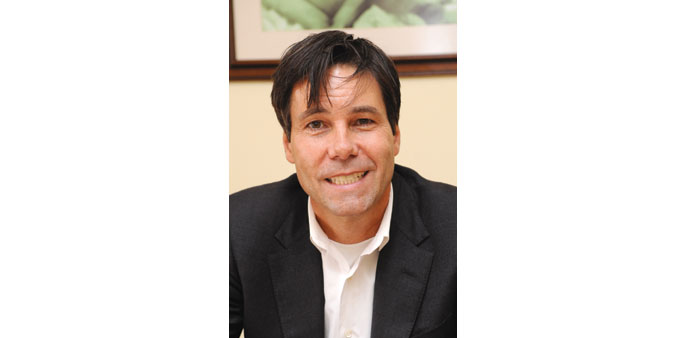
Dr Eric Hoskins, who was in Qatar recently on a trade mission, described the Vision 2030 as an “extremely ambitious” and “attainable goal.”
“We admire and share Qatar’s National Vision for 2030; I think it is very far-reaching, but it is a comprehensive and attainable one. We have so much confidence in the ability of the Qatari people and the government,” Hoskins said.
One of the goals of the trade mission, Hoskins said, was “to explore how to further strengthen the relations between Qatar and Ontario by showing our support to this country’s ambitions for 2030.”
“We want the Qatari government to feel our presence and help it realise that goal; and we think we have the skill set to help. So that’s the main message [from this trade mission],” Hoskins stressed.
Hoskins said Canada and Qatar “have enjoyed very good relations over the years.”
“We recently strengthened our diplomatic relations with the opening of an embassy [here] in 2012; Qatar, on the other hand, opened its embassy in 2011. By opening those two offices, it provided us the opportunity to increase those ties and strengthen the relationship further,” the minister said.
Hoskins also noted that Qatar and Ontario share “parallel developments” in achieving both countries’ visions for the future.
He stressed that both Canada and Qatar had withstood the negative impacts of the recent recession. “Qatar withstood the recession very well, as did Canada,” Hoskins noted.
He also cited the stability of QNB and two other Canadian banks, which he described as having “high rankings in the world.”
“Our banking systems were seen as one of the key reasons for that happening so we share that in common as well. Qatar and Ontario have a very strong investment climate and sound financial system; “both are very strong and very trustworthy, so we have that in common, too,” Hoskins said.
Another “parallel” development is in the field of infrastructure. While Qatar is spending billions in road, transportation, and infrastructure projects, Hoskins said Ontario is spending $35bn every three years on infrastructure and a $50bn investment in Ontario for a public transit project.
While Qatar is spending on infrastructure for hosting the FIFA World Cup in 2022, Hoskins said Canada is spending in preparation for the 2015 Pan Am games in Toronto.
“[These are] good lessons to be learned and avenues for partnership and co-operation for Qatar and Ontario in light of these upcoming major events.” Hoskins said.
Hoskins said another way for Ontario to help realise Qatar’s Vision 2030 is to provide opportunities “to strengthen its human capacity and skills by building and increasing its position as a leading knowledge-based economy.”
He said human capacity can be improved by investing in R&D in the fields of health care, life sciences, education, investments, and renewable energy.
The minister said Qatar must take advantage of its strengths in the oil and petroleum industry to improve its ranking in the knowledge-based economy index. “To be a leading knowledge-based economy, Qatar should diversify its great strengths, which is oil and gas,” he said.
Hoskins also suggested the “commercialisation of ideas and innovation so we can take them to market and use them in practical ways, so I think there’s a lot of opportunity there.”
Trade volume up in 2008-’12
The total trade volume between Qatar and Ontario in Canada had showed a significant increase from 2008 to 2012, revealing “a very positive and trusting relationship” between the two countries, the minister of economic development, trade and employment of Ontario said.
During a trade mission here from March 1 to 2, Ontario’s Trade Minister Dr Eric Hoskins said “Canada and Qatar have enjoyed very good relations over the years.”In a November 2013 report, Statistics Canada, the international trade division, revealed that Ontario’s goods exports to Qatar jumped from C$25.5mn to C$32.9mn in 2012.
Top five goods Ontario exported to Qatar in 2012 were autos, (C$11.4mn); chemicals and analysis instruments, (C$4.2mn); transmission equipment for cellular phones, (C$1.5mn); aluminium structures, (C$1.1mn), and centrifuges, filtering machines for liquid/gases, (C$1.1mn).
Other goods exported to Qatar included ice cream and other edible ice, (C$.799mn); telephone equipment, including modems, (C$.719mn); non-domestic dryers, (C$.664mn); electric sound/visual signalling equipment, (C$.581); and lifting, handling machines, (C$.574mn)
Similarly, Ontario’s imports from Qatar showed a significant increase from C$286,000 in 2008 to C$18.7mn in 2012. These products were mostly non-crude petroleum oil (C$11.3mn); metal ash and residues, (C$4.9mn); catalytic preparations, (C$2.1mn); and unwrought aluminium (C$.303mn), among others.
The report also showed Ontario’s top five trade partners, with Qatar way below at number 64 or 0.02% in the export list: US, (77.92%); UK, (9.01%), Norway, (1.21%); China, (1.21%); and Mexico, (1.13%).
For imports, Qatar ranked number 85 or 0.01% in the list: US, (56.34%); China, (10.82%); Mexico, (7.47%); Japan, (3.82%); and Germany, (2.59%).