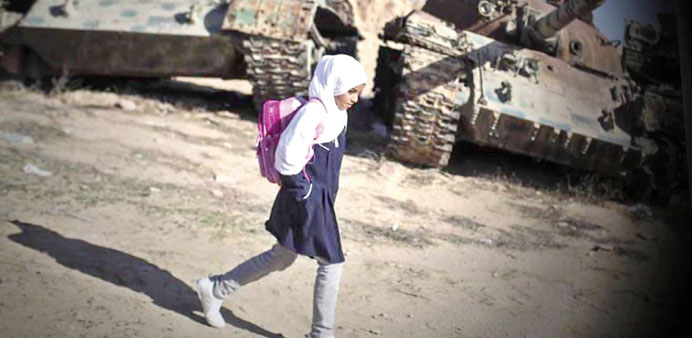
The study identifies 30 countries with a pattern of deliberate attacks between 2009 and 2013, including 10 in the Mena region.
Schools and universities, as well as students, teachers, and academics, are intentionally targeted for attack in conflicts worldwide, Global Coalition to Protect Education from Attack (GCPEA) – of which Qatar-based Protecting Education in Insecurity and Conflict (PEIC) is a part - has observed in a 250-page study released yesterday.
“Education Under Attack 2014” identifies 30 countries where there was a pattern of deliberate attacks between 2009 and 2013, including 10 in the Middle East and North Africa (Mena) - Bahrain, Egypt, Iran, Iraq, Israel/Palestine, Libya, Sudan, Syria, Turkey and Yemen.
“Schools, students and staff are not just caught in the crossfire but are all too often the targets of attacks,” said Diya Nijhowne, director of the Global Coalition. “They are bombed, burned, shot, threatened and abducted precisely because of their connection to education. They are soft, easy targets, and states and armed groups need to protect them from being used as a tactic of war.”
Both armed non-state groups and national military and security forces are attacking education to advance their own interests, the Global Coalition said. They may be retaliating against a community’s perceived support for the opposition; seeking to demonstrate a lack of government control by harming schools and teachers, symbols of the state; attacking forces based in or using a school building; or opposing the spread of ideas deemed to be objectionable, such as the education of girls.
“Attacks on education in the last five years have killed hundreds of students, teachers and academics and injured many more,” Nijhowne said. “Hundreds of thousands of students have been denied the right to an education when their schools and universities have been intentionally damaged or destroyed or used for military purposes.”
In 24 of the 30 countries profiled in the study, including seven in the Mena region, warring parties took over schools in whole or part, using them as bases, barracks, firing positions, weapons caches and for other purposes.
The GCPEA also examined assaults on higher education, which have been monitored less than attacks on elementary and secondary schools. Colleges, universities and individual students and academics were attacked in 28 of the 30 profiled countries, including 10 in the Mena region. The aim was often to restrict political protest or control knowledge and research in sensitive areas.
Between 2009 and 2012, the Global Coalition found, students and educators were most at risk in 13 countries. In heavily affected countries, such as Iran, Israel/Palestine, Libya and Yemen, there were reports of at least 500 attacks, or at least 500 education-related victims, or education buildings used for military purposes. In very heavily affected countries, such as Sudan and Syria, there were 1,000 or more attacks or victims.
The GCPEA is a coalition of organisations that include PEIC, Council for Assisting Refugee Academics, Human Rights Watch, Institute of International Education /IIE’s Scholar Rescue Fund, Save the Children, Scholars at Risk Network, Unesco, UNHCR and Unicef.
PEIC, a programme of the Education Above All Foundation - a global initiative of HH Sheikha Moza bint Nasser, works to catalyse global action to promote and protect education in times of conflict. Based in Qatar, its experts in education in crisis situations, international human rights, humanitarian and criminal law work in partnership with organisations such as the GCPEA to ensure that all those who wish to learn, teach and research can do so in peace, security and dignity.
The study is available at http://www.protectingeducation.org/education-under-attack-2014