


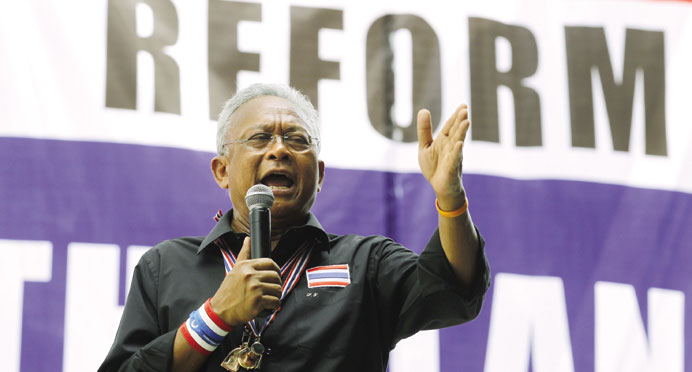
Thai anti-government protest leader Suthep Thaugsuban addresses supporters during a rally at Silom intersection in Bangkok yesterday.
AFP/Bangkok
Thai opposition protesters seeking to force the prime minister from office said yesterday they would abandon most of their rally sites in the capital, ending their self-styled “shutdown” of Bangkok.
The move follows increasingly frequent gunfire and grenade attacks targeting the protest sites, mostly at night.
Attendance at the demonstrations has fallen sharply in recent weeks, with most sites nearly deserted for much of the day and a few thousand people joining the rallies in the evenings.
Prime Minister Yingluck Shinawatra has been under intense pressure to resign following four months of protests.
While the scaling back of the protests is a relief for the embattled premier, she also faces negligence charges linked to a flagship rice subsidy scheme that her critics say is riddled with corruption.
If found guilty she could be removed from office and face a five-year ban from politics.
The demonstrators have occupied several key intersections in the heart of the capital for more than a month, camping out alongside upscale shopping malls and luxury hotels.
Civilian protest guards — many wearing body armour —have searched cars and pedestrians at roadblocks made from tyres and sandbags, to the annoyance of some residents.
From Monday the demonstrators will consolidate into one base in Lumpini Park, their leader Suthep Thaugsuban announced on stage late yesterday.
He said the move aimed to ease traffic congestion caused by the rallies.
“I feel for the Bangkok residents who joined hands to fight” alongside the protesters, Suthep said.
But he said the struggle to topple the government and end the political domination of Yingluck’s billionaire family would go on.
“I will speed up to reach the end game as soon as possible ... within March,” Suthep said.
Violence linked to the rallies has left 23 people dead and hundreds wounded in recent weeks.
Four children were among those killed in two separate grenade and gun attacks on opposition rallies in Bangkok and eastern Thailand last weekend, drawing widespread condemnation.
The demonstrators have besieged a number of major state buildings including the government headquarters, forcing Yingluck to work from various temporary offices.
The unrest has caused a drop in tourist arrivals to Bangkok -- usually one of the world’s most visited cities -- in a blow to the kingdom’s already struggling economy.
The backdrop to the protests is a longstanding struggle between a royalist establishment — supported by the judiciary and the military — and Yingluck’s family which has strong support in the northern half of Thailand.
Suthep said on Thursday he was ready to meet Yingluck for one-to-one talks but only if the discussions are broadcast live on national television.
Yingluck indicated she would be ready to talk if protesters agree to end their rallies. `
The premier’s opponents accuse the Shinawatra family of plundering the public coffers to win the votes of rural voters through populist policies such as the rice scheme.
The protesters want Yingluck to step aside in favour of an unelected “people’s council” to tackle what they see as a culture of money-driven politics.
They accuse Yingluck’s elder brother Thaksin Shinawatra — a billionaire tycoon-turned-premier who was ousted from office by royalist generals in 2006— of running the government from overseas, where he lives to avoid a jail term for corruption.
Minister rejects proposal for talks
A senior Thai minister rejected a proposal for talks from the leader of an anti-government protest movement yesterday as demonstrators rallied at ministries to put pressure on Prime Minister Yingluck Shinawatra to step down. Protest leader Suthep Thaugsuban had suggested that he and Yingluck should hold a televised debate. “Yingluck is the legitimate leader of the country and Suthep is a man with warrants for his arrest who heads an illegal movement. The prime minister should not talk to Suthep,” said Labour Minister Chalerm Yoobamrung, who oversees a state of emergency imposed last month. “Suthep is only proposing negotiations, even though he dismissed them before, because protest numbers are dwindling.”