


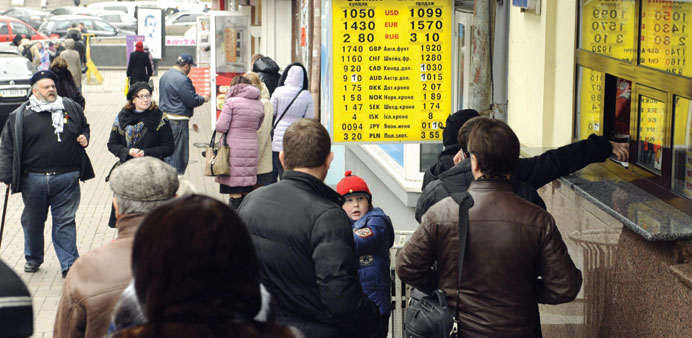
People queue at an exchange counter in central Kiev yesterday. Ukraine’s hryvnia currency firmed sharply and was being quoted at around 9.100 to the dollar yesterday, having plunged to a historic low of 11.3075 on Thursday.
Europe’s main stock markets closed stable or moderately higher yesterday, while Ukraine’s under-pressure currency, the hryvnia, firmed on the promise of IMF financial help.
Traders closing shop for the weekend opted for prudent optimism, taking into account the uncertainty in Ukraine but leaning more to data generally showing an accelerating world economy.
London’s FTSE 100 stock market index barely moved from close the day before, finishing just one point down at 6,809.7 points.
The DAX 30 in Frankfurt added 1.08% to 9,692.08 points, and Paris’s CAC 40 closed up 0.27% at 4,408.09 points.
Wall Street stocks moved higher in early trade yesterday, shrugging off a lower estimate of fourth-quarter US economic growth. About 35 minutes into trade, the Dow Jones Industrial Average rose 71.06 points (0.44%) to 16,343.71.
Ukraine’s hryvnia currency rebounded yesterday from record dollar lows after the IMF urged calm.
International Monetary Fund chief Christine Lagarde said: “We do not see anything that is critical, that is worthy of panic at the moment.”
US Secretary of State John Kerry said after a telephone conversation with his Russian counterpart that Russia also stood ready to help Ukraine as it seeks to stave off economic collapse.
The hryvnia rose to around 9.100 to the dollar yesterday, having plunged to a historic low of 11.3075 on Thursday.
Ukraine’s central bank also took the step of capping cash withdrawals in the country to 15,000 hryvnia (€1,095, $1,400) per day to stem a run on bank accounts.
Kathleen Brooks, analyst at trading site Forex.com, said “the global show of support for Ukraine, especially from the US, and the IMF loan request are the bigger drivers of hryvnia strength today”.
Meanwhile the euro picked up against the dollar, strengthened by eurozone inflation figures judged unlikely to prompt a European Central Bank rate cut.
Eurozone inflation stood at 0.8% in February from a year earlier, official data showed yesterday.
Market expectations had been for a reading of 0.7%.
The euro at 1700 GMT was trading at 1.3804 to the dollar, up from 1.3710 late Thursday.
The European unit also gained on the yen, at ¥140.90 against 140.05 the day before, while the dollar stabilised against the Japanese currency, at ¥102.08 from 102.15 on Thursday.
The European single currency rose to 82.43 British pence from 82.15 pence on Thursday. The pound gained to $1.6743 from $1.6688.
The Chinese yuan fell to 6.1451 to the dollar, its lowest point since June 2013.
On the London Bullion Market, the price of gold fell to $1,326.50 an ounce from $1,332.25 on Thursday.