


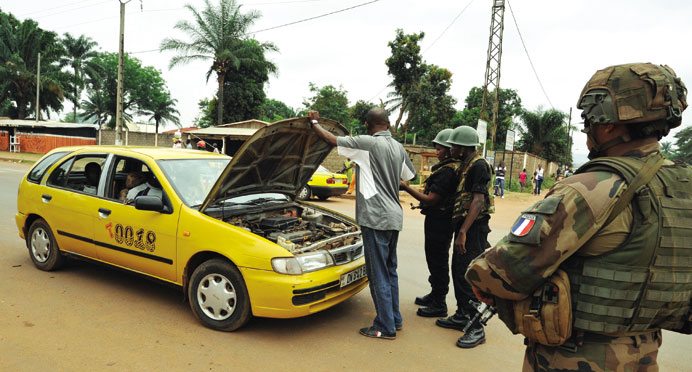
Two Central African gendarmes check a car as a French soldier, part of the Sangaris operation, observes at a checkpoint in the PK4 district of Bangui.
|
|
President Francois Hollande flew to the Central African Republic (CAR) yesterday to tell its leaders and French forces stationed there that France will work to stop the country splitting in two.
France’s parliament voted on Tuesday to extend the mission, despite tepid popular support at home for a military operation in the former colony where tens of thousands of people have been killed and around 1mn forced from their homes.
France sent troops four months ago – its force now numbers 2,000 – to the majority Christian country where Muslim Seleka rebels seized power last March and have since been pushed back by Christian “anti-balaka” militia.
Thousands of Muslims have fled northeast from the capital towards the border with Chad, creating a de facto division of the country which the UN human rights chief has said now faces “ethnic-religious cleansing”.
“In the east and the north, we need to stop score-settling, establish the authority of government, allow it to engage in dialogue and avoid any temptation to partition the east of the Central African Republic,” Hollande told French soldiers gathered in a helicopter hanger at Bangui airport.
He also said French troops would disarm militias and bandits that were “terrorising the Muslim population”.
Hollande also met the force’s top commander, General Francisco Soriano, at France’s main Bangui airport base.
As he tried to rally international support for a military operation last year, Hollande had warned France’s former colony was on the brink of becoming a Somalia-style “failed state”.
Yesterday, with foreign backing still tepid for France’s intervention, Hollande admitted that the new authorities in Bangui faced the task of building a state almost from scratch.
“That should start with paying civil servants their salaries,” he said before meeting interim President Catherine Samba Panza.
He later came out of the meeting saying that funds from the regional grouping would ensure that salaries are paid soon.
Hollande then flew out after a visit that lasted seven hours.
Hollande said that the situation in Bangui had “significantly improved” since French troops arrived, echoing the observations of some aid workers.
But the Red Cross said yesterday that more than 10 people had been killed in the capital this week, adding that some bodies had been mutilated.
The next phase of the French operation, named Sangaris after a local butterfly, will be to deploy roughly half of its troops beyond the capital, according to a presidential source.
As well as the northeast, that would also include a key supply route into Cameroon.
“Clearly this is more risky and we are more exposed,” the source said. Three French soldiers have been killed since deployment began in December.
Medical charity Doctors Without Borders said more than 8,000 refugees had arrived in Chad since late January.
“The World Food Programme and Chadian authorities should intervene in all urgency to distribute food to these people who are completely destitute,” said MSF’s Sarah Chateau in Chad.
Amy Martin, head of the UN Office for the Co-ordination of Humanitarian Affairs, said that there had been clashes in Kaga-Bandoro, about 200km north of Bangui, earlier this week.
“The anti-balaka have been following the Muslims and monitoring their positions and try to attack them as they move,” she said.
The scope of the violence has forced France to change the timeline of its operation.
“Francois Hollande thought that the mission of the Sangaris troops would be over in a few months. A mistake,” the Bangui daily Le Quotidien said yesterday.
On Wednesday, President Samba Panza urged French troops and the 6,000 African Union peacekeepers backing them to make full use of their UN mandate to “wipe out these unchecked elements that poison our lives”.
Soriano replied in an interview to AFP on Thursday that France was already doing a lot and urged the Central African forces to start doing their share.
Hollande visited the landlocked nation for the first time in early December, days after French troops poured into the country to cheers from villagers.
Today, there is mounting hostility towards the French as the violence has escalated, sparking warnings by top aid officials that ethnic cleansing was under way, including in remote parts of the country.
“No need to come, Mr Hollande, we’re already dead,” said one Muslim woman in a Bangui street.
Nearly a quarter of the 4.6mn population has been displaced since the start of the conflict. Some 400,000 residents of the capital – half its population – have fled their homes for makeshift camps.
A top UN official said the world should do more to prevent a bloodbath.
“It reminds me of Srebrenica,” said Philippe Leclerc of the UN refugee agency, referring to the massacre of 8,000 Muslim men and boys by ethnic Serb forces in 1995 during the Bosnian war.
“The violence is as tough and the situation of the people is extremely dire,” he told reporters in Geneva. “An ethnic-religious cleansing is going on, targeting Muslims. People have no escape ... there is no way out and people are trapped.”
Leclerc said that while there are international forces on the ground, “there are not enough troops and with the multiplication of all of these places where such massacres could potentially take place, it is very difficult for them to be in all areas at the same time”.
The European Union has pledged to contribute between 800 to 1,000 troops to the international effort in the CAR.
Paris is urging the United Nations to expedite plans to take over the lead role in peacekeeping efforts, as it has done in the restive Democratic Republic of the Congo.