


By Salman Siddiqui
Staff Reporter
|
|
Ashghal has already finished 18% of its overall work on the Lusail Expressway project and expects it to be complete by the fourth quarter of 2016, senior civil engineer Mohamed Eissa Shamya told Gulf Times yesterday.
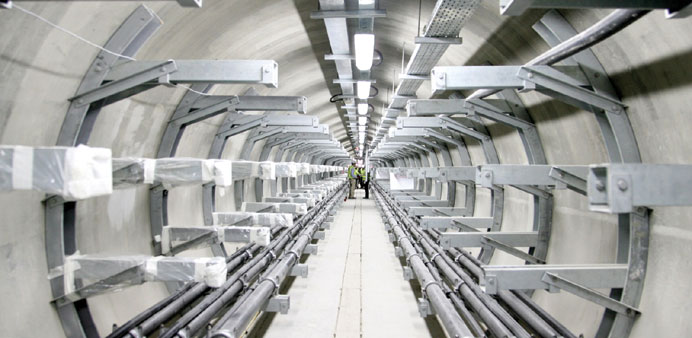
He was speaking on the sidelines of a briefing given on the “underground world” being developed at Lusail Expressway. After the briefing, reporters visited the project’s 20m-deep “micro tunnel”.
“The Lusail Expressway project includes the reconstruction and development of the current Lusail Expressway south of the former Arch roundabout to the northern canal corridor,” Shamya explained. It consists of a 5.3km highway of four lanes in addition to extra lanes to facilitate traffic between intersections.
The project includes three major interchanges, including the Wahda Interchange (the former Arch roundabout that will become a three-level interchange); the Onaiza Interchange which will be a complete free-flow interchange built below and above the ground on three levels; and the Pearl Interchange that will become a three-level interchange to provide a visually appealing access to the Pearl Qatar.
This project will serve the important growing urban areas like Dafna and Al Gassar and those that contain touristic attractions such as Katara the Cultural Village and the Pearl Qatar through the development of intersections as well as easing traffic flow.
The intersections will be developed through the removal of roundabouts and replacing them with multilevel junctions that provide smooth traffic in all directions. Beautification and landscaping work along the Lusail Expressway is also being undertaken.
Ashghal (Qatar’s Public Works Authority) is the client of the project while the main contractor responsible for the detailed design and construction of Lusail Expressway is Hyundai Engineering and Construction Company.
The US-based consultant group CDM Smith is the construction supervisor while another American company KBR is responsible for the the project’s programme management.
Officials said that micro-tunnels allowed the installation of electricity and fibre optic cables below other utilities and below the roads.
In the Lusail Expressway project, approximately 2.9km long tunnels of 3,000mm internal diameter are being constructed for the conveyance of 132kV cables; also approximately 1.2km of tunnels of internal diameter 2,500mm are being constructed for the drainage system.
Hyundai Engineering’s Health, Safety and Environment Department specialist Iftikhar Ullah said that they had maintained “very high safety standards” inside the tunnels, which include a fire alarm system, lighting and even an emergency hotline.
The media was told that the progress in the construction of the micro tunnels had been excellent so far. The tunnelling works for the crossing under the North Canal started in early 2013 while the installation of 132 kV cables has also commenced. Tunnelling under the South Canal is completed while tunnelling at the site of the future Onaiza Interchange is in progress.
The project engineers also showed the under-construction Light Rail Transit Tunnel, being built by Ashghal, which upon completion, will be 1,106m long, 9.5m wide and 5.5m high.
The project engineer Shamya highlighted the fact that Ashghal cared deeply for the environment and it was for this reason that during the construction of one of its tunnels, they had relocated the sea grass and some marine creatures from one of their project sites to Qatar’s Aaliya Island in the first quarter of 2013.