


President Vladimir Putin put Russian combat troops on high alert for war games near Ukraine yesterday, the Kremlin’s most powerful gesture yet after days of sabre rattling since its ally Viktor Yanukovych was toppled as president in Kiev.
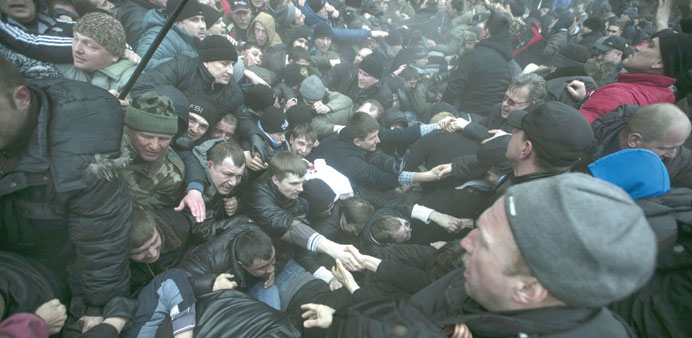
Thousands of ethnic Russians, who form the majority in Ukraine’s Crimea region, demonstrated for independence for the peninsula that hosts part of Moscow’s Black Sea Fleet. They scuffled with rival demonstrators, mainly from the Tatar minority, who support the new authorities in Kiev.
Local health authorities said one man died of a heart attack during the mayhem in the port town of Simferopol.
“According to initial information from medics, the cause of death was acute cardiac arrest,” the authorities said.
An AFP journalist said that the two sets of demonstrators sprayed each other with pepper spray and used batons as police struggled to keep them apart during the brief fighting.
Ambulances were called as several people could be seen nursing light injuries before crowds dispersed following appeals from local lawmakers for them to go home.
With the political turmoil hammering Ukraine’s economy, the hryvnia currency tumbled 4% yesterday, with ripples spreading to Russia where the rouble fell to five-year lows and bank shares took a hit.
Ukraine’s central bank, which has been rapidly spending its hard currency to protect the hryvnia, said it had abandoned a managed exchange rate in favour of a flexible currency.
Moscow denounced what it described as the rise of “nationalist and neo-fascist sentiment” in Ukraine’s mainly Ukrainian-speaking western areas, where it said Russian speakers were being deprived of rights. It has repeatedly expressed concern for the safety of Russian citizens in Ukraine.
“In accordance with an order from the president of the Russian Federation, forces of the Western Military District were put on alert at 1400 (1000 GMT) today,” Interfax news agency quoted Russian Defence Minister Sergei Shoigu as saying, announcing a drill. The western district borders on Ukraine.
Shoigu said the training drills were not linked to events in Ukraine, and Deputy Defence Minister Anatoly Antonov said they had been previously planned. He said they would involve about 150,000 military personnel.
The western district encompasses most of western Russia and borders Ukraine, which lies between Nato nations and Russia.
Forces must “be ready to bomb unfamiliar testing grounds” as part of the drill, Shoigu told a defence ministry meeting.
Putin has made no public comment on Ukraine since Yanukovych was driven from power over the weekend.
The US and European nations have warned Russia against military intervention in Ukraine, a former Soviet republic that Putin has called a “brother nation” and wants to be part of a Eurasian Union he is building in the region.
Russian officials have said Moscow will not interfere in Ukraine, while accusing the West of doing so.
Interfax cited the speaker of the upper parliament house, Valentina Matviyenko, as saying yesterday that it would not use force.
But Prime Minister Dmitry Medvedev said on Monday that Russia’s interests and its citizens in Ukraine were under threat, language reminiscent of statements justifying Russia’s invasion of Georgia in 2008, when he was president.
Shoigu said the drill would be conducted in two stages, ending on March 3, and also involved the command centres of Russia’s Air and Space Defence forces, paratroops and long-range aviation as well as some troops in central Russia.
In the two-day first stage, military units would be brought to “the highest degree of combat readiness” and would be deployed to testing areas on land and sea, Interfax quoted Shoigu as saying.
The second stage would include tactical exercises and involve warships from the Northern and Baltic Fleets, he said, and some warplanes would move to combat airfields.
Descriptions of the exercises did not mention the Black Sea Fleet, which is based in Sevastopol in Crimea. Tension over Ukraine’s turmoil is high because of the fleet’s presence and the region’s large ethnic Russian population.
In separate comments, Shoigu said Russia was “carefully watching what is happening in Crimea” and was taking unspecified measures to ensure the security of the facilities and arsenals of the Black Sea Fleet, state-run RIA reported.
Shoigu said the drill would also test the counter-terrorism measures in place at military units. Russian officials have referred to some of the Ukrainian opposition forces whose protests pushed Yanukovych from power as “terrorists”.
In the latest of a series of increasingly strident statements, Russia’s foreign ministry said Ukrainian extremists were “imposing their will”, and a Ukrainian church affiliated with the Moscow-based Russian Orthodox Church had faced threats.
Western governments have repeatedly urged Moscow not to intervene. Asked about the Russian army drill, British Defence Secretary Philip Hammond said London was watching any Russian military activity.
“We would urge all parties to allow the Ukrainian people to settle their internal differences and then to determine their own future without external interference.”
Since Yanukovych’s downfall on Saturday, all eyes have been on Putin, who ordered an invasion of neighbouring Georgia in 2008 to protect two self-declared independent regions with many ethnic Russians and others holding Russian passports. Moscow recognised the regions as independent states, effectively seizing control of the territory from its neighbour.
Any military action in Ukraine, a country of 46mn people that has close ties with European powers and the US, would be far more serious – the closest the West and Russia have come to outright confrontation since the Cold War.
Ukraine’s new leadership plans to name its new cabinet this week, paving the way for urgent IMF talks to stave off financial meltdown now that Russia is all but certain to cut off a $15bn financial lifeline it offered Yanukovych as the prize for turning his back on ties with the EU in November.
The International Monetary Fund (IMF) has said it is prepared to send a team of negotiators to Kiev, but a government must first be formed there and request the aid.
US Deputy Secretary of State William Burns, visiting Kiev, said that American financial experts were already in the country looking for ways to help.
Yanukovych fled his luxurious palace on the outskirts of Kiev on Friday night after days of violence in which scores of his countrymen were killed, including demonstrators shot dead by police snipers from rooftops.
A street leading to Independence Square where many were killed has been renamed “Avenue of the Glory of the Heavenly Hundred” for those slain. It is now covered with heaps of flowers and candles. Pictures of the dead are nailed to trees.
Ukraine has suffered an identity crisis throughout two decades of independence from the Soviet Union.
With borders drawn by Bolshevik commissars, it is split between a largely Ukrainian-speaking west, including areas annexed by the Soviets from Austria and Poland, and eastern provinces where Russian is spoken, mainly Russian territory since the Middle Ages.
Although most ethnic Ukrainians in the east speak Russian as a first language, the only area where ethnic Russians predominate is the Crimea, which has frequently seen separatist tension at times of mistrust between Moscow and Kiev.
The regional parliament was due to debate the issue yesterday. Crimea was administered as part of Russia within the Soviet Union until 1954 when it was transferred to Ukraine.
However, even in Yanukovych’s home region of Donetsk, there was little sign of support. His portrait had been taken down at the Donetsk headquarters of his former ruling Party of the Regions, where its leader in the provincial parliament Nikolay Zagoruyko said Yanukovych was to blame for the killings while he was president.
“Of course he is guilty,” he said without hesitation. “He was the president. The guilt for what happened lies with Yanukovych.”
Oleskander Turchinov, the parliament speaker who assumed the presidential duties after the assembly removed Yanukovych from power on Saturday, took the helm of the armed forces. He is expected to pick a cabinet to be announced later to crowds in Independence Square, crucible of the revolt.
Turchinov is an ally of opposition leader Yulia Tymoshenko, who was freed from jail moments before parliament removed Yanukovych.
Tymoshenko, a former prime minister, has said she does not want to return to the job, which could go to economist Arseny Yatsenyuk, who ran her party while she was jailed.
Retired heavyweight boxing champion Vitali Klitschko, who has said he will run for president, may also be given a post.
Ukrainians were shocked by the lavish palace that Yanukovych abandoned, stocked with a private zoo, exotic birds, a floating restaurant built like a pirate ship and a private golf course.
Yanukovych’s precise whereabouts are not known, although the government says it believes he is hiding in Crimea.
Parliament has voted to request he be tried at the International Criminal Court in The Hague over the deaths on the square.
Yesterday the new authorities disbanded the Berkut “Golden Eagle” riot police units blamed by the public for posting sharpshooters on rooftops who killed protesters.
The US Treasury warned banks to be on the look-out for potentially suspicious transfers of assets by Yanukovych or members of his circle.