


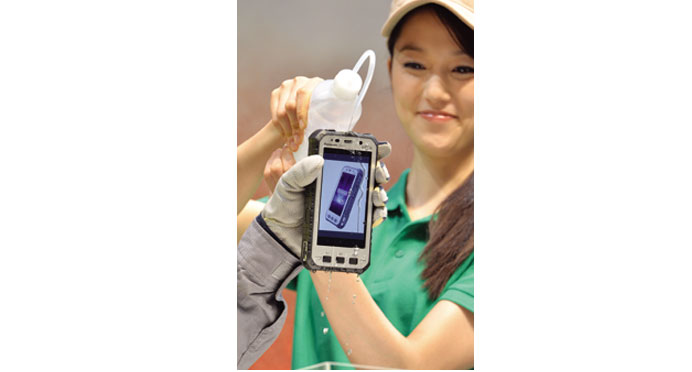
A model demonstrates a water proof test on the new heavy duty tablet computer of Panasonic
Toughpad FZ-X1 in Tokyo on Monday. The Japanese firm yesterday said it is considering investing in a US car battery plant planned by Tesla.
Reuters/Tokyo
Panasonic Corp is considering investing in a US car battery plant planned by Tesla Motors, sources familiar with the plan said yesterday, with total investment estimated by one source around ¥100bn ($979mn).
The facility, expected to go on-stream in 2017, is part of Tesla’s blueprint for a more affordable electric vehicle and would be the first major, integrated US facility producing battery cells for electric cars.
Tesla shares hit an all-time high on Tuesday, after a brokerage set a new target price suggesting a rise of almost 50% from Monday’s close, while Panasonic’s shares jumped 7% yesterday to a three-week high.
Last week, Tesla gave some initial hints about plans for a lithium-ion battery plant, or “giga factory”, that would likely include Panasonic and other suppliers as partners. It said that further details would be announced this week.
Tesla declined to comment on Tuesday. Panasonic, the car maker’s primary supplier of lithium-ion batteries, said it wanted to expand its cooperation with Tesla but declined to comment further.
“We have a cooperative relationship with Tesla and are looking at various ways of strengthening that relationship in the future,” the company said.
Sources close to the situation said Panasonic was considering investing in the giga factory project with an eye to expanding battery supplies to Tesla when its current supply contract ends in 2017. One of the sources added that the project would likely require a total of about ¥100bn.
“Panasonic is looking at various types of cooperation, including taking on some of the investment,” the source said. “But Tesla is a venture business, so there’s a need to be cautious in looking at the risks involved.”
The ¥100bn figure was first reported in the Nikkei business daily, which also said Panasonic was inviting several Japanese materials makers to join the project.
The Nikkei said the plant would produce small, lightweight batteries for Tesla and may also supply Toyota Motor and other automakers.
Battery costs have been a major stumbling block to widespread electric car adoption in the US, according to analysts. Tesla’s giga factory will lower costs by shifting material, cell, module and pack production to one spot.
In Tesla’s earnings conference call last week, Chief Executive Elon Musk said the electric car maker expects to build the factory with more than one partner, but a “default assumption” was that Panasonic, as a current battery cell partner, “would continue to partner with us in the giga factory”.
“The factory is really there to support the volume of the third generation car,” Musk said on the call. “We want to have the vehicle engineering and tooling come to fruition the same time as the giga factory. It is already part of one strategy, one combined effort.”
Tesla posted better-than-expected fourth-quarter results and said deliveries of its luxury Model S electric sedan would surge more than 55% this year to more than 35,000 vehicles.
Shares in the Palo Alto, California-based company, which was founded in 2003, surged as much as 19% on Tuesday, hitting an all-time high intraday trading price of $259.20 a share after Morgan Stanley raised its target price for the stock to $320 a share from $153.
Tesla shares closed up $30.35, or 14%, at $248on the Nasdaq.
Panasonic shares rose nearly 7% yesterday morning in Tokyo to a three-week high of 1,279 yen.
Morgan Stanley analyst Adam Jonas said in his research note that the potential for lower battery costs through higher sales volume could nearly double Tesla’s share of the global car market to 0.9% by 2028. Tesla remains the firm’s top pick in the US auto sector with an “overweight” rating.
“Tesla is an extremely ambitious company for whom flooding the market with fun-to-drive EVs and giving competitors a headache might not be the endgame,” he said.
Stifel analyst James Albertine said the giga factory could be far more than an auto opportunity, as Tesla could have an even more significant opportunity to supply the energy storage market. He expects the factory would take two to three years to build and require a $5bn to $6bn capital infusion.
“While we remain negative on Tesla shares above $200 as an automotive OEM (original equipment manufacturer), the energy storage opportunity requires a broader perspective and could very well justify current, if not higher valuation levels,” he said in a research note.