


By Aradhana Aravindan, Reuters/Mumbai
It’s got four wheels and seatbelts, but Bajaj Auto, the creator of India’s first quadricycle, would rather you didn’t call it a car.
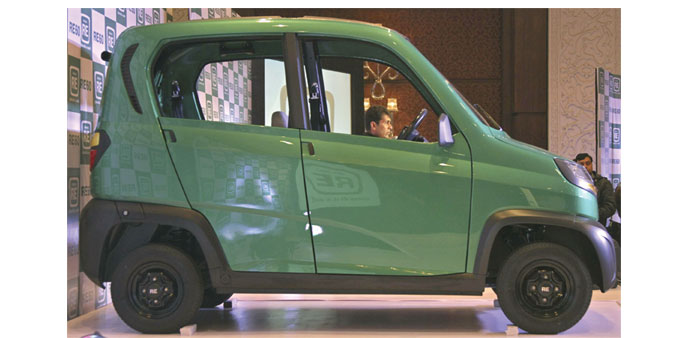
Bajaj Auto is marketing the RE60 as a more stable and comfortable alternative to the three-wheeled autorickshaws ubiquitous on India’s roads even though it looks like a small hatchback car and is expected to cost less.
Weight, top speed and other specifications, including safety standards, mean the RE60 will not be classified as a car. But that didn’t stop executives from India’s top automakers such as Tata Motors from comparing it to a car and finding its safety features come up short.
Rajiv Bajaj, the company’s managing director, insists the RE60 is neither a car nor an autorickshaw. The government is even creating a new classification category for the vehicle, which is expected to be launched within months.
“In every market that a three-wheeler is available the quadricycle should be relevant,” Bajaj told Reuters in a phone interview.
“Because at the end of the day it provides a very logical upgrade from a three-wheeler for people who want to pay a little more and want to have the comfort and safety of four wheels, four doors, a roof and seatbelts,” he said.
In India, autorickshaws typically have no doors and a soft roof. The vehicles are usually turned into taxis and are known in many countries as tuk-tuks. The RE60 is part of a long-term expansion strategy by Bajaj to boost sales growth at home and abroad.
The RE60 weighs 400kg, about 100kg more than Bajaj’s smallest autorickshaw and half as much as a small hatchback. The engine can run on gasoline or CNG and goes up to 70kph.
The vehicle is likely to be priced between an autorickshaw and a small car. Analysts expect the RE60 to cost Rs200,000 ($3,200), more than the roughly Rs150,000 for the most basic Bajaj three-wheeler, but less than the Rs270,000 for India’s bestselling car, the Maruti Alto hatchback.
Bajaj spent Rs5.5bn ($88mn) developing the vehicle, according to media reports. The company can initially make up to 5,000 vehicles a month and has been waiting for two years to get them on India’s roads. The federal government is expected to allow quadricycles from October 1.
Bajaj hopes the quadricycles will catch on in countries where three-wheelers are widespread, and has sent samples for test runs in Sri Lanka, Colombia and Kenya. Managing director Bajaj, however, declined to give any sales forecasts.