


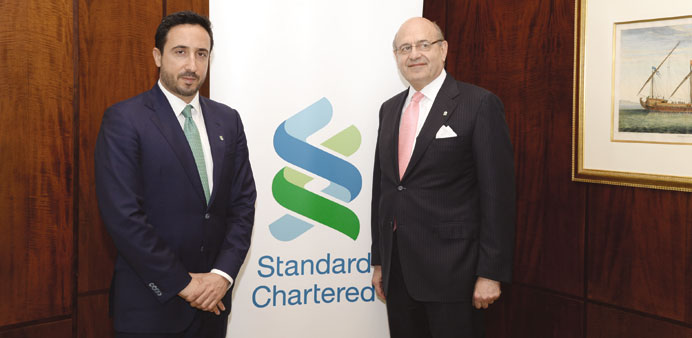
Maratheftis and Carlson: Bullish on Qatar.
Supporting Qatar’s demand for ‘AAA’ rating, global banking giant Standard Chartered has said investment in infrastructure, not energy prices, will be the key to growth and inflation is headed towards “moderate” increase.
Moreover, shale gas development in the US and Europe is not going to be a “big problem” for Qatar, which is now looking eastwards than the west with energy exports now directed to Asia, especially China amid rising demand.
“If I look at the economic statistics alone, then Qatar should be a good candidate for AAA rating,” StanChart global head of macro research (global markets) Marios Maratheftis told the media in Doha.
Former finance minister Yousef Hussein Kamal had last year said Qatar rightfully deserved a place among the ‘AAA’ rating due to inherent economic strengths.
However, Standard & Poor’s subsequently said Qatar’s “limited monetary flexibility and banks’ increasing dependence on external financing” stood in the way of raising the rating from ‘AA’, the third-highest investment grade.
On growth prospects, Maratheftis said he would expect Qatar to expand 5.5% this year as non-hydrocarbon dynamics accelerate against “good growth but no boom” in the US, Europe and Asia.
“Its (real gross domestic product growth) is pretty decent,” he added.
Asserting that Qatar’s outlook remains strong in 2014, StanChart said LNG dynamics are likely to remain healthy and will underpin strong fiscal and reserve positions but non-hydrocarbon should be the primary growth driver.
The bank forecast $34bn project contracts to be awarded this year for key infrastructure projects, besides the estimated $183bn planned between 2011 and 2016.
Government commitments on infrastructure in line with the 2022 World Cup and the Vision 2030 objectives have resulted in a “significant” pick up in investment in the economy in 2013, StanChart said.
“We expect these spending trends to continue but not to peak in 2014. A key challenge will be managing the different dynamics as the economy enters this growth phase,” it said.
Contracts are being awarded but execution of projects is still a couple of years away, may be this year end or early next year, StanChart Qatar CEO Charles Carlson said.
Highlighting that the World Cup is only a part of the (growth) story, Maratheftis said investment in infrastructure is the key growth driver in Qatar as well as in the Gulf and not the oil market, which according to him, has a “neutral impact” on the economy and the markets.
Any country with resources should be diversifying and moving up the knowledge chain because historically countries with hydrocarbons have underperformed those with no hydrocarbons, he said, expecting oil prices to hover around $100 a barrel.
On Qatar’s inflation, which has started rising, Maratheftis said the key determinant is rents, which are expected to begin rising next year.
“We believe this will be driven the by the size of the project pipeline in Qatar, which will require an inflow of expatriates, generating a new pool of tenants,” the bank said, forecasting inflation to be at 3.5% this year against its earlier projection of 2.5%.
Unlike in the past when Qatar’s inflation peaked to about 15%, he said this time around both liquidity factors and food prices were not the factors of contribution.
Qatar’s consumer price index inflation rose 2.3% year-on-year in January mainly on 4.8% jump in rents, fuel and energy group, which has the highest weight in the basket, Ministry of Development Planning and Statistics said. “It is certainly not back to 2007 and 2008 levels of high inflation,” he said, adding Qatar has gone through cycles of high inflation to deflation and then to disinflation and now to “moderately” increasing levels.