


By Denise Marray
London
When a major financial institution or company conducts its business in accordance with the principles of Islamic finance, particularly in cross border transactions, it wants to know that the contracts it signs will stand up in a court of law. So getting the right kind of legal advice to ensure that everything is Shariah-compliant and legally watertight in the chosen legal jurisdiction is a key factor in any major commercial undertaking.
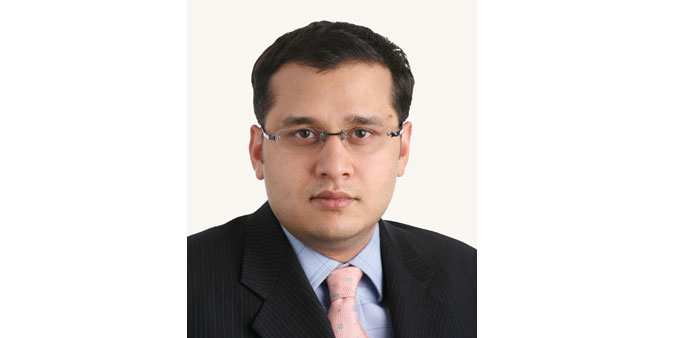
To get an insight into the level of expertise needed to guide clients in the drawing up of Shariah-compliant contracts, Gulf Times spoke to Atif Hanif, who heads up Allen & Overy’s European Islamic finance practice.
His experience includes advising the mandated lead arrangers on two murabaha facilities for Etihad Etisalat Company (Mobily), the second largest mobile phone and broadband service provider in Saudi Arabia, one supported by the Finnish ECA, Finnvera, and the other supported by the Swedish ECA, Exportkreditnämnden (EKN) for $325mn and $320mn respectively. The facilities are some of the first Shariah-compliant financings to involve Finnvera and EKN. The proceeds of the facilities are for trade finance purposes, and will be used to finance the purchase of telecommunications equipment and related services from Ericsson AB and Nokia Siemens Tietoliikenne Oy. This project was voted Murabahah Deal of the Year and Trade Finance Deal of the Year at the Islamic Finance News Awards 2013.
He also advised the Islamic financiers on the $2.8bn project financing for the construction of the Qurayyah Independent Power Project, set to be the world’s largest independent power generation project. The project was voted as Best Project Finance Deal of the Year in the Euromoney Islamic Finance Awards 2012.
“From a lawyer’s perspective - and also from the perspective of a lot of the parties we deal with - they would like some certainty as to what is the governing law for the transaction and how any disputes or ambiguities in the contract will be resolved, whether under English or Shariah law. This is one of the biggest issues we face in our day to day business in this field,” Hanif said.
He observed: “In the international cross border space, the consensus amongst most parties is that English law as the governing law is the one that should be followed because of the reputation the English courts have in terms of looking at commercial contracts, and also their reputation for independence backed up by centuries of case law.”
The English courts have established a good reputation for being able to understand and pronounce judgment on Islamic finance transactions “without necessarily getting drawn into the whole debate concerning whether something is Shariah-compliant or not,” Hanif said. He cited the 2004 case of Shamil Bank of Bahrain vs Beximco Pharmaceuticals and Others as illustrating the reasoning that the English courts have used in making their judgements.
In this case the High Court and the Court of Appeal granted summary judgement to the bank on its claims concluding that the principles of Shariah did not apply to the murabaha (sale of goods at cost plus an agreed profit mark-up) agreements, principally because that had not been the parties’ intention.
The court reasoned that the reference to the “Glorious Shariah” in the governing law clause was merely intended to reflect the Islamic religious principles according to which the bank held itself out as doing business. It was accepted that there could not be two separate systems of law governing a contract.
The Rome Convention provided that a contract shall be governed by “the law chosen by the parties” and the reference to a choice of law was to the law of a country, not to a non-national system of law such as Shariah. The general reference to principles of Shariah in the governing law clause did not identify those aspects of Shariah which were intended to be incorporated into the contract.
Commenting on the outcome in this case Hanif said, “The English courts quite rightly asked the question, ‘Why would somebody agree to have a contract governed by English law and to submit to the jurisdiction of the English court, only for the English court to then pronounce on religious principles?”
He added that for financial institutions that were not fully Islamic but have Islamic windows, including major global banks such as Deutsche Bank and Citibank, such judgements offered reassurance that whatever had been agreed to in the contract was enforceable in law in the English courts.
“The English courts are there to give effect to the intention of the parties and if the contract clearly sets out what the intention is then the English courts will respect that,” he said.
Hanif, who earlier in his career worked in Saudi Arabia and Bahrain, reflected on how radically the Islamic finance industry has changed over the last decade. “I remember the time when most of the work I did with banks and financial institutions used to be the standard conventional interest bearing loans, and that was true right across the GCC (Gulf Co-operation Council). But over the last decade that has changed dramatically. If we look as what we are doing now out of our offices in Qatar, Saudi Arabia and the UAE, I would say that two thirds of the work is Shariah-compliant.”
He noted that participants in the GCC market are increasingly demanding Islamic financial services and products wherever they choose to do business. In London, he said, investors based in Malaysia and the Middle East who were buying up property or investing in businesses are increasingly “demanding that the transaction be financed in a Shariah-compliant manner.”
Hanif pointed to some of the major developments of Qatari Diar as prime examples of Shariah-compliant transactions; for example, the Chelsea Barracks transaction, where the non-equity portion of about £950mn was financed on a Shariah-compliant basis.
“What distinguishes London from some other European jurisdictions is the fact that over the last ten years the UK government has made a conscious effort to promote and accommodate Islamic finance within the spectrum of services which the City of London provides,” he said.
Hanif said, “I don’t think there is anything that is not doable within the current regulatory and legal framework in the UK either from a tax perspective or any other regulatory perspective. The significant difference that the UK has is related to the fact that a lot of these Islamic financial transactions are asset-related or asset-based; they are not interest bearing loans which is what we are used to in the west as being the only form of financing available. What the UK government has done is level the playing field. You should not have a disadvantage or indeed an advantage just because you are doing an Islamic finance transaction. You should be treated much the same way as you would have been had you decided to go ahead with a conventional transaction.”
Regarding the lack of a uniform view on Shariah-compliance stipulations, Hanif said: “There is a diversity of views and opinions and that reflects the rich history of Islamic jurisprudence spread across various geographies and various schools of thought. But I think the industry players, whether sponsors, investors, financial institutions or regulators, are conscious that if the Islamic finance industry is to continue with its growth trajectory they need to address this diversity of opinions and try to harmonise standards as much as possible.”
Hanif noted that Malaysia had already tried to harmonise their domestic market with regard to Shariah standards. But he cautioned that “the modern Islamic finance industry is only about thirty years old and it will take time to move towards standardisation and harmonisation in the context of a 1,400-year old history.”