


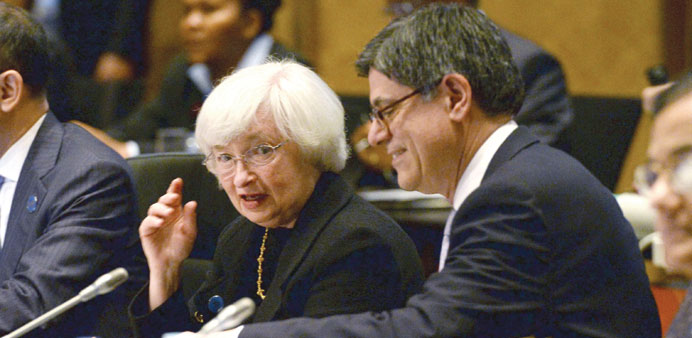
US Federal Reserve Chairman Janet Yellen (left) chats with US Treasury Secretary Jack Lew before the G20 finance ministers and central bank governors round table meeting in Sydney yesterday. Lew yesterday called for China to more quickly expand the role of markets.
Bloomberg/Sydney
China’s finance minister Lou Jiwei turned the tables on the US, pointing to a lack of structural change in its economy after Treasury Secretary Jacob J Lew called for China to more quickly expand the role of markets.
Lou also played down the risks from shadow banking, saying that possible defaults in some wealth-management products don’t reflect “big problems” in the industry. Lew this week highlighted potential danger in China’s financial sector as one of several risks clouding the global economic outlook.
“They have always been saying that China should boost its consumption ratio and the US should boost its investment ratio, but that structural change is not happening in the US,” Lou told Bloomberg News yesterday in Sydney, where he is attending a meeting of Group of 20 finance ministers and central bankers. The US recovery “is being helped by monetary policy and not much by structural adjustment,” he said.
Lou’s comments underscore the tensions between the world’s two biggest economies as the US recovery gathers pace while China’s expansion is set to be the weakest in 24 years. Communist Party leaders have indicated they are prepared to tolerate lower growth as they implement economic and social reforms to boost consumption and allow markets to play a bigger role in pricing resources.
“I have yet to see the signs that they are moving with the speed that we would want,” Lew said in Sydney on Friday, referring to China’s promised changes. The US will continue to press the nation’s leadership “to move faster, with more clarity and more immediacy,” he said. Expansion in China will this year slow to 7.5% from 7.7% last year, according to an International Monetary Fund estimate last month, as President Xi Jinping reins in investment and credit growth and implements policies to rebalance the economy toward consumption. In contrast, the Washington-based lender forecasts US gross domestic product will increase 2.8%, up from a 1.9% pace last year.
Premier Li Keqiang will announce the government’s GDP growth target for this year at the annual meeting of the National People’s Congress, China’s legislature, in Beijing next month. The goal was 7.5% last year.
Lou also hit back at concerns that the growth of shadow banking in China is increasing financial risks in the economy. Such activity is less risky than in western countries because it’s more closely linked with economic growth, he said. “Shadow banking in our country is still related to the real economy,” whereas in western economies shadow banking products such as credit default swaps are “far from real economic activities on the ground,” he said.
Investors are focused on financial stresses in China after the near-default last month of a high-yield trust product. The bailout of Credit Equals Gold No 1, distributed by the nation’s largest bank to its wealthy clients, averted what would have been the biggest default in a decade in the country’s $1.8tn market for trust products.Shadow banking is an issue of worldwide concern, although it isn’t “intrinsically nefarious,” Lew said at a conference in Sydney on Friday.
Shadow banking, a catchall phrase for lending outside the regular banking system, encompasses risky investment products, private lending between individuals as well as derivatives and money-market funds. It poses “systemic risks” to the global financial system, according to the Financial Stability Board, the Basel, Switzerland-based body that’s responsible for strengthening global financial rules on behalf of the G 20.
The size of China’s shadow banking industry is manageable, Lew said, although in a letter to his G 20 colleagues earlier this week he highlighted potential dangers in the country’s financial sector as one of several risks clouding the global economic outlook.
China’s economy will in 2014 maintain the same trend of steady growth as it did last year, Lou said yesterday, declining to give a detailed forecast. GDP increased 7.7% in 2013, the same pace as the previous year, and down from an average 10.6% a year in the decade through 2011.
GDP will expand 7.5% this year, according to the median estimate in a Bloomberg News survey of analysts from February 14 to February 19. That would be the least since 1990.
China’s leaders outlined in November the biggest expansion of economic freedoms since at least the 1990s, pledging to give markets a “decisive” role in allocating resources. Lew said yesterday some of the changes may mean sacrificing short-term growth for long-term more stable expansion.
Central bank Governor Zhou Xiaochuan on Friday expressed confidence in the country’s growth prospects even as a slowdown in manufacturing and stresses in the financial system damp the outlook.