


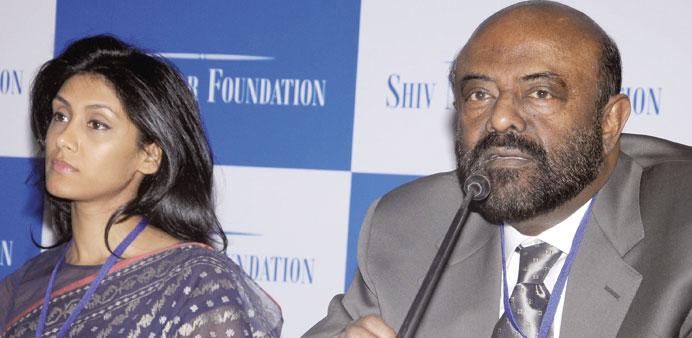
Roshni Nadar and Shiv Nadar at a press conference in Bangalore. The billionaire founder of HCL is sounding out buyers for his $10bn stake in India’s fourth-largest software and outsourcing firm.
Dow Jones/Mumbai
The billionaire founder of HCL Technologies is sounding out buyers for his $10bn stake in India’s fourth-largest software and outsourcing firm, two people briefed on the matter told The Wall Street Journal, in what could be the biggest sale of an Indian company so far.
The smallest and youngest of India’s big four information technology groups, HCL was founded by Shiv Nadar in 1991. Nadar has received bids for HCL in the past but has long said that he has no plans to sell. But now, the 69-year-old is open to considering selling his stake because his only child, daughter, Roshni Nadar, isn’t interested in continuing in the technology business, one of the people said.
Roshni Nadar, 32, a graduate of Northwestern University in Chicago where she concentrated on television production and journalism, sits on the HCL Technologies board, and is the chief executive of its holding company HCL Corp.
Shiv Nadar controls 62% of Mumbai Stock Exchange-listed HCL, and has yet to hire bankers to advise him on a sale, the people said. Nadar will only formally appoint advisers if he is satisfied with the potential offer, the people said. HCL Corp yesterday said it had no plans to exit. This after news of the planned sale was published.
“HCL Corp denies any plans to exit HCL Technologies,” the holding company of HCL Technologies said in a statement. HCL Corp also owns Mumbai-listed computer hardware distributor HCL Infosystems.
HCL, along with bigger peers Tata Consultancy Services, Infosys, and Wipro, has been buoyed by the pickup in the US economy and the weaker rupee, because it earns a chunk of its revenue from the US HCL posted a 39% net profit gain, in US dollars, for the three months ended December.
If Nadar sells out, HCL will be joining a host of India’s outsourcing giants that have seen a shake-up at the top. Last year, Infosys, which had been struggling to expand revenue, brought its chairman and co-founder NR Narayana Murthy back from retirement to revive the firm’s sagging fortunes. He brought his son, Rohan Murty, into the company as an adviser last June.
Wipro founder Azim Premji has also brought in his son Rishad Premji into the company. Tata Consultancy Services, a unit of giant Indian conglomerate Tata Group, is the only one of India’s big four IT firms that hasn’t shuffled its management in recent years. It is run by executives who aren’t related to the company’s founders.
Proceeds from a sale by Nadar would be invested in HCL’s health-care and education businesses that his daughter is spearheading, both people added. The Shiv Nadar Foundation, of which Nadar is a trustee, is already active in supporting education initiatives. The foundation runs an engineering college in the southern Indian city of Chennai and the Shiv Nadar University in the northern Indian state of Uttar Pradesh. The foundation also runs schools that teach impoverished children free.
In February, HCL Healthcare, a recently formed unit of HCL Corp said it would invest $161mn over five years into the health-care and well-being business. HCL Healthcare runs a health-care delivery unit called HCL Avitas, which has collaborated with Johns Hopkins Medicine International to run multi-specialty clinics across India.
Nadar’s son-in-law. Shikhar Malhotra, is the vice chairman of HCL Healthcare and the chief executive of Shiv Nadar School-a not-for-profit K-12 school initiative of the Shiv Nadar Foundation that aims to establish 25 schools across India by 2020. He is also a director and a board member of HCL Corp. Malhotra “drives (the foundation’s) strategic initiatives and future road map,” HCL’s website said.
If the sale happens and a tender offer for additional shares held by minority shareholders is made in compliance with local rules, it could be the biggest stake sale in India ever. The biggest acquisition of an Indian company was in 2007, when Vodafone Group PLC agreed to pay $12.9bn for a majority stake in Hutchison Essar.
The most recent such exit in the technology sector was when Baring Private Equity Asia agreed to buy a 68% stake in Indian software company Hexaware Technologies for about $434mn from founder Atul Nishar and General Atlantic LLC in August 2013.
In January 2011, the founding brothers of Patni Computer Systems sold their stake to a private-equity-led consortium in a deal valued at $1.22bn. India’s tech sector is a favorite of foreign investors, however, and was where most deals in the country took place last year. Data from Dealogic showed that there were 47 acquisitions of stakes in Indian tech firms last year valued at a total of $788mn, the highest in terms of deals among any sector.
Indian founders who held on tightly to their ventures have increasingly found their children unwilling to take on the mantle of the family business. Most of the billionaire kids have trained in top colleges in the US and want to start their own or new ventures.
After interning with television channels CNBC TV18 in India and CNN in New York, Nader worked for a year-and-a-half at Sky News in London. In 2006, Ms. Nadar decided to pursue her management programme in social enterprise and management and strategy from the Kellogg School of Management at Northwestern in Evanston, Illinois. “That’s where the world of philanthropy came about,” Ms. Nadar said in a November interview with The Wall Street Journal.
HCL Technologies’ stock price has more than doubled to Rs1,490 ($23.97) a share in the past 12 months on the Mumbai Stock Exchange, data showed. It earned a revenue of more than $5bn for the calendar year that ended in December.
However, an investment professional questioned whether there would be any takers as Nadar would expect a premium over the market price to hand over control. Also, under current Indian rules, any acquirer must offer to buy a 25% stake in the company. That could cost an additional $4.21bn and would take a potential acquirer’s stake to 86.75% if all minority shareholders agree to sell their shares.
But local laws also require that no majority shareholder or founder own more than 75% in a listed company. That would leave a potential acquirer a tough choice-delist HCL Technologies by paying another $2.2bn, or sell part of its stake to bring its shareholding in line with statutory requirements. Under Indian takeover rules, anyone buying more than 26% needs to offer to buy an additional 25% from minority shareholders.