


Agencies/New Delhi
A gang of women vigilantes, who fight for social justice in rural India and are famed for their pink saris and sticks, are the subject of an award-winning documentary opening this week.
The Gulabi (Pink) Gang battles for women’s rights across a handful of districts in the northern state of Uttar Pradesh, tackling domestic violence, dowry disputes, child marriage and other forms of abuse.
The fatal gang-rape of a student in New Delhi in December 2012 caused widespread anger and protests across the country, but such crimes in poorer rural areas still receive far less media attention.
The film Gulabi Gang, directed by Nishtha Jain and being released nationwide tomorrow, tracks the founder and leader of the group, 56-year-old Sampat Pal Devi.
It also explores the workings and recruitment strategies of the gang, whose members now number in the thousands.
Jain said she was attracted to making the documentary because the group was “a spontaneous women’s movement in one of the most backward parts of India.”
“I wanted to profile not only the leader but also the other courageous members of Gulabi Gang, the majority of whom are poor, old, unlettered and from backward castes,” she said.
The film opens with a case in which a young wife has been found burnt to death. Her family blames a fire that broke out when she was cooking.
Pal and her comrades believe there is foul play involved and pursue the case relentlessly - offering support to the girl’s parents and ensuring the police conduct speedy investigations.
Their method is to protest, arbitrate, counsel and, in extreme cases, use aggression to drive home their message.
But deep-rooted prejudices can still hamper the gang’s work - some members have faced expulsion for standing by male relatives who have abused women.
Gang leader Pal, who attended a screening of the documentary in Mumbai last week, said she does not only fight for women.
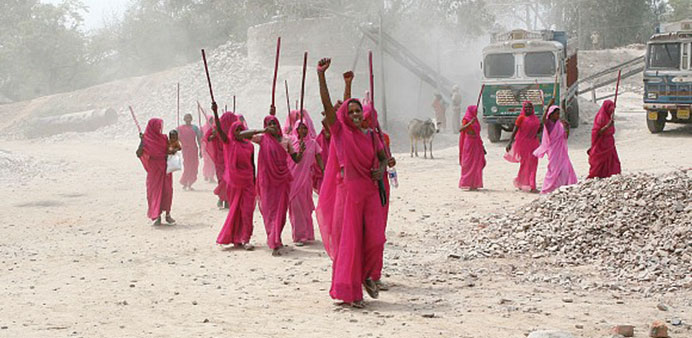
A spontaneous women’s movement.