


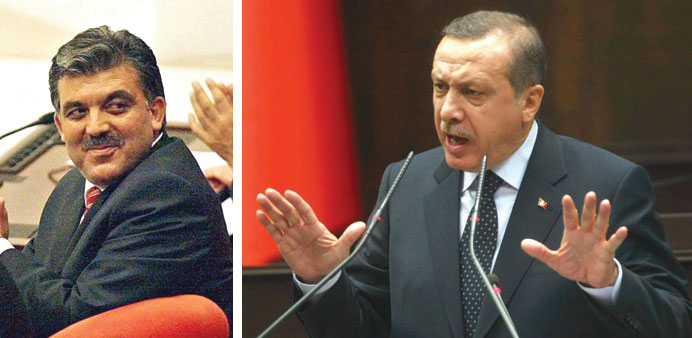
Gul: the concerns will be taken into account. Erdogan: denies accusations of online censorship.
Reuters/AFP/Istanbul
From a campaign to “unfollow” President Abdullah Gul on Twitter to an opposition appeal to Turkey’s highest court, Turks vented their anger yesterday at a new law tightening government control of the Internet.
Gul approved the legislation, which will let the authorities block webpages within hours and collect data such as users’ browsing histories, late on Tuesday, bolstering Prime Minister Recep Tayyip Erdogan but raising renewed concerns about free speech.
Erdogan’s critics say that the law, along with a bill increasing government power over the judiciary, as an authoritarian response to a corruption inquiry shaking his government and as an effort to stop leaks about the case circulating online.
Rights groups and the opposition had urged Gul, seen as a more conciliatory figure than Erdogan, to veto the new law.
Gul, a frequent social media user, lost almost 80,000 followers overnight after he tweeted late on Tuesday that he had approved the measure.
He said the government had assured him it would soften two disputed articles of the legislation, which the opposition and rights groups say infringes citizens’ freedoms.
“I am aware of the problems mainly on two points ... these concerns will be taken into account in the new law,” said Gul, who still has 4.3mn Twitter followers.
Nonetheless, the move triggered an angry response on Twitter.
“First thing to do today#unfollow@cbabdullahgul,” tweeted one user using the name mevan.
“President Gul approved Internet law. Welcome to the censorship era on Internet,” wrote another, named tanikunal.
“Of course we’re angry. The picture is so obvious – they are trying to manipulate everything. But our anger makes no difference,” said Cinar, a 29-year-old cook sitting with a friend in a cafe near the Besiktas fish market in Istanbul.
The main opposition Republican People’s Party appealed to the constitutional court to overturn the law, saying that it breached the constitution and aimed to cover up the corruption inquiry.
“We will raise in detail at every international platform how the Internet law will be used by the Erdogan government to repress freedoms,” said Faruk Logoglu, deputy head of the opposition Republican People’s Party.
“With this law, Turkey will be in a much worse league of countries than China and Iran,” he told AFP.
Social media and video sharing sites have been awash with alleged recordings of ministers, including Erdogan, and business allies, presented as proof of wrongdoing in the graft scandal.
The government says the law is aimed at protecting individual privacy not gagging its critics, will enable specific content rather than entire web sites to be blocked and will replace prison sentences with fines for violations.
It has cast the corruption scandal as a smear campaign designed to undermine it before elections this year and orchestrated by US-based cleric Fethullah Gulen, a former Erdogan ally whose followers say they number in the millions.
Turkey already has strict Internet laws under which thousands of websites have been blocked, from news portals viewed as close to Kurdish militants to gay dating sites.
Google legal director Susan Infantino said in a December report that the number of requests from Turkish authorities to remove content from the firm’s platforms had risen nearly tenfold in the first half of 2012.
In the six months to the end of June 2013, it was asked to delete more than 12,000 items, making Turkey the top country on its “request to remove content” list, the report said.
Erdogan’s reaction to the corruption probe, in particular government efforts to tighten control over the naming of judges and prosecutors and the Internet, has drawn sharp criticism from the EU, which Turkey has been seeking to join for decades.
In power for more than a decade, Erdogan’s Islamist-rooted Justice and Development Party (AKP) has increased its share of the vote in each of the past three elections, ushered in unprecedented political stability and overseen some of the fastest economic growth in Europe.
But the government’s handling of protests in mid-2013 and the fallout from the corruption scandal have heightened fears of some Turks about what they view as Erdogan’s increasingly authoritarian leadership.
“This frightens me even though I’m not doing anything criminal. I already hesitated to write anything critical of the government online,” said Emre, a 35-year-old engineer working on his laptop in a Besiktas cafe. “This government is not democratic enough for such a law. If I trusted it more, I would not be so frightened.”
Erdogan has vehemently denied accusations of online censorship, and boasted that the number of Internet subscribers in predominantly Muslim Turkey has swelled to 34mn from 20,000 since his party came to power in 2002.
Under the new law, telecommunications authorities can demand that Internet providers block pages deemed insulting or considered an invasion of privacy.