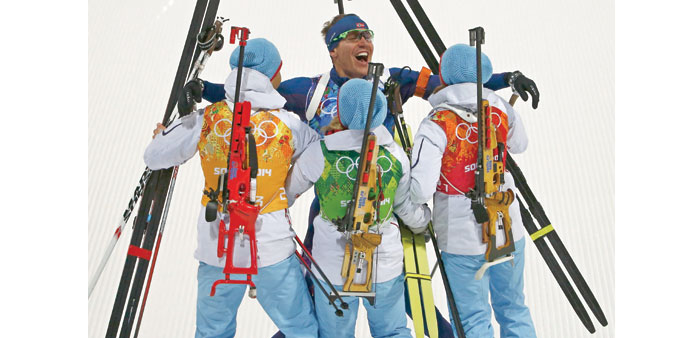
Norway’s Ole Einar Bjoerndalen, Emil Hegle Svendsen, Tiril Eckhoff and Tora Berger (L-R) celebrate after crossing the finish line to win the mixed biathlon relay. (Reuters)
Reuters/Rosa Khutor, Russia
At the age of 40, Ole Einar Bjoerndalen has more Olympic and world championship medals than birthdays. Yesterday, the Norwegian became the most decorated Winter Games athlete when he won his 13th medal with gold in the biathlon mixed relay at the Sochi Games.
The Norwegian, who made his World Cup debut in 1994, moved ahead of compatriot and cross-country skier Bjorn Daehlie’s record of 12.
He has 52 medals in world championships and Olympics, and has now matched Dahlie’s Winter Games record of eight golds.
After almost two years without an individual win, Bjoerndalen would have been forgiven for relying on the relays to add to his tally here since Norway, with Bjoerndalen in their ranks every time, have won all five world championships and Olympic relays since 2009.
Yet the soft-spoken Bjoerndalen started his Sochi campaign with gold in the 10km sprint. Yesterday he made no mistake on the shooting range to help Norway win the first Olympic mixed relay.
Bjoerndalen, taking part in his sixth Games, looks set to continue his harvest as Norway are the favourites to win Saturday’s relay.
His attitude is his greatest asset, according to Liv Grete, a seven-times world champion and three-times Olympic medallist, who was in the same sports school as Bjoerndalen in the early 1990s.
“We were training a lot together and we made the Norwegian team together. It was a lot of training and a lot of hard work,” Grete told Reuters.
Hard work quickly paid off for Bjoerndalen, who claimed his first World Cup win in 1996.
“At 15, he was already a professional, he was already way ahead of all the others in the way he was comprehending the sport,” Grete recalled.
“You have to have a huge respect for what he’s achieved, keeping the same motivation for 20 years.
“What is impressive is that he still has got this taste for competition after all these years, and that he is not afraid of failing.
“People just cannot imagine the amount of motivation it takes,” said Grete, who quit the sport in 2006.
“He deserves it. He is a professional who has helped our sport evolve,” his great rival Raphael Poiree of France told reporters at the start of the Games, when asked if Bjoerndalen could win a 12th medal.
“He is a perfectionist. There are not a lot of athletes like him. It’s been hard for him in the past three years, I think he had trouble accepting he had changed. But he learnt a lot.”
Third place in the 10km sprint in Hochfilzen, Austria, and second place in the 10km sprint in Oberhof, Germany, this season showed that Bjoerndalen remained a formidable opponent.
But he was lacking an individual win since February 2012.
“Until 2010 there was no contest, he was by far much better than me,” Frenchman Martin Fourcade, the five-times world champion and current World Cup leader, told Reuters before the Games.
“He was not a role model but more of an idol. I still remember how proud I was when he came to congratulate me after I had won my second World Cup event.”