


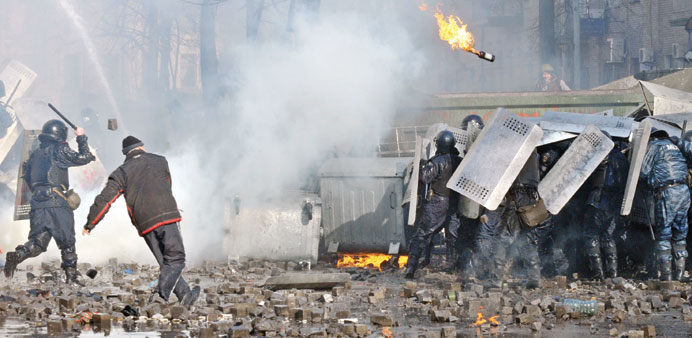
At least seven people were killed and scores injured yesterday as anti-government protesters battled riot police in Kiev in the first outbreak of violence in weeks.
Police said five civilians and two police officers had died in a day of clashes that turned parts of central Kiev into a war zone.
Medics working at field hospitals run by the opposition earlier said three protesters died of gunshot wounds and that around 150 others were injured, of which 30 were in a serious condition.
President Viktor Yanukovych’s ruling Regions Party said that an employee at its headquarters was also found dead after protesters briefly seized the building.
Protesters occupied the building for 20 minutes before being driven out by riot police, opposition lawmaker Lesya Orobyets told the Itar-Tass news agency.
One police officer died while being taken to hospital after being shot in the neck, the interior ministry said.
Kiev police later said that a second police officer had died from gunshot wounds.
Police said that 47 other servicemen had been injured, including five with bullet wounds, as parts of Kiev resembled a war zone with demonstrators and security forces fighting pitched battles in locations close to Ukraine’s parliament building.
Security forces issued an ultimatum warning that they would use “grave actions” to restore calm if unrest persisted.
Kiev also shut down vast subway network for the first time in the three month-long crisis.
“If unrest continues we will be forced to take grave actions,” Ukraine’s interior ministry and state security agency warned in a joint statement.
Riot police had succeeded in forcing protesters back into their camp on Kiev’s iconic Independence Square after heavy reinforcements arrived.
Yesterday’s chaos marked the first violent clashes since mid-January in the Ukrainian capital, which has been wracked by anti-government demonstrations since Yanukovych in November rejected an EU pact in favour of closer ties with historical master Russia.
Protesters briefly seized Yanokuvych’s party headquarters after several hundred attacked it with Molotov cocktails and smashed their way inside but later withdrew as smoke continued to billow from part of the building, an AFP reporter at the scene said.
Fighting flared after some 20,000 mainly peaceful protesters marched from their sprawling tent encampment towards parliament to demand legislators strip the president of a raft of powers.
Among them were opposition lawmakers, including Oleh Tyanihbok, leader of the Svoboda nationalist party.
Police fired rubber bullets and hurled smoke bombs and stun grenades at protesters who threw paving stones and set two trucks on fire trying to break through to the heavily-fortified parliament.
The violence was first concentrated in Mariinsky Park near parliament but then spread to other parts of the city.
The protesters lit tyres and set fire to at least two police trucks, media reported.
Television footage showed black smoke hovering over the city centre while there was constant sound of gunshots.
Inside parliament, opposition deputies blocked the speaker’s dais after speaker Volodymyr Rybak refused to put the opposition’s reform initiatives on the daily agenda.
Rybak has indicated that Yankukovych will appoint a new prime minister this week.
“The authorities do not want to compromise on any issue ... We understand that yet another odious candidate will be put forward (for prime minister), one who will be unable to restore the economy or end the political crisis,” said Vyacheslav Kyrylenko, an opposition deputy.
Inside parliament, where opposition leaders brought proceedings to a halt by blocking the speaker’s tribune, opposition leader Vitali Klitschko urged Yanukovych to take riot police off the streets to avert further “conflict in society”.
“It will be the decision of a real man,” the boxer-turned-politician said inside parliament.
Demonstrators were calling on the Rada parliament – where Yanukovych’s party has a majority – to vote on returning the country to its 2004 constitution, under which key powers would shift from the president to parliament.
“People were tired of waiting for the constitution to be changed – they needed action,” said demonstrator Volodymir, from Kiev, refusing to give his second name.
Another protester, Anatoli, also from Kiev, said that the latest protests could outstrip January’s brutal clashes when several protesters were killed.
“I think the actions will be on a bigger scale than they were on Grushevsky street (where January’s fatal clashes happened),” he said. “We need to surround the parliament until there is a complete change of government.”
The political crisis in Ukraine has snowballed into a titanic tug of war for the country’s future between Russia and the West.
The US ambassador on Twitter lamented the resumption of violence.
“After weekend progress in Kyiv, sorry to see renewed violence,” envoy Geoffrey Pyatt wrote. “Politics needs to happen in the Rada, not on the street.”
But the Russian foreign ministry lashed out at Western countries, accusing them of turning a blind eye to the more radical elements inside the protest movement.
“What is happening is a direct consequence of the policy of connivance among those Western politicians and European agencies that have been shutting their eyes to the aggressive actions of Ukraine’s radical forces since the beginning of the crisis,” the Russian foreign ministry said in a statement.
Russia on Monday said it would release a $2bn tranche of a larger $15bn bailout that it had essentially frozen since protests escalated last month.
News of the fresh credit from Russia failed to cheer the currency market, where the troubled Ukrainian hryvnia fell by up to 1.6% against the dollar yesterday, Reuters trading system showed.
It also failed to impress the protesters.
“We don’t need this money from Russia because it is not meant to help but to buy us. But we are not for sale. Can’t they see that this is simply a dirty bribe?” said Valentin Sypko.