


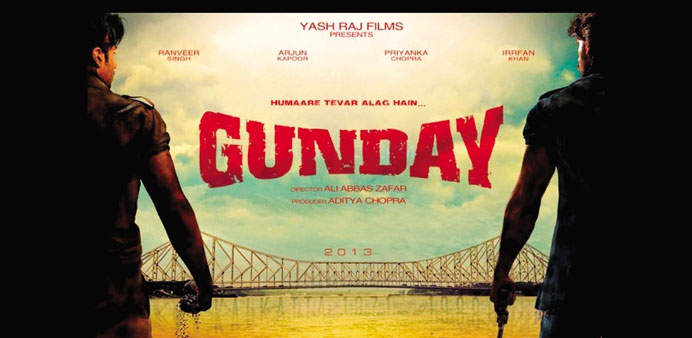
ENCROACHMENT? Gunday was released in Kolkata and elsewhere in both the original Hindi and Bengali versions – causing jitters in the state of West Bengal.
By Gautaman Bhaskaran
Ali Abbas Zafar’s Gunday comes from a big production house like Yash Raj Films (YRF). It opened last week. In many parts of the world and across India. Bengal as well. Nothing new about this. What, though, was, the movie was dubbed in Bengali.
And it was released in Kolkata and elsewhere in both the original Hindi and Bengali versions – causing jitters in the state. After all, Yash Raj Films is a big, big house, whose money power can be intimidating, to say the least.
Yes, Bengal may be facing this kind of competition – in which the local, struggling-for-finance cinema is pitted against huge Bollywood producers – for the first time. But one has been seeing this the world over for decades.
Much like the large fish that swallows the small fish in the depths of the ocean, Hollywood has often gobbled up small, independent European and even Asian cinema.
I remember during my long stay in Japan how sensibly made low-budget local movies with hauntingly beautiful native flavours ran to near empty houses, while Harry Potters and James Bonds attracted mile-long queues with popcorn munching-Coke sipping crowds.
There were some weekends when a freshly released Japanese film had just me sitting in a theatre meant for 300! It is not very different either in Cannes, where American fare invariably draws the most number of critics and others, while French pictures are not as hot.
Similarly, Bollywood is India’s big brother – whose money and muscle power have been the daunting obstacles for the country’s other cinemas. A time came when Telugu, Kannada, Bengali, Malayalam and even Tamil films shamelessly aped Bollywood, which was already a copy of Hollywood, in order to woo the viewer.
However, there were intervals in this business of copying – when movies from Tamil Nadu, Kerala and Bengal tried to get back to their own distinct roots. And they succeeded to a fair degree in getting audiences back. I know some Bengali films did impressively at the boxoffice.
Ditto, Malayalam works and, of course, Tamil, whose superstars have always enticed a humungous audiences.
One of the reasons for a Malayalam or Telugu or Tamil or Bengali cinema doing well in their respective states was the language. In states like Kerala or Tamil Nadu and even Bengal – with a strong sense of language and culture – Hindi was either not easily understood or welcomed. So, these movies had a certain advantage over Hindi pictures.
But when a big time Mumbai production house decides to dub one of its premiere works in the local language of the state, it can spell trouble, and this is precisely what is happening in Bengal, much to the chagrin of the cinema industry there.
When the trailer of Gunday opened some weeks ago in Bengal, it caused both joy and sorrow – perhaps more distress than delight. Set in the 1970s Calcutta (as it was then called), Gunday captures the mood and essence that were singularly Bengali. Visuals of Kolkata’s many splendours — Howrah Bridge, the leisurely sauntering tramcars (the only city where they still live), and the signboards in the artistic looking Bengali alphabets — were alluring to the Kolkatan.
However, when the main stars like Ranveer Singh (seen in another Bengal centric work, Lootera) and Priyanka Chopra started speaking in Bengali, there were gasps and a sense of dismay in the industry. More than this, Gunday, dubbed in Bengali, caused insecurity and fear.
Even the songs were in Bengali, and Gunday was coming from one of the most powerful Mumbai studios, Yash Raj Films – with a lot of money for publicity and promotion.
Many in the Bengali movie world saw this as an encroachment – even as an invasion into their blissful existence, ever so often pepped up with the melodious Aamar Sonar Bangla (Our Golden Bengal). Gunday’s Bengali songs are available on YouTube.
What is more, nobody had any doubt that Yash Raj Films was trying to get into the non-Hindi sphere. Along with the YRF Bengali channel, the movie house is also running YouTube channels in Tamil and Telugu.
Last year, it released Dhoom 3 in Tamil (100 screens) and Telugu (700 screens) along with the Hindi version. Earlier, Chennai Express – set in Tamil Nadu with Tamil characters – was dubbed in Tamil, and this edition did extremely well in a state where Hindi is still not easily spoken. Besides, YRF is planning to remake Band Baja Bharat in Tamil. Called Aha Kalyanam, it will hit theatres this weekend.
All this has understandably flustered Bengali actors, directors and producers. Celebrities like Jeet, Dev, Parambrata Chattopadhyay, June, Payel Sarkar, Haranath Chakraborty, Aniruddha Roy Chowdhury, Srijit Mukherji, Raj Chakraborty, Mahendra Soni, Shrikant Mohta, Ashok Dhanuka, Nispal Singh and Sudeshna Roy among others gathered recently at a Kolkata studio to protest against this so-called disaster.
Ali Abbas Zafar-helmed Gunday is spiced with he-men, glam dolls, great style and peppy dialogues that will undoubtedly enamour the multiplex crowds. Maybe the rural populace will also join in. And then we have that brilliant actor called Irrfan Khan as a cop in times that were known for sheer ruthlessness in Bengal.
It was the time of the emergence of Naxalites. It was the time when cops were butchered on the streets. It was also the time when hundreds of educated young men followed Charu Mazumdar, and dug their own graves in bloody police encounters.
The Bengali film industry is perhaps afraid that it will face a future as bleak as the young men of Kolkata. And unlike Tamil Nadu or even Andhra and Kerala, Bengal has no great heroes – like Surya, Rajnikanth, Mahesh Babu, Mohanlal and Mammootty. In fact, Bengali stars have often modelled themselves on their Mumbai counterparts.
And this from the land of Satyajit Ray and Ritwick Ghatak – whose purity of form, style and story enraptured millions across continents. They continue doing so.
As far as Gunday is concerned, it is a movie that is contrived, clichéd and implausible. We have a police officer dolled up as a cabaret artist. We have Ranveer Singh and Arjun Kapoor, who run away from Bangladesh and arrive in Dhanbad to become coal thieves.
When they grow up, they call themselves Gunday or ruffians, get ambitious, come to Calcutta and become dons! No policemen can match up to them, till Irrfan Khan steps into the ring. He is cool, calculative and restrained, and plays the game like one of chess.
He plants his men into the Gunday’s inner circle, gets an officer to be a sexy moll. Both ruffians flip for her. We all know what will happen after that.
If there is one high point in Gunday, it is Khan’s impeccable performance. He rises above the script with his splendid dialogue delivery and brilliantly nuances style.
The others, including Singh, Kapoor (as Gunday) and Priyanka Chopra (as the cop) pale in comparison. But, yes Saurabh Shukla as the lawyer trying desperately to tame the Gunday is also wonderful to watch.
We saw his calibre in Jolly LLB, and we see it again in Gunday. But despite Khan and Shukla, the work comes off as an exaggerated piece of cinema. I have said this before. I say this again. If you must watch Gunday, use your eyes, not your head!
*Gautaman Bhaskaran has been writing on Indian and world cinema for over three decades, and may be e-mailed at [email protected]