


|
Last Sunday Barcelona recovered their place at the top of the Spanish league table by beating Sevilla 4-1 at the Snchez Pizjun. It had taken them a solitary week to return and they have now been top for 60 of the past 61 weeks. |
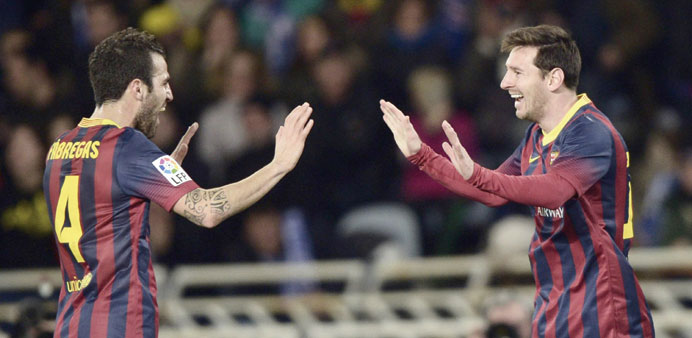
On Wednesday night they then eased into the final of the Copa del Rey for the third time in four years, with Leo Messi’s goal at Anoeta taking him to 335 for Barcelona, a total no player has ever exceeded for a Spanish club. And then there was more good news when they returned to training: Neymar will be fit to face Manchester City in the Champions League on Tuesday, just as they had hoped.
If the scene appears an idyllic one, the impression is perhaps a little false. This has been a difficult season for Barcelona and these have been particularly difficult weeks.
The president, Sandro Rosell, resigned amid the controversy of the Neymar signing, what should have been his greatest triumph instead proving his downfall, and debates have dominated on and off the pitch.
What Johan Cruyff described as the entorno, that swirl of politics, pressure and power, interest, exposure and intrigue, reappeared. Questions have been raised about the very identity of the club. As one headline put it after defeat in December, their first all season: “This is not our Barcelona”.
That was then, this is now. But the sense of vulnerability has not departed entirely nor the risk of crisis, lingering in the background.
Critics have lingered there too, awaiting their opportunity. Some fear that it may not be that far away. The realisation that Manchester City are the strongest team that they could have faced plays a part; that Barcelona are still not quite the team they once were does as well. The last two performances have helped but the margins have been fine.
Last Sunday Barcelona went one-nil down against Sevilla. Soon afterwards it should have been two. Carlos Bacca hit the post and Ivan Rakitic missed a wonderful opportunity.
The rain poured and Barcelona appeared overrun; there was, it seemed, no way out from deep inside their own half. They were facing a second successive defeat in the league. Worse, they had won only one of the last four. Valencia had become the first team to win at the Camp Nou in a year and they had drawn at Levante and Atletico Madrid.
The lead at the top had disappeared. The week before, Atletico had overtaken them; the night before, Real Madrid had also overtaken them. They could turn to Messi, of course, but Messi had not scored a league goal in open play since September and he did not look likely to either. Sure, he had returned from injury and scored against Getafe in the cup but there was something about him that appeared distant, almost apathetic, as if he was holding back.
As the Argentinian coach Angel Cappa put it, it looked like he’d lost a little passion, a little “madness”. Then Barcelona equalised, Alexis Snchez heading in Messi’s free-kick in an offside position, and they took control. Messi scored two superb goals that were an awakening and now the passion was certainly there, the aggression and determination.
“If you prick Messi’s pride, you tend to have problems,” the defender Martn Montoya said. Cesc Fbregas added the fourth to make it 4-1. Barcelona were back on top. Three days later they controlled the game in San Sebastin against Real Sociedad to reach the Copa del Rey final. One newspaper in Catalonia called it an “exhibition”.
After the Sevilla game the sporting director, Andoni Zubizarreta, said:
“We construct theses that are only valid for a day.” He was talking about Messi, seeking to avoid extreme judgments, and it cuts both ways; from good to bad and back again. The head coach, Gerardo Martino, summed it up well. He talked about how well Barcelona had played for an hour but admitted: “I’m conscious of the fact that we could have been 2-0 down. We need to be more consistent.”
In part Barcelona have been victims of their own success; they have set the bar so high. Martino certainly is in an impossible position: when it comes to comparisons between him and his predecessor Pep Guardiola he cannot win, even when he wins. In his first season he has had to handle injury to Messi, a president who departed, a maturing and possibly even a mutating team, and a scandal over his biggest signing. Then there are the politics.
As he himself pointedly put it, he is not home-grown or Dutch. Largely Martino’s handling of the media has been impressive. He has been calm and controlled, even-tempered.
That was one of the few outward expressions of the pressure that has been brought to bear on him, a glimpse perhaps that he felt that there was a willingness to attack him that others would not have faced, those that “fit” the club’s identity and heritage, protected by power brokers and opinion formers. Asked about the entorno, he replied: “I’ve found a few nooks and crannies here, yes.”
Although Barcelona’s results were impressive, many questioned the style. Barcelona did not put pressure high up the pitch; one of the defining features of Guardiola’s style had gone. They were less intense, less aggressive. They were more direct than before, turning repeatedly to long diagonals from the back to either wing. Against Rayo Vallecano earlier in the season, Barcelona had less than 50% of the ball for the first time in five years.
The style was treated not just as a mistake but as if it was somehow wrong, like a kind of moral aberration. The first of Messi’s goals against Sevilla came from a swift, incisive counter-attack, even if in one post-match interview Xavi Hernndez appeared horrified at the thought.
The debate over the style was also exaggerated: Barcelona may have undergone an evolution but there has been no revolution. At 67% they are still the team that has the most possession in La Liga. And few wanted to contemplate the possibility that maybe the style did need to be altered a touch. (Guardian News and Media 2014)