


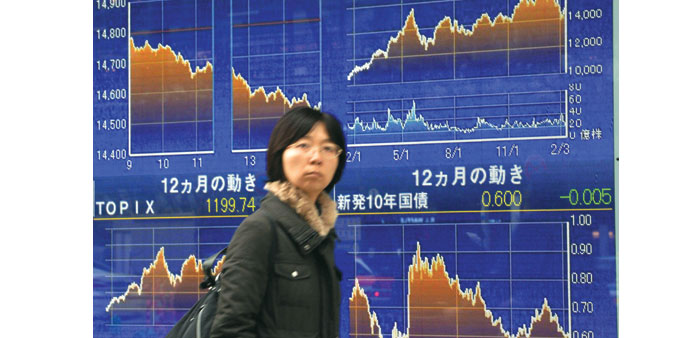
A pedestrian passes before a share prices board in Tokyo. Japan’s share prices fell 265.32 points to close at 14,534.74 points yesterday.
AFP/Tokyo
Asian shares fell on profit-taking yesterday following four strong sessions as a rally on Wall Street fizzled out, but Sydney pared earlier losses caused by data showing Australian unemployment at a 10-year high.
With few catalysts to drive trade, investors took a breather before the release of fresh data from the US and China.
Tokyo fell 1.79%, or 265.32 points, to end at 14,534.74 as a stronger yen hit exporters, while Sydney was flat, dipping 2.0 points to 5,308.1. Seoul gave up 0.46%, or 8.88 points, to end at 1,926.96.
Hong Kong fell 0.54%, or 120.26 points, to 22,165.53 and Shanghai was down 0.55%, or 11.56 points, at 2,098.40. In other markets, Singapore closed 0.15%, or 4.45 points, higher at 3,039.90. SingTel rose 1.7% to Sg$3.57 while Keppel Corp fell 1.33% to Sg$10.39.
Bangkok slipped 0.17%, or 2.19 points, to 1,311.87; Charoen Pokphand Foods dropped 4.59% to 26baht, while telecoms company True Corp fell 2.70% to 7.20 baht.
Kuala Lumpur slid 8.49 points, or 0.47%, to 1,817.15; Kuala Lumpur Kepong ended 2.9% lower at 23.52 ringgit while Felda Global Ventures shed 1.6% to 4.46. Guinness Anchor Berhad climbed 1.6% to 15.08 ringgit.
Jakarta edged down 0.10%, or 4.63 points, to 4,491.66; Bank Negara Indonesia rose 0.12% to 4,315 rupiah, while state miner Aneka Tambang fell 1.93% to 1,015 rupiah.
Taipei fell 0.51%, or 43.17 points, to 8,467.70; Taiwan Semiconductor Manufacturing Co was unchanged at Tw$105.0, while leading chip design house MediaTek dropped 1.15% to Tw$429.0.
Wellington was flat, edging up 5.56 points to 4,873.53; Air New Zealand added 0.29% to NZ$1.70 and Telecom was 1.26% higher at NZ$2.42.
Manila closed 0.17% lower, dipping 10.59 points to 6,101.72; Metropolitan Bank and Trust closed 0.56% lower at 79.55 pesos while SM Prime Holdings fell 2.26% to 14.70 pesos.
Global markets have so far enjoyed a positive week after a tumultuous time caused by the US Federal Reserve’s decision to reduce its stimulus programme for a second time in two months.
The gains came despite last Friday’s below-forecast US jobs data. Buying was given extra support Wednesday by a report showing a huge surge in Chinese exports last month.
The China figures were welcomed after a string of disappointing news, including contracting manufacturing activity, that have indicated a slowdown in the world’s number-two economy.
Market players will be looking to the release in Beijing today of inflation data.
Sydney shares were hit after the Australian Bureau of Statistics said the jobless rate rose to 6.0% in January—its worst level since July 2003 - from 5.8% in December.
The rise comes as the government struggles to manage a bumpy economic transition from a decade-long Asia-led mining investment boom.
It also follows the news earlier in the week that Japanese auto giant Toyota, the last carmaker in the country, will close its Melbourne plant in four years, sounding the death knell for the Australian car industry.
On Wall Street, a four-day winning streak came to an end for the Dow and S&P on Wednesday, as investors took their cash off the table ahead of retail sales figures and unemployment benefit claims.
The Dow lost 0.19% and the S&P 500 dipped 0.03% but the Nasdaq rose 0.24%.
Sensex at four-month low; rupee falls
India’s benchmark stock index slid to a four-month low after earnings from several of the country’s biggest companies missed estimates.
Drugmaker Cipla plunged the most in almost five years and Coal India fell the most in four weeks after reporting a drop in profits. Oil & Natural Gas Corp posted the steepest decline in five months after the Supreme Court asked the explorer to pay royalties to the Gujarat state at market prices. Hindalco Industries retreated to a six-month low after the aluminum maker’s net income trailed analyst forecasts.
The S&P BSE Sensex dropped 1.3% to 20,193.35, the lowest close since October 8. About 74% of the 30 companies in the gauge that have so far posted earnings for the quarter that ended December 31 have beaten or matched estimates, compared with 70% in the September quarter and 47% three months earlier. While a report yesterday showed consumer prices dipped below 9% for the first time since 2012, the core inflation gauge held at 8%, signaling the Reserve Bank of India may keep borrowing costs unchanged.
“The decline was led by bad results in an atmosphere of risk aversion,” Dipen Sheth, head of institutional research at HDFC Securities, said by phone yesterday. “The inflation data may not warrant a change in interest rates now. We don’t expect an immediate loosening in rates.”
RBI Governor Raghuram Rajan, who increased the main rate to 8% from 7.75% last month, said in the policy statement then that further increases were unlikely in the near term if prices cool as he expects. India’s wholesale price index probably slowed to 5.60% growth in January, after rising 6.16% in December, a Bloomberg survey showed before a report due tomorrow.
The consumer-price index climbed 8.79% from a year earlier, the least since January 2012, and down from December’s 9.87%, data showed after trading ended yesterday. Higher rates have curbed demand, with another report yesterday showing factory output shrank 0.6% in December.
Cipla plunged 7.9% to Rs380.3, the most since May 2009, after its third-quarter profit of Rs2.84bn missed the median estimate of Rs3.4bn. The stock was the worst performer on the Sensex. At least three brokerages, including HSBC Holdings, downgraded the shares.
Coal India tumbled 3.5%, the most since January 17. The world’s biggest producer of the fuel reported after market hours yesterday that net income fell 12% to Rs38.9bn. The stock was the third-biggest loser on the Sensex.
Meanwhile the rupee fell the most in more than two weeks on speculation oil importers will step up dollar purchases to repay borrowings from the central bank.
Refiners will make the payments by the end of May, according to an official with direct knowledge of the matter, who asked not to be identified as the decision is not yet public. The swap facility was introduced in August when the currency plunged to a record low.
The rupee dropped 0.5% to 62.44 per dollar in Mumbai, the biggest decline since January 27, according to prices from local banks compiled by Bloomberg. It earlier reached 62.01, the strongest level since January 23, after a report yesterday showed inflation dipped below 9% for the first time since 2012.
“There were stop-losses triggered after the earlier surge,” said Vikas Babu, a trader at Andhra Bank in Mumbai. “The news about the maturing swaps amplified dollar-buying later in the day.”
Consumer prices rose 8.79% in January from a year earlier, official data showed after the market shut yesterday, below the 9.2% median estimate in a Bloomberg survey and the previous month’s 9.87%.