


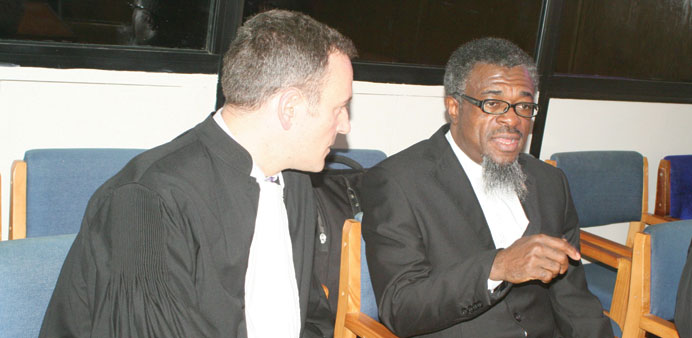
Former squadron commander in the elite reconnaissance unite Innocent Sagahutu (right) speaks with his lawyer prior to a hearing of his appeal trial in front of the UN-backed court for Rwanda in Arusha.
AFP/Arusha, Tanzania
A UN-backed court yesterday acquitted on appeal a Rwandan ex-paramilitary police chief and another former top officer of charges related to the 1994 genocide.
General Augustin Ndindiliyimana was acquitted on the grounds that he did not have effective authority over the subordinates for whose abuses he had been sentenced.
Major Francois-Xavier Nzuwonemeye, the former commander of an elite battalion, was acquitted because the judges said his implication in the assassination of the prime minister and the killing of 10 Belgian blue helmets - crimes in which men from his battalion took part - had not been proven beyond reasonable doubt.
The Arusha, Tanzania-based International Criminal Tribunal for Rwanda (ICTR) reduced the sentence of a third officer, Innocent Sagahutu, a squadron commander in the elite reconnaissance unit, from 20 years behind bars to 15.
The ICTR said it would hand down its decision on a fourth officer, former army chief Augustin Bizimungu, at a later date.
The UN-backed court was set up in 1994 to try the alleged masterminds behind the genocide, in which an estimated 800,000 people, the overwhelming majority of them ethnic Tutsis, were killed.
Lesser perpetrators have been tried before other jurisdictions, either in the formal court system in Rwanda or before thousands of grassroots tribunals called gacacas, which have handed down punishments including prison sentences and forced labour in the community.
The ICTR had in May 2011 sentenced Ndindiliyimana to 11 years imprisonment for genocide crimes, a term he had already served in preventive detention since his arrest in Belgium in 2000.
The appeal judges argued that their lower court colleagues had been incoherent in sentencing Ndindiliyimana.
Despite having accepted that by 1994 the paramilitary police were in fact under the command of the army, the judges had nevertheless sentenced Ndindiliyimana for abuses committed by paramilitary police, both in Kigali and close to the general’s house in the south of the country.
The appeal judges said there was no proof Ndindiliyimana had control over the men who committed those abuses.
Nzuwonemeye and Sagahutu had both been sentenced to terms of 20 years for crimes against humanity and war crimes.
Nzuwonemeye was sentenced for the assassination of prime minister Agathe Uwilingiyimana and the murder at the very beginning of the genocide of 10 Belgian UN blue helmets who were part of a unit tasked with protecting her.
Uwilingiyimana was killed on the first day of the genocide, half of her head blown off as she stood in front of her house, and her body sexually mutilated.
The Belgian blue helmets were killed the same day in a military camp - most of them battered to death - by a mob of soldiers brainwashed into thinking that Belgians had helped shoot down the plane carrying President Juvenal Habyarimana the previous evening.
Three other moderate figures who might have taken control after Habyarimana’s death were killed the same day as the prime minister.
The appeal judges argued that it had not been established beyond all reasonable doubt that the major had been responsible for those two incidents.
As for Innocent Sagahutu, the lower court judges had sentenced him for “ordering” the killing of the Belgian blue helmets, whereas the appeal judges found he had only “aided” and “encouraged” the killers.
Bizimungu, the most high-profile of the four officers, had been sentenced to 30 years in prison for crimes of genocide, crimes against humanity and war crimes.
Nzuwonemeye was arrested in February 2000 in France. Sagahutu was detained in Denmark in February 2000 and Bizimungu in 2002 in Angola.