


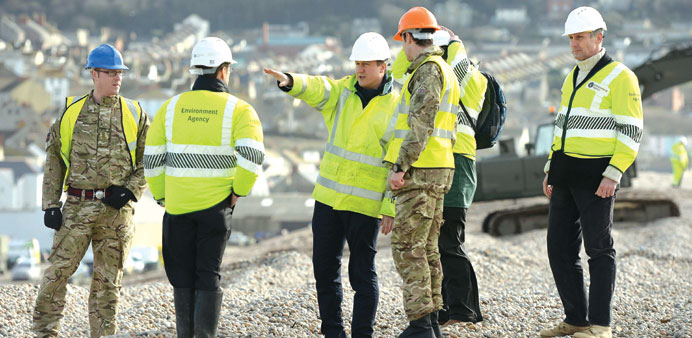
Prime Minister David Cameron talks with members of the Environment Agency as he inspects work being carried out on Chesil beach between Portland and Weymouth in Dorsett yesterday.
Reuters/Burrowbridge
Britain’s top political leaders headed to flood-hit areas of south-west England yesterday as they looked to limit the growing fallout from the government’s handling of the crisis.
Prime Minister David Cameron returned to the area for the second time in four days, visiting Dorset, while Deputy Prime Minister Nick Clegg arrived in badly-flooded Somerset.
Parts of Britain have seen their wettest January on record and around 5,000 homes have been flooded, with some remaining under water for more than a month.
Attention is also turning to more populated areas close to London, where water levels are still rising.
Anger among residents over the slow response to the crisis and the lack of resources put into preventing it in the first place have led to a pointing of fingers over whether the Environment Agency or government is to blame.
“I back the Environment Agency, I back the work they are doing. Everyone has got to get on with the job they are doing,” Cameron told reporters from a windy beach in Dorset as politicians on all sides criticised the escalating blame game.
“I am only interested in one thing and that is making sure everything the government can do is being done and will go on being done to help people through this difficult time.”
Earlier Cameron’s spokesman said the government acknowledged part of the problem had been the failure to dredge rivers, a measure he said had been cut back since the Environment Agency was established in the late 1990s.
“That needs to change and will change,” he said.
Last week, the government pledged an extra £130mn to help with the repairs and maintenance of flood defences, and the military have been drafted in to help build defences and evacuate homes.
Mohamed Khan, insurance partner at PwC, estimated the cost of the damage caused by the bad weather in December and January could be more than £600mn, with the insurance industry facing paying out as much as £500mn.
“Given the weather forecasts for this week and further into February, we would expect further flash flooding and for these estimated costs to rise,” he said.
On top of the devastation in the south west, the Environment Agency has issued severe flood warnings for areas of the River Thames west of London, and the Thames Barrier was closed yesterday to protect east London from flooding.
Environment Agency chairman Chris Smith, who has faced calls to resign over the handling of the crisis, defended his department’s record and blamed government rules on limits to funding available for individual flood prevention schemes.
“There’s no place for playing politics in the serious business of flood protection,” he wrote in the Guardian newspaper. Rail links to much of the south west, a popular area for tourism, remained cut off ahead of school holidays next week.
Rob Wood, chief UK economist at Berenberg, said the wider economic impact of the floods would depend on how quickly the weather dissipated.
“Previous episodes of bad weather like snow have taken upwards of 0.1, 0.2 (percentage points off quarter-on-quarter GDP),” he said, adding that sectors such as construction and manufacturing would likely be worst hit. “If it snows in January and February, then you don’t make up the loss until the second quarter so you have the whole quarter depressed.”
Residents brace for more damage
Residents living near the Thames yesterday told how their homes had been ruined as the river reached record levels. Shepperton was worst affected, with some families evacuating the area around Thames Meadow. Jonathan Fish, 50, struggled across the waters to dry land with his wife Sharon and son James. He said: “I have not known it this bad in 43 years here. Neighbours have some boats and we’re looking after the elderly as best we can. It is supposed to get worse so we have our fingers crossed.” Bill and Lynne Clarke, who live in Dunally Park, one of the worst hit areas in Shepperton, said the waters had wrecked their house renovations. “We have had a lot of work done and it has all been ruined. We are expecting the waters to rise two feet more. We are braced for the worst,” Clarke said. Michelle Brown, 42, had to carry her children through the floods to get to school: “We are all watching the waters inch up to our door. It is a dire situation.” In Chertsey, residents were piling up sandbags and raising possessions away from the floor as they suffered power cuts.