


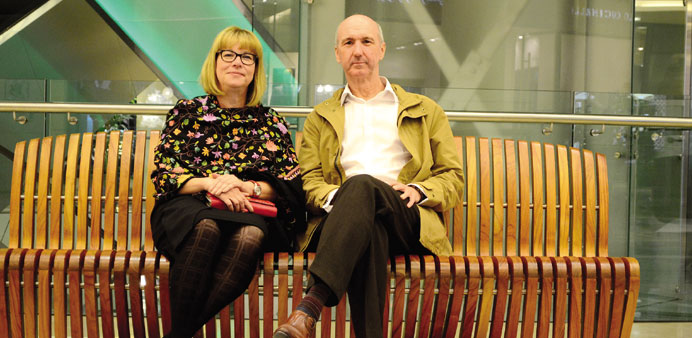
TERMS OF ENDURANCE: Canadian couple Lori Burns and Michael Arbow, outside a café in a West Bay mall. Photo by the author
Michael Arbow and Lori Burns literally, climbed a mountain to know what it feels like to struggle for breath. When daughter Elspeth, struggling with cystic fibrosis, escaped the fate of those dying waiting for a donor, they set out to make a difference for others. Anand Holla narrates the inspiring story.
For those who wish to scale Mount Kilimanjaro, the incentives usually revolve around experiencing a heightened sense of accomplishment, or enjoying the hard-earned high of trekking to the summit, or both.
Doha-based Canadians Michael Arbow and Lori Burns, however, were driven by a strange motivation that sounds like a nightmare for most amateur mountaineers — breathlessness.
Chatting over hot lattes at a café in West Bay, the couple explains why running out of breath while climbing the world’s highest free-standing mountain only strengthened their resolve.
“We wanted to experience what those who have trouble breathing go through every day. We wanted to feel what they have to live with,” Arbow says, “At the top, there’s 46 per cent of the oxygen that we are breathing right now. So you need to breathe twice for what we get from every breath down here.”
Burns nods along, and says, “That’s pretty much like we were experiencing what our daughter Elspeth had endured, and so many others experience daily, but we were feeling it only for a few hours.”
She adds, “You can empathise and you can hurt for someone. But until you experience it, you don’t REALLY know what they are going through.”
That is why in association with Qatar Organ Donation Centre (QODC) of Hamad Medical Corporation, their quest — Breathless No More — was planned to raise awareness on organ donation.
However, the couple’s journey to Kilimanjaro starts with Elspeth. Born with cystic fibrosis (life-threatening lung disease that impairs breathing), her lung capacity kept shrinking every year.
“Every time she got sick, it kept decreasing. Eventually, when she was 12, her lung capacity had deteriorated to around 30 per cent. Doctors in Canada opined that she will have to get a lung transplant,” Arbow says.
While this may be a normal recourse for cystic fibrosis patients who are above 20 years old, it’s very rare for a 12-year-old. The most anguishing part was the wait for the donor, which in Elspeth’s case was six months.
“Sadly, statistics say that three out of four of those wanting transplants die waiting. If everyone was a donor, they wouldn’t have to wait. So this is preventable,” Arbow points out.
Fortunately for Elspeth, who was getting sicker by the day, six months after the request, the double lung transplant came through.
“The first three months of her recovery period were rocky. But doctors say, if you survive those, you are in the clear,” says Arbow.
A few weeks away from her 18th birthday, Elspeth is now studying cinematography at the University of Toronto.
It’s interesting that Arbow, a professor with the faculty of business at the College of the North Atlantic-Qatar, and Burns, who works at Qatar Rail, jumped head first into the organ donation awareness campaign here in Qatar.
“Knowing how important it is to promote organ donation in our society, I was keenly following the organ donation stories,” Arbow says, “I moved to Qatar 18 months ago and found this drive catching up here. Then I read Her Highness Sheikha Moza bint Nasser had become a donor as well. That was fantastic.”
Last January, Arbow became a donor in Qatar, and Burns followed suit. “Qatar is doing us a big favour by providing us this job, this life in Doha, to experience all this,” he says, spreading his arms.
Burns agrees and says, “It was our way of thanking Qatar and helping the cause. The possibilities to do good work are welcomed here. Michael met Dr Riadh Fadhil, Director of Qatar Organ Donation Centre, only to ask whether they mind if we mention their programme, and it just blossomed.”
Joined by their Canadian friend Don Bastarache — who found the perfect cause to strike Mount Kilimanjaro off his bucket list – Arbow and Burns knew what they had signed up for. They prepared for the arduous 5,895 metres-long trek by lugging crazy weights around the Corniche.
“Though we hit the gym three days a week, we had to get in top shape and build endurance. At our age, that takes a lot more time,” laughs Arbow.
Burns who began climbing 18 flights of stairs at her workplace, says they carried 10 kg of backpacks and did several rounds of the Corniche in their hiking boots.
“We would put the treadmill on an angle and walk with all our mountaineering gear on. We looked cute,” she chuckles. “We tried to walk fast so that we were out of breath, and thereby experience being out of breath.”
Three weeks of hiking in the Alps last summer also helped the couple second-guess the hardships that Africa’s rooftop had in store. To visualise how high six kms straight up is, Arbow explains: “Ten minutes after your plane takes off from Doha airport, look out of the window.”
The trio flew to Nairobi on Qatar National Day, December 18, and then to Kilimanjaro in Tanzania for their week-long effort — five days to the top, two days to climb down. “We took the first day to get used to the elevation in Arusha, 4,500 feet above sea level. It was nice in the jungle at 32 degrees,” says Arbow.
By day three, at 3,100 metres, they started feeling a little out of breath. By day four, at around 4,000 metres, the troubles had begun escalating.
Arbow says, “At nights, the temperature was below zero degrees. Going to the bathroom at night was a rigorous task — getting boots on, stepping outside the tent, and trudging back in. I was exhausted!”
The 15-men entourage of guides, assistant guides, porters and cooks that accompanied Arbow, Burns and Bastarache, kept reiterating the secret to scaling Kilimanjaro — Poli Poli, which is Swahili for slowly, slowly. “The key indeed was to walk slowly,” says Arbow.
In biting cold weather, walking four kilometres up takes twice the time, says Arbow. “It’s not because you take stops. In fact, it’s gotten so cold now that you don’t want to stop. You just keep moving. You catch a break for three or five minutes, and you walk 15 minutes. You are really moving 20 centimetres at a time,” he says.
Perhaps, this is the part where your mental strength faces its toughest test. Arbow elaborates, “If you look down after walking for two hours, you can still see the camp you left and it looks nearby. An hour later, you look down and the camp’s still there. You feel like you’ve gone nowhere. You’ll think — Am I on a treadmill?”
Since Burns is scared of narrow edges, getting past the treacherous Barranco wall was a pain. “I had a terrible cold, and tough time breathing. I was nervous. By the end of the day, I was so exhausted that I could not walk the next 200 feet to reach the registration camp. Michael and Don did that for me, while the porters pampered me with tea,” she recalls.
Since you never see the top of Kilimanjaro till the very end, it feels frustrating at times, says Arbow. “Moreover, you are making your final ascent at midnight. All you see is one foot in front of the other until 5.30am,” he says.
A kilometre away from their goal, Don sat down at around 4am, saying he felt like he could fall asleep. “When someone says that at subzero temperatures, that’s a danger sign. We shook Don out of it and kept climbing,” says Arbow.
By the time they made it to the summit, Arbow and Burns’ knees were shot, their legs felt like rubber, and the trio had endured bouts of extreme breathlessness.
“From 32 degrees to minus 10 degrees in five days; it was difficult for our bodies to get accustomed to that. But to see the beauty of nature so closely, and to reach the top, it was all worth it,” Burns says.
As they reached the peak, almost cinematically, they could see the sun rise over the plains of Africa. “The sun emerged over the clouds that were below us. It was so beautiful. We were literally on top of the clouds,” Burns laughs. There, they flew Qatar’s national flag and also the banner of QODC.
Their takeaway seems unanimous. “Strangely, the most emotional part was when we woke up the morning to fly there. I was crying, thinking of my daughter and all the people we were doing this for,” Arbow says.
Like him, Burns, too, found the experience spiritually rewarding. “The world seems so small when you are up there. You feel so insignificant, which actually isn’t a bad thing. It was so humbling,” she says.
Meanwhile, the QODC has been promoting the organ donation awareness on social media. For the uninitiated, the website organdonation.hamad.qa may help. “It’s simple. More donors can save more lives,” Arbow says.
What turned out to be a good metaphor for the trip was the jungle safari that the trio went on after completing their Kilimanjaro trek.
Arbow says, “We saw a cheetah. In a flash, it crouched and chased a rabbit. The hunt got over in two seconds, and was a happy ending for the rabbit as it managed to escape. But that just reinforced the delicate balance of life and death. Not everybody makes it to the top of Kilimanjaro. We are fortunate to have survived the journey.”