


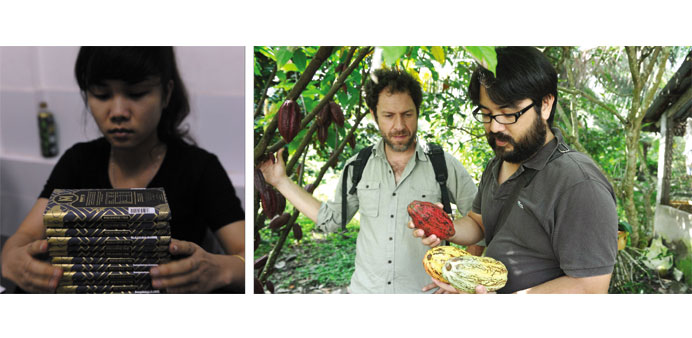
A worker packing a chocolate bar at chocolate workshop Marou, Vietnam’s first artisan chocolate maker in Ho Chi Minh City. Right: Vincent Mourou (left) and Samuel Maruta, co-founders of Vietnam’s first artisan chocolate maker Marou, inspecting cocoa fruits as they visit a farmer’s garden growing cocoa trees in Go Cong Tay district, southern province of Tien Giang.
AFP/Ho Chi Minh City
Deep in the Mekong Delta, two Frenchmen have their heads buried in a sack of cacao beans.
The pair — co-founders of Vietnam’s first artisan chocolate maker — resurface, murmuring appreciatively.
The sweet-toothed entrepreneurs — who quit their day jobs to set up award-winning chocolate company Marou — buy three out of four of 64-year-old farmer Vo Thanh Phuoc’s sacks of dried, fermented cacao, paying a premium on the market price for the better-than-average beans.
“When we started, the farmers thought we were crazy,” Marou’s co-founder Vincent Mourou said as he nibbled on a cacao nib. Every sack of beans is individually checked as the smell, colour, texture and taste give a good indication of the chocolate to come.
“Now, they try the beans too.”
Cacao was likely first introduced in Vietnam by French colonialists in the late 19th century, but never took off as a cash crop.
As demand for high-quality chocolate rises globally — particularly in emerging markets — while supply from traditional producers like Ivory Coast falls due to ageing tree stock and other problems, the industry is eyeing communist Vietnam as a new supplier.
Cacao prices hit two-and-a-half-year highs in late January amid concerns over inventory, and some industry figures are warning of a possible deficit of 1mn tonnes by 2020.
The chocolate industry is “desperate to diversify” its supply of beans, which would lessen the risk of supply crunches owing to disease or political unrest, said Chris Jackson, lead economist with the World Bank in Hanoi.
Current production in the communist country is just 5,000 tonnes per year, compared to the roughly 1.4mn tonnes exported by Ivory Coast, according to the International Cocoa Organisation.
But this needs to grow to give the cacao industry a chance in Vietnam, said Gricha Safarian, managing director of Puratos Grand-Place, a Belgium joint venture which produces the majority of chocolate used locally in Vietnam —by hotels, bakeries and ice cream companies — and exports high-quality chocolate and cacao beans. “Vietnam has a place to take as a medium size producer of quality beans,” said Safarian, who has worked in Vietnam’s nascent cacao industry for two decades.
“Year by year the market is going to be more rewarding for quality beans because of this coming shortage” as demand for quality chocolate rises, especially in Asia, he said.
Vietnam’s chocolate has “a different flavour profile -- the Vietnamese beans are rather different from the African bean,” which makes it stand out in the market, he said.
“The cacao sector in Vietnam is really at a crossroads — it could go for quality or quantity,” said Vien Kim Cuong, programme manager for Swiss NGO Helvetas, which works with cacao farmers on certification.
The country is well-known for cheap agricultural exports like coffee -- it provides 50% of the world’s low-end Robusta beans -- and catfish so cheap it is repeatedly hit by US anti-dumping measures.
Marou and Puratos Grand-Place want the government to take a different, more upmarket route with the cacao sector —they are trying to add value locally and build a reputation for Vietnamese luxury chocolate.
“We transform an agricultural product, the cacao bean plus sugar, into a high-quality chocolate that we position as a premium product on the export market,” said Safarian — whose Made in Vietnam chocolate is found in top restaurants from Paris to Tokyo.
For Marou co-founder Samuel Maruta, setting up an artisan chocolate company in Vietnam — not known for cacao, chocolate or even high-quality export goods — was a risk.
But the pair have successfully positioned their Vietnamese single-origin chocolate as part of a growing bean-to-bar revolution, a rebellion against homogeneity in an industry dominated by major players like Kraft and Italy’s Ferrero.
Mass-produced chocolate can be “incredibly soulless,” said Maruta, a world apart from the rich, fruity, spicy notes found in a bar of the company’s 78% dark chocolate.
From their Ho Chi Minh City-based factory, they’re now exporting close to two tonnes of chocolate a month, to some 15 countries.
The pair want Vietnam “to push quality cacao, so that Vietnamese cacao is known for quality and not quantity,” Maruta said.
Officials at state department VinaCacao said they aimed to increase cacao production some five-fold by 2020, but declined to provide further details.
Major buyers including industry leader MARS are eager for Vietnam to grow more higher-quality “certified” beans — MARS has pledged to use only certified beans by 2020.