


By Steff Gaulter
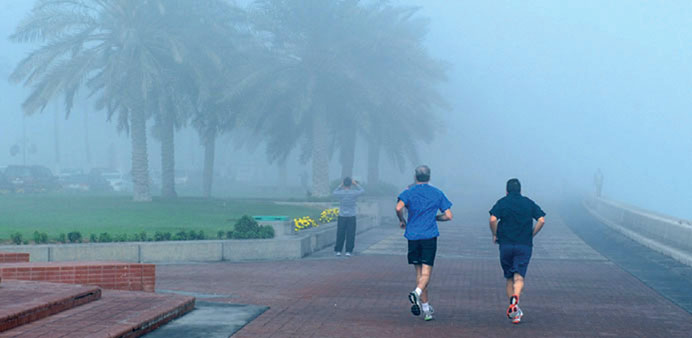
Early on Wednesday, January 22, I drove to Qatar Foundation. Normally this would have been a fairly easy task, but on this particular morning, everything was obscured by thick fog. This made map-reading rather more difficult, and the traffic worse than usual.
By the time I left the school at 8:30, the fog had become low cloud. It hadn’t actually changed at all, it had just lifted. Fog and cloud are essentially the same thing, they’re both made up of tiny droplets of water, but instead of hovering in the sky above our heads, in fog the collection of droplets rests on the ground.
Generating fog is fairly simple; all you need to do is cool down very humid air. As warm air can contain more water vapour than cool air, when you lower the temperature of air, water droplets will start to condense. The exact temperature at which the water vapour condenses depends on many factors, but is mostly dependent on the amount of moisture present. As the water droplets continue to form, the visibility will get steadily worse.
At the end of January, the winds were flowing gently from an easterly direction. This brought in plenty of humidity from the sea. The humid air then just needed to be cooled in order for fog to form. Sure enough, during the night the temperature fell, tiny water droplets appeared and the landscape was shrouded in fog.
In order to be officially classed as fog, the visibility has to be less than 1km (0.6 miles). Most of us, however, would still call this mist, and think of fog as being more dense. However, using the official definition, Doha Airport only reported fog on two days.
In other parts of Qatar, however, the visibility was much lower. At Al Udeid, the army base, nine days were shrouded in fog, and between 21 and the 28 January every day except one was foggy.
For Doha, this has been quite an unusually long run of fog. Fog here is relatively rare, and usually happens only a handful of times every year. Elsewhere, however, it is far more common. One of the foggiest spots on the Arabian Peninsula is Salalah in southern Oman. This is such a stark contrast to the rest of the region, that it’s a very popular holiday destination in the summer. I went there a few years ago and was somewhat surprised to see groups of people picnicking in thick fog.
The reason for the fog along the south coast of Oman is the cold sea waters that well up in the summer months. Obviously the rest of the Arabian Peninsula is hot and humid at this time of year; as this sticky air meets the cold ocean current, the air cools and water droplets begin to condense. The fog breathes life into the region, providing much needed moisture, and transforming the barren hills into a green, lush landscape.
Coastal fog isn’t a phenomenon which only happens in Oman. There are other parts of the world which are also prone to murky conditions. Along the east coast of the UK, fog is so common it’s given a name: the locals call it haar or fret. In San Francisco there is also a regular coastal fog, which even has its own twitter account @KarlTheFog, which has over 35,000 followers!
Of course fog can form away from coasts too. All you need is a generous amount of humidity. Some spots are more prone to fog than others, depending on many things from the type of soil to the topography. California’s Central Valley calls its fog ‘Tule fog’. It’s a spot that’s so prone to fog that in 2008, the California Highway Patrol spent $12mn on the first fog pilot detection system, which was designed to alert drivers of fog.
I have to say I find the scheme rather strange. There are similar, but manual, alert systems in the UK. As you drive along, concentrating hard due to the reduced visibility, you could see an orange flashing sign up ahead. You squint, trying to make out what the hazard was, only to discover that it’s warning you of something you already knew: it’s foggy.
Obviously the alert system is designed to reduce the amount of accidents, because as we all know, fog can be very treacherous on the roads. People who don’t see fog very often can forget how to drive in it. If you see fog, the thing to do is to slow down and leave more room between you and the car in front.
The other thing to remember, is to use your fog lights and don’t try to use your full beam headlights, as this will cause the light to reflect off the water droplets, ensuring that you actually end up seeing less.
The final thing to remember about fog is that it doesn’t block out all of the sun’s rays. Some of you may have had previous mishaps like me, and accidentally got sunburnt on a cloudy day. Given that fog is just low cloud, the same thing can happen when it’s foggy.
It seems somewhat unfair that although you might not be able to see to the sun, it can still burn your skin, but don’t let that put you off from picnicking in the fog. After all, it’s all the rage in Salalah.