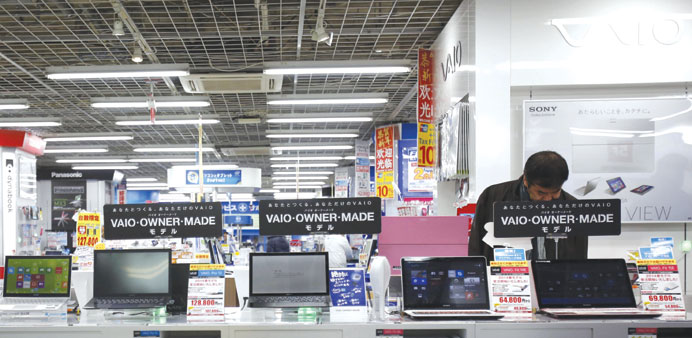
A shopper looks at Sony’s Vaio PCs at an electronics retail store in Tokyo. The company is in talks with investment fund Japan Industrial Partners to sell its loss-making Vaio personal computer division, a source said yesterday.
Reuters/Tokyo
Sony Corp’s plans to quit making personal computers after years of losses focus a spotlight on how it intends to fix a much bigger problem – a flagship TV division that has lost $7.5bn over the last 10 years.
The pullout comes as Japan’s electronics firms look for daylight beyond the shadow of industry giants like Apple Inc and Samsung Electronics Co Exiting the Vaio PC business Sony founded 17 years ago will mark the first time Chief Executive Officer Kazuo Hirai pulls a major consumer
product line.
Still unclear is when Sony can catch up with local peers Panasonic Corp and Sharp Corp on the restructuring track. The pair have swallowed charges, sold off or cured many loss-making businesses, and bounced back to strong profits.
Sony is now in talks with Japan Industrial Partners, a Japanese fund that buys up businesses that are being restructured, to take over the Vaio brand’s operations in Japan, according to the plan under consideration, a source told Reuters yesterday.
Financial details and final stakes in the new entity were still being discussed, the source said. Sony is scheduled to report earnings for the October-December quarter today.
The deal will follow the disposal of assets such as its New York headquarters and a major building in Tokyo last year and could presage CEO Hirai stepping up restructuring efforts, said Macquarie Research analyst Damian Thong.
“The only way to fund restructuring was to receive funds in deals like this one,” said Thong, who has an ‘outperform’ rating on Sony stock. “And if you look at the last six months, I have to say that this has been the battle strategy that Kaz Hirai has been playing.”
Sony said it had not announced anything about its PC business and that it was exploring various options for the unit. An official at Japan Industrial Partners declined to comment.
Yesterday, Sony’s shares rose 4.6% as investors welcomed the news on the Vaio sale. But shares in Panasonic surged 19% after it more than tripled third-quarter operating profit.
Sony doesn’t break out details of its PC division’s financial performance. Analysts estimate its operating loss in the year through March 2014 will be around ¥30bn. Dwarfed by industry giants like Lenovo Group as well as Apple and Samsung, Sony’s share of the PC market slipped to 1.9% in 2013 from 2.3% in 2011, according to research firm Gartner.
The news that Sony is preparing to exit one of its better-known brands will sharpen interest in the performance of the company’s TV business when it reports earnings today. Analysts expect a strong showing by Sony’s financial services and music businesses to help lift operating profit for the quarter to about ¥72bn from ¥46.4bn a year earlier.
In the first six months of fiscal 2013, Sony’s financial unit brought home ¥85.2bn in operating profit. But Sony logged just ¥51.1bn in operating profit overall, revealing deep losses for electronic gadgets such as video games, audio equipment and TVs.
Citing losses linked to the sale of the PC business, the Nikkei business daily reported yesterday that Sony could slip into a net loss for the year ending March 31 for the first time in two years.
Sony’s progress has been hampered by its reliance on consumer electronics. With an array of business-to-business divisions, Panasonic and Sharp have been able to adjust their business models and focus on industrial products, like auto parts, solar panels or energy-efficient housing systems, instead of consumer goods.
Having last turned an annual operating profit in the 12 months ended March 2004, Sony’s TV business has piled up total operating losses of ¥761.9bn ($7.5bn) in the meantime.
Like other Sony businesses, Vaio – an acronym for ‘Visual Audio Intelligent Organiser’ – has seen its thunder stolen by Apple gadgets. The Macbook Pro has eaten up much of the consumer market for sleek, high-end laptops that had become the focus of the Vaio brand.