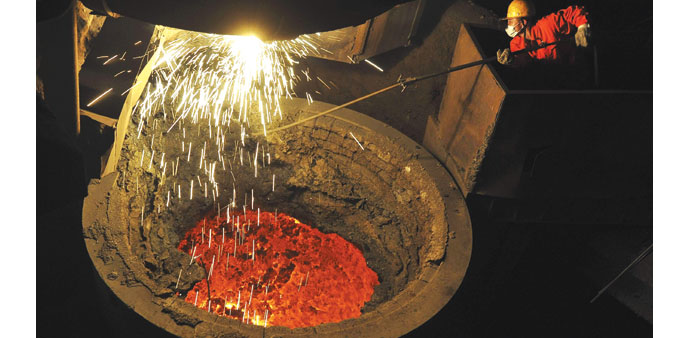
An employee works above a furnace containing molten steel at a factory in Dalian, Liaoning province of China. Factory growth in China eased to an expected six-month low in January, hurt by weaker local and foreign demand, a survey showed.
Reuters/London/Beijing
Manufacturers around the world enjoyed a solid start to the year as order books swelled, surveys showed yesterday, though a struggle for growth in China and a downturn in France took the shine off the overall picture.
Eurozone factories had their best month since mid-2011 and, with unemployment near record highs, increased headcount for the first time in two years. They were led by a sharp pick-up in Germany and a revival among the states on the region’s periphery.
But France, the bloc’s second biggest economy, remained a drag on the region.
“The major area of uncertainty over the last few years has been the euro area, but the latest PMI numbers tend to confirm (it)... is on a gentle recovery path with the periphery gaining encouraging momentum as well,” said Philip Shaw at Investec.
“The latest numbers on China, and the UK, are a little less positive but there is nothing that would signal any major concerns about those economies from today’s surveys.”
Growth in China’s service sector growth slowed to a five-year low, putting the focus on concerns of an slowdown in Asia’s economic powerhouse — a factor behind the selloff that has hit emerging markets in the past two weeks.
The rate of expansion in activity in US factories probably also slowed last month, figures due later are expected to show, echoing earlier data from Britain that suggested a swift upturn in factory activity there eased slightly.
Markit’s final Eurozone Manufacturing Purchasing Managers’ Index (PMI) rose to 54.0 last month, pipping an earlier flash reading of 53.9 and comfortably ahead of December’s 52.7. The last time it was higher was in May 2011.
A reading above 50 indicates growth. The sub-index measuring output, which feeds into a composite PMI due on Wednesday and seen as a good guide to broader economic growth, rose to 56.7 from December’s 54.9, in line with a flash estimate and its highest since April 2011.
Germany’s PMI jumped to a 32-month high but while France’s rose to a 23-month peak, it held firmly below the breakeven 50-mark.
Factories increased headcount to meet demand, providing some cheer to policymakers after data on Friday showed unemployment across the bloc held near a record high of 12% for the third month running in December.
However, manufacturers were unable to raise prices last month as fast as they did in December, possibly stoking fears of deflation in the region after consumer price inflation dropped unexpectedly in January.
Spain’s manufacturing sector grew at the fastest rate since April 2010 in January, adding to a run of recent data pointing to an earlier recovery than expected for the battered economy.
Markit’s purchasing managers’ index (PMI) of manufacturing companies rose to 52.2 in January from 50.8 in December, marking the second straight month above the 50 line separating growth from contraction.
Spain’s manufacturing sector has expanded for six of the last eight months, having not previously grown since April 2011.
Spain emerged from a two-year recession in the third quarter of last year with a modest 0.1% quarterly expansion. Preliminary data suggest the growth rate sped up to 0.3% from October to December.
While the economy seems to be showing signs of recovery, the unemployment situation in Spain remains dire, with 26% of the working population unable to find a job.
But the Markit index showed that the manufacturing sector added jobs in January for only the second month since August 2007, with the employment index rising to 50.8 from 48.4 in December.
Irish manufacturing activity grew for the eighth straight month in January, albeit at a slightly slower pace than in December, as the country looks to build economic momentum and post solid growth in 2014.
Ireland became the first eurozone country to exit an international bailout last year and is becoming increasingly confident it can deliver economic growth of 2% this year after two years of near stagnation.
The Investec Manufacturing Purchasing Managers’ Index fell to 52.8 in January from 53.5 in December, when it recorded its second-highest reading in almost 18 months. But the index remains well above the 50 line dividing expansion from contraction.
That put Ireland behind the 53.9 flash reading recorded for the euro zone as a whole last month, the highest since May 2011.
Irish unemployment has fallen to 12.4%, just above the euro zone average, from a 2012 high of over 15%. January’s manufacturing data showed employment grew across all three groups of investment, intermediate and consumer goods.
The PMI sub-index measuring employment rose to 53.9 from 52.8 in December and has also grown for eight months in a row. Growth in new export orders bounced back from a five-month low thanks chiefly to solid growth in neighbouring Britain. Dublin is counting on the domestic economy to spur on the recovery this year as its usually robust export sector has been struggling due to the mixed picture in Europe and the expiry of patents among the large cluster of drugs companies located in Ireland.
Recent numbers from China have painted a subdued picture of developments there.
The Markit/HSBC manufacturing PMI fell to a six-month low of 49.5 in January, suggesting the overall factory sector contracted from December. A similar government measure also fell to a six-month low, although it indicated the sector was still expanding modestly.
A government PMI on the services sector fell to 53.4 in January, firmly in expansion territory but still the index’s lowest level since December 2008.
That run of data provided further reminders for markets of the pressures on the world’s top emerging market economy as Beijing tries to push major reforms without tamping down growth too much.
China’s government wants to reduce a heavy reliance on the investments and exports that have fuelled breakneck economic growth in the past three decades in favour of consumption and services, which it thinks will provide lower but more sustainable growth.
Barclays analysts, referring to manufacturing, said they estimated the seasonal impact of Lunar New Year holidays was minimal on China’s factory sector.
“In our view, much of the decline reflects (a) downbeat demand outlook and suggests continued softening in growth momentum,” Jian Chang and Jerry Peng said in a note.
Other PMIs yesterday showed Indian manufacturing running at its strongest pace since March 2013 and in South Korea the sector was expanding at its fastest in eight months. An Indonesian PMI showed a slight pick-up in factory activity.
Last week, a Japanese PMI rose to its highest level in nearly eight years as new orders expanded at their fastest pace on record — a sign of strong domestic demand before prices rise with an increase in a domestic sales tax due in April.