


Reuters/Doha
Iraq’s vice president warned that an armed standoff in Anbar province could spread to other parts of the country as Sunni Muslim opposition to Shia Prime Minister Nuri al-Maliki grows.
Stirred by a bloody raid to arrest a Sunni politician in the Anbar city of Ramadi, fighters of the Al Qaeda-linked Islamic State of Iraq and the Levant (ISIL) and tribal allies took over Fallujah and parts of nearby Ramadi three weeks ago at a time of rising Sunni anger with the Shia-led government.
Tarek al-Hashemi, a Sunni sentenced to death in 2012 after an Iraqi court convicted him of running death squads while vice president, something he denies, has accused Maliki of pursuing a political witch-hunt against his Sunni opponents.
“I’m not optimistic about the future... I think this spark in Anbar will spread to other provinces,” Hashemi told Reuters in an interview this week in his Doha office.
“Maliki is targeting Arab Sunnis [in Iraq] in different provinces, with the use of army forces, or handing them death sentences in a way that has never been seen before in Iraq’s modern history, and therefore it’s the right of these individuals to defend themselves in every way possible.”
On Sunday, Iraqi government forces battling ISIL militants intensified air strikes and artillery fire on Fallujah. The confrontation has displaced tens of thousands of residents.
Many in Iraq’s once dominant Sunni minority, the main community in Anbar, share ISIL’s enmity toward the Shia Muslim-dominated government. But some tribal leaders in Anbar, a vast western province that borders civil war-wracked Syria, have been trying to steer a middle course between the two.
Iraq’s US-equipped armed forces have killed dozens of militants in recent days in shelling and air strikes, officials say. The scale of casualties among civilians, the security forces and tribal fighters is not yet clear.
ISIL has sought to extend its control into neighbouring areas, creating two desert entities that it refers to as “wilayah” (governed area). One is called the State of North Al Jazeera, outside the northern city of Mosul, and the other the State of South Al Jazeera, in the Anbar desert.
Hashemi, who divides his time between Qatar and Turkey, appealed to outside countries for humanitarian aid to “support the victims”.
He said it would be “disastrous” if Maliki, in power since 2006, could win a third term if voters choose him in a parliamentary elections set for April 30.
“Today, we are objecting to Maliki not because he’s Shia. It’s because of his flawed policy,” said Hashemi.
“Maliki ... controls political decisions and the power to implement them and he also controls the judiciary system, stripping it of independence.”
Like Hashemi, critics of Maliki say he has gained undue control over the army, police and security services, using them freely against Sunni Muslim and other political foes while allowing grave abuses in prisons.
Hashemi said he longed to return to his homeland but did not feel safe to go back at this point. “There isn’t a single square metre in any (Sunni) governorate that’s safe for me to return to,” he said.
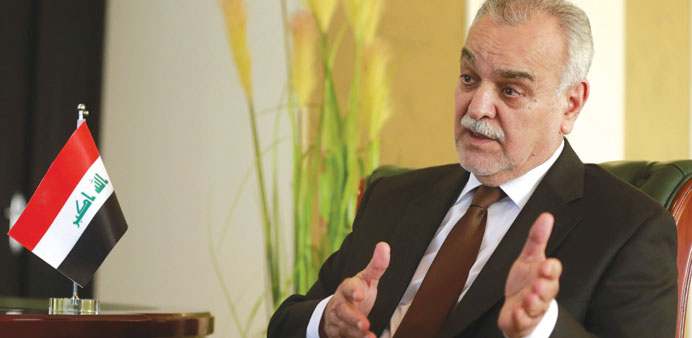
Hashemi gestures during the interview in Doha on January 26.