


AFP/Sanaa
Reconciliation talks have outlined Yemen’s future as a federal state, but its leaders now face the challenge of implementing change in an impoverished country grappling with multiple revolts.
A political transition stipulated by a UN-backed deal that saw long-ruling president Ali Abdullah Saleh step down in the face of Arab Spring protests was supposed to culminate this February with a new constitution and free elections.
But a national dialogue that is part of the same agreement concluded four months late on Saturday, extending the transitional period and allowing an extra year to draft a charter and vote on it.
In the meantime, Sanaa has struggled with an increasingly assertive separatist movement in the south, deadly clashes between Shia rebels and Sunni Islamists in the north, and a string of attacks on security forces blamed on a powerful Al Qaeda affiliate, all feeding a sense of crisis in the Arab world’s poorest country.
And elements of the Saleh regime have been accused of deliberately undermining the transition, with the UN Security Council weighing action against them, diplomats said on Tuesday.
Yemen’s parties hope to rein in the unrest by agreeing on a federal system, but remain divided on whether it should consist of two regions or six.
Sanaa fears that a north-south division could set the stage for the south to secede, while southerners oppose the multi-region option, which would dilute their power.
“The dialogue has set the theoretical framework for a federal state,” said Yemeni analyst Fares al-Saqqaf.
Interim President Abd-Rabbu Mansour Hadi formed a committee on Monday, led by himself, that will decide on the number of regions and insert it into the text of the new constitution, which should be drafted and voted on within a year.
Postponing the decision on the number of regions allowed the talks to conclude, but did little to resolve the underlying conflict.
A government official speaking on condition of anonymity said that Hadi has “ruled out” a north-south division, which “would maintain tension in the country and leave the door ajar for future conflicts”.
Hardline separatists have meanwhile boycotted the dialogue altogether, insisting on complete independence, with some factions waging an armed struggle against the central government.
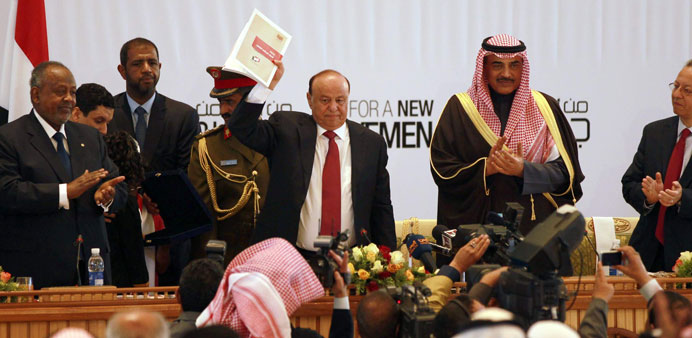
Yemen’s President Abd-Rabbu Mansour Hadi shows the book of the national dialogue at the end of a conference aimed at drafting a new constitution and e