


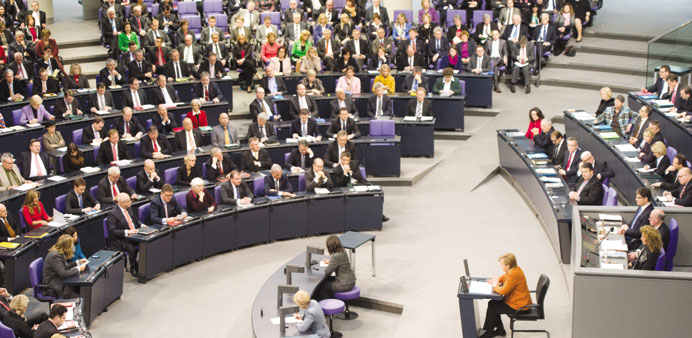
Merkel delivers her government policy statement to the German Parliament in Berlin. She delivered the policy statement seated due to injuries sustained in a skiing accident.
Chancellor Angela Merkel vowed yesterday to push through wage hikes for the low paid and boosts in pensions for elderly Germans over the next four years as well as tougher regulation of financial markets.
She was setting out in parliament the domestic and foreign policies for the next four years of her new, more leftist coalition.
She formed a coalition a month ago with the Social Democratic Party (SPD) after agreeing to soften previous policies of austerity.
Germany will impose a minimum wage of 8.50 euros ($11.60) hourly from the start of next year.
“I say with complete conviction, the advantages outweigh the disadvantages,” she said of the new policy.
In a nod to outraged conservatives who perceive the wage threshold as interfering with free enterprise, she urged employers to exploit an exemption for a further two years for lower hourly rates if they are regulated by collective labour agreements.
“Employers and unions have the freedom to make use of this wherever it helps to preserve jobs,” she said.
She also repeated a conservative mantra: “No tax increases, no new taxes.”
The chancellor said that Germany would crack down on employers staffing their factories with “temps” from labour agencies who are paid less per hour than the rates for regular workers governed by collective labour agreements.
In last year’s election campaign, which was dominated by demands to help low-income workers after years of austerity, the chancellor was embarrassed by allegations that carmaker BMW was using temps long term to cut its labour costs.
The chancellor said that Germany would oblige employers to pay temps the same rate as regular workers after nine months on the job and would outlaw the use of temps for more than 18 months in one position.
The more leftist flavour of her third chancellorship also came through in her defence of a policy to wind back the retirement age for millions of manual workers to 63, while gradually raising the pension age of most others from 65 to 67.
The chancellor’s speech came after cabinet backed pension changes which are expected to cost between 9bn and 11bn euros a year by 2030.
The changes also call for an extra pension benefit for more than 9mn women whose children were born before 1992.
Merkel also came out strongly in her speech in support of a financial transaction tax, despite last year’s misgivings at the European Commission about its workability.
That tax is an SPD demand.
“More progress in regulation of financial markets is indispensable,” she said, saying that a “deceptive calm” in the world economy should not divert attention from the need to avoid a repeat on a world financial crisis.
On foreign policy, Merkel backed anti-government protests in Ukraine and told Kiev the door remained open to bring the Ukraine into an association agreement with the European Union, as the protesters demand.
She conceded Germany and the US remain “far apart” in negotiations to limit electronic surveillance.
Merkel, whose own mobile phone was reportedly bugged for years by the US National Security Agency (NSA), said that spying by the US and Britain went to the core of “co-operation between allied states”.
In her speech ahead of talks with US Secretary of State John Kerry tomorrow, Merkel said that Western powers sacrificing freedom in the quest for security were sending the wrong signal to “billions of people living in undemocratic states”.
“Actions in which the ends justify the means, in which everything that is technically possible is done, violate trust, they sow distrust,” she said. “The end result is not more security but less.”
“Is it right to act this way because others in the world do the same?” she added before also touching on alleged British spying at international talks.
“Is it right if in the end this is not about averting terrorist threats but, for example, gaining an advantage over allies in negotiations, at G20 summits or UN sessions?
“Our answer can only be: No, this can’t be right. Because it touches the very core of what co-operation between friendly and allied countries is about: trust.”
She insisted that the “force of argumentation” was on Germany’s side in the dispute.
But Merkel said she would not be calling off EU negotiations with the US on a free-trade agreement in protest.
“Sulking doesn’t help,” said Merkel, who has rejected calls to invite US whistleblower Edward Snowden to Germany to testify about the surveillance. “Other levers that have been recently proposed to force America to change its mind do not in my opinion really exist.”
Opposition leader Gregor Gysi, floor leader of the leftist Die Linke, immediately attacked Merkel.
“You say you are working with the force of argumentation, but that is far too little,” he said. Germany should cease its “submissiveness to the US”.
“Why don’t we expel people from this country who conduct surveillance from their embassy?” he said.
The chancellor, who grew up under communism in the former East Germany, reiterated that Berlin was now driving efforts for a European no-spying agreement and new rules to safeguard data privacy.
But she played down expectations for a similar deal with Washington, which has been reluctant to set a precedent fearing other countries would demand similar agreements.
“Many say the attempts for such an agreement are doomed to failure from the outset, an unrealistic endeavour. That may be,” Merkel said. “Certainly the problem won’t be solved by just one visit.”