


By Noimot Olayiwola/Staff Reporter
A food safety specialist has suggested appointment of a ‘person in charge’ (PIC) at all eateries, to implement safety measures.
Speaking at a seminar in Doha yesterday, Richard Sprenger, chairman, Dubai-based Highfield Awarding Body for Compliance (Middle East and Asia), said that it was important for food outlets to elect a qualified PIC who will be in charge of implementing the food safety guidelines, besides co-ordinating with enforcement officers.
While relating experience from Dubai, he said that any PIC must be qualified having passed the internationally recognised food safety examinations level 2 or 3 valid for five years.
He said PICs must know the rules associated with their business besides ensuring that business maintains policies and procedures.
“PICs must also ensure that food handlers are trained about hygiene before they start work. They must also ensure that their food suppliers are registered and approved by appropriate authorities in order to trace the origin of any food contamination,” he added.
However, he maintained that implementing food safety procedure does not save money; rather it costs businesses more money.
“It costs money because you’ll have to pay for everything to do with it, including training, cleaning, maintenance, pest control,” said, adding that implementing the safety programme properly can protect businesses from
closing down.
“I know that people will go to somebody and they’ll say implement HACCP (hazard analysis and critical control point) and you’ll save money. But from my experience, you don’t save money by implementing HACCP because it costs money to implement it,” he pointed out.
HACCP is a management system for food safety through the analysis and control of biological, chemical, and physical hazards from raw material production, procurement and handling, to manufacturing, distribution and consumption of the finished product.
Speaking about Qatar, he said: “The Supreme Council of Health and the municipality here are looking very carefully at what is happening all over the world, which is a really good approach to determine what is going to be good for Qatar. They’ll know what standards they want to achieve.”
“I am sure that Qatar is starting in the right way and I know that food safety is going to receive much more prominence in Qatar in the future. You can always learn from different countries and can generally improve on what the other countries have done.”
On the future of food safety, Sprenger added: “We are seeing an increase in food safety seminars being run in Qatar and I think that is important because you have to increase the awareness.”
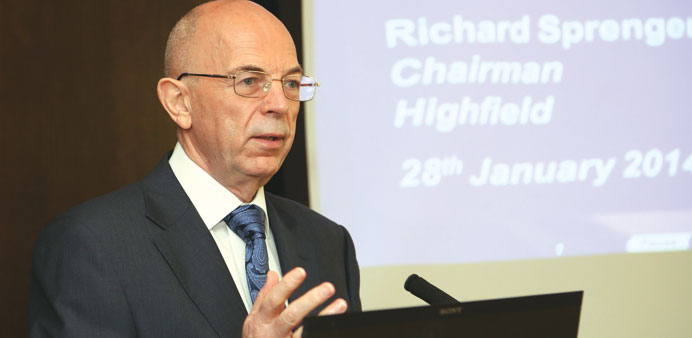
Sprenger making a presentation.