


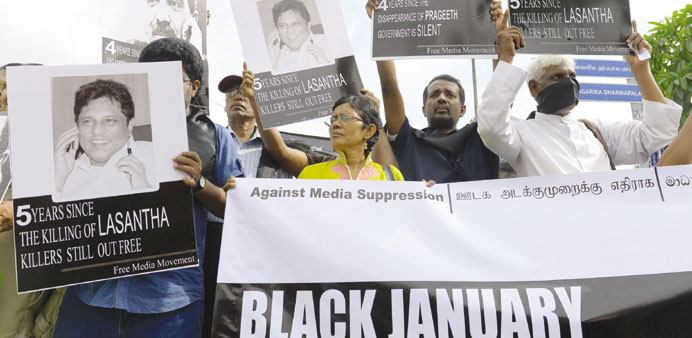
Activists from the Free Media Movement, Sri Lanka’s media watchdog, holding placards in Colombo yesterday. The activists marked ‘Black January’ when most of the attacks against journalists have taken place over the years.
An international inquiry into war crimes in Sri Lanka would bring “chaos,” and the government’s national reconciliation process must be given several more years to work, a top aide to Sri Lanka’s president has said.
Lalith Weeratunga, in Washington to lobby against calls for such an inquiry, said on Monday that Sri Lanka needed at least five years from the July 2012 date the government regards as the start of its reconciliation process for the effort to take root.
“After 26 years of conflict ... we want to make it a sustainable peace. It’s a very delicate, delicate process. Reconciliation is not a task that can be achieved in a day or two,” said Weeratunga, who is secretary to President Mahinda Rajapakse and Sri Lanka’s top civil servant.
The final few months of Sri Lanka’s long civil war in 2009 were by far the bloodiest, and both the government and Liberation Tigers of Tamil Eelam (LTTE) rebels blame each other for the deaths of tens of thousands of mainly Tamil civilians during that period.
The United Nations has called on Sri Lanka to punish those in the military involved in atrocities, and US embassy officials in Colombo say Washington plans to introduce a resolution calling for an international investigation at the March session of the UN Human Rights Council.
British Prime Minister David Cameron said in November he would push for an international inquiry if Sri Lanka did not conclude an independent investigation by March.
US embassy officials say the United States will demand that the government investigate other abuses as well as alleged war crimes, including lack of progress in reconciliation, abductions of anti-government critics, attacks on churches and mosques and the media, and alleged restrictions on freedom of association and labor union activity.
But Weeratunga rejected the charges and said an international inquiry would only reopen old wounds, as it would require investigation of all those involved in the conflict, including former rebels and Indian peacekeepers as well as the armed forces.
“There would be huge chaos in the country ... armed forces that liberated the country from terrorism would again be put to a judicial test. That is really going to reduce the morale of the army. These are things that need to be considered very carefully,” he said in an interview.
“Why single out Sri Lanka for an international inquiry when ... other countries that have gone through more difficult issues are not be investigated?,” he asked.
“If there is an international investigation, the whole period has to be investigated - from the 1980s onward - which includes the two-year tenure of the Indian peacekeeping force, which will upset India, which will upset our relationship with India.”
Weeratunga said the government needed more time for its efforts to resolve land disputes, resettle people displaced by war and improve people’s livelihoods.
He also said the government was investigating 13,000 cases of missing persons, a task complicated by the unwillingness of countries like Britain to provide information on people thought to be living there.
Ten cases of attacks on churches and mosques were “being dealt with severely,” he said, but added it took time to probe cases where there was no evidence as to who carried
them out.
Religious leaders blame cops for rising hate attacks
Sri Lanka’s Buddhist hierarchy and other religious leaders accused police yesterday of failing to prosecute those behind a recent wave of attacks on Christians and Muslims.
A multi-religious group led by Buddhist monks said the country had failed to grasp the threat posed by hate speech and attacks because local media reports had not been “impartial or factual”.
“There is at present a public perception that such attacks are taking place due to failure of law enforcement authorities to take necessary action,” said the Forum for Inter-Faith Dialogue (FIFD).
“If unchecked, these alarming trends would cause immeasurable damage and drawback to the country.”
FIFD, which is backed by the highest levels of Buddhist, Hindu, Christian and Muslim clergy and is an initiative of former president Chandrika Kumaratunga, said it was asking for full implementation of the law.
The call came after a string of attacks against churches and mosques, some of them led by young Buddhist monks.
Videos shared on YouTube have shown Buddhist monks throwing stones and smashing a Christian prayer centre in southern Sri Lanka earlier this month while police looked on.
Monks were also caught on video camera last year smashing Muslim-owned businesses just outside the capital.
Mobs led by Buddhist monks had also attacked mosques and forced the closure of at least one Islamic prayer centre in the capital in August, fuelling international concern for religious freedom in the majority Buddhist nation.
The country is emerging from nearly four decades of ethnic war which according to UN estimates claimed at least 100,000 lives between 1972 and 2009.
The United States in March last year initiated a UN Human Rights Council resolution against Sri Lanka over alleged war crimes against Tamil Tiger rebels in May 2009. It also urged Colombo to ensure religious freedom.
Seventy percent of Sri Lanka’s 20mn people are Buddhists, while Muslims are the second-largest religious group making up just under 10%.
President Mahinda Rajapakse, who is also a Buddhist, warned monks in January last year not to incite religious violence.
However, police broke up a protest denouncing religious extremism last year, sparking opposition allegations that the government was tacitly supporting the violence.