


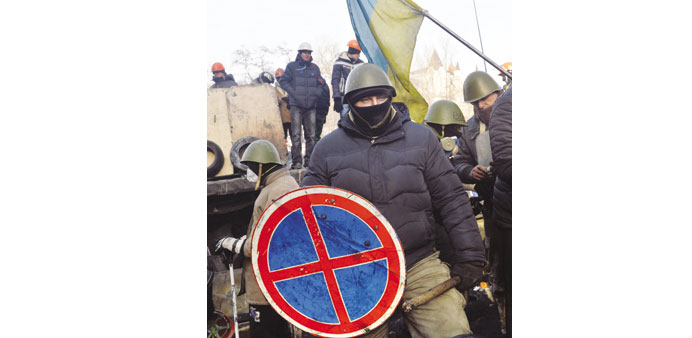
An anti-government protester with a road sign as a shield guards a barricade in central Kiev yesterday.
Ukraine’s justice minister has threatened to press for a state of emergency if protesters did not vacate a ministry building they occupied overnight in the third such action in street protests against President Viktor Yanukovych’s rule.
A state of emergency would limit movements of people and vehicles, ban rallies, marches and strikes, suspend the activity of political parties and introduce a curfew.
However, Foreign Minister Leonid Kozhara told reporters yesterday: “Today we are not considering the introduction of a state of emergency. Today, this measure is not on the table.”
The Ukrainian parliament was due to meet today to discuss concessions proposed by Yanukovych, in a highly anticipated extraordinary session that could be a make-or-break moment to resolve the stand-off.
With concern growing in the West that the situation in Ukraine was spiralling out of control, the country’s worst crisis since independence was also set to dominate an EU-Russia summit today.
The protests, which began in November as a drive for EU integration after Yanukovych ditched a key deal with the bloc under Russian pressure, have now turned into an all-out uprising to unseat him.
Amid a febrile atmosphere in Kiev, the Dzerkalo Tyzhnia news website reported the cabinet was preparing a decree for a state of emergency which would restrict movement on some Kiev streets.
Tensions remained high in Kiev after several dozen radical protesters seized control of the justice ministry late on Sunday.
Justice Minister Olena Lukash, who is taking part in the negotiations with the opposition, said that she would ask for the talks to be broken off if the building was not freed.
If the protesters do not vacate the building, Lukash said that she would also approach Ukraine’s national security council with “a demand to discuss imposing a state of emergency in this country”, Lukash told Ukraine’s Inter channel.
After occupying the premises for over 12 hours, the activists walked out of the building but dozens dressed in battle fatigues still blocked the front entrance, an AFP correspondent said.
Opposition leaders said in a joint statement that they were still open to negotiations “despite an attempt by the authorities to abandon the negotiations and declare a state of emergency”.
The statement confirmed the justice ministry building had now been emptied of protesters, whose action had been seen as a dangerous provocation by many within the mainstream opposition.
The occupation of the justice ministry building was the third such action in four days.
Protesters occupied the agricultural ministry on Friday and only agreed to leave the energy ministry which they entered on Saturday after the minister warned their action could disrupt energy supplies in the country.
Protesters now control much of the city centre of Kiev around a hub on Independence Square, with their camp protected by barricades several metres high and guarded by activists dressed in balaclavas and armed with baseball bats.
Ukraine announced yesterday that it would draw on another $2bn of credit – adding to $3bn already received for purchase of a bond – from a $15bn bailout package offered by Moscow after the former Soviet republic walked away from the EU deal.
But though the Russian aid package will help Ukraine handle $8bn of foreign debt this year and boost depleted reserves, this does not seem to be impressing thousands on the streets who are pressing for hard political concessions from Yanukovych.
The rebellion has now spread well beyond Kiev, with protesters occupying regional administrations in all but one region in the west of the country which has traditionally been anti-Yanukovych.
But most worryingly for the president, protests have swept to the country’s east and centre, usually considered more his heartland.
Protesters have now blockaded or attempted to blockade 14 of the 25 regional administrations across Ukraine.
However, the security forces appear to have been fighting back in the east, using force to disperse protests in the regional centres of Dnipropetrovsk, Cherkasy and Sumy and arresting dozens, local media reports said.
Under unprecedented pressure, Yanukovych on Saturday offered the opposition posts in government including that of prime minister, but his opponents said the offer fell short of their needs.
Yanukovych proposed sharing leadership with Fatherland party chief Arseniy Yatsenyuk as prime minister and UDAR (Punch) chief and world boxing champion Vitali Klitschko as deputy prime minister.
Klitschko, who is believed to have a personal rivalry with Yatsenyuk, condemned the proposal as a “poisoned offer” in an interview with German newspaper Bild am Sonntag.
Yanukovych’s office has also said that the president is willing to consider constitutional changes to reduce his power and return to a system according more authority to the prime minister.
A crucial day in the stand-off is expected to come today when parliament meets in an extraordinary session to debate and possibly pass some of the changes offered by the president.
“Yanukovych this week will be more inclined to negotiate as he is getting weaker and the protesters stronger,” political analyst Yevgen Glibovitsky wrote in a column for online newspaper Ukrainska Pravda.
The parliament session also coincides with an EU-Russia summit where President Vladimir Putin will be hosted by European Council president Herman Van Rompuy and European Commission head Jose Manuel Barroso.
The meeting – already shortened to less than three hours – is expected to be shadowed by tensions over Ukraine, with Moscow slamming protesters as extremists but the West worried about police violence.
In a statement yesterday, the European Union stressed that an end to human rights violations by the government “was a prerequisite for the restoration of trust”.