


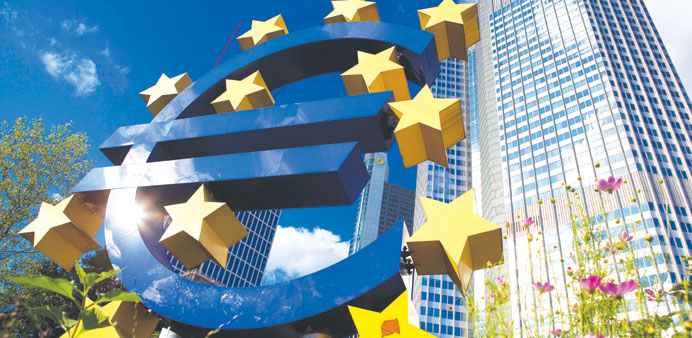
The headquarters of the European Central Bank stands beyond a euro sign sculpture in Frankfurt. The Bundesbank said it expected economic growth to pick up between January and March as the industrial sector gains traction.
Reuters/Berlin
German business morale hit its highest level in 2-1/2 years in January and the Bundesbank said growth in Europe’s largest economy would accelerate in the first quarter. The Munich-based Ifo think tank’s closely-watched business climate index, based on a monthly survey of some 7,000 firms, rose for a third straight month to 110.6.
That was more than a full point higher than the December reading of 109.5, above a Reuters consensus forecast for 110.0 and the highest reading since July 2011.
Ifo economist Klaus Wohlrabe said the strong survey suggested the German economy could grow by 0.5% in the first three months of the year, roughly double the rate expected for the fourth quarter.
“January’s Ifo survey suggests that the German economy has started the new year with a reasonable amount of momentum,” said Jonathan Loynes, Chief European Economist at Capital Economics.
In its monthly report, the Bundesbank said it expected economic growth to pick up between January and March as the industrial sector gains traction. It pointed to strong improvements in both the export and production outlook.Surveys last week showed the German private sector growing at its fastest pace in more than 2-1/2 years and investor morale staying close to its highest level in nearly eight years, boding well for the first quarter.
But economists warned that the economy’s performance last year was not as strong as “soft” privately-produced survey evidence would have suggested.
“The small growth conundrum of the German economy continues. While soft indicators remain buoyant and both consumer and business confidence are close to all-time highs, hard data has been lagging behind and still is,” ING economist Carsten Brzeski said. Still, the latest hard data has shown increases in industrial output, orders, exports and retail sales.
While Germany was a growth locomotive in the early years of the eurozone crisis, its performance has tailed off over the last two years and it only managed an expansion of 0.4% in 2013, its weakest performance since the global financial crisis.
But economists predict gross domestic product (GDP) will increase by around 1.7% this year thanks to strong domestic demand while exports are also expected to pick up. Berlin is considering raising its forecast to 1.8% from 1.7%, a German magazine reported at the weekend.
The Bundesbank said GDP likely increased “very strongly” at the end of the year thanks to growing domestic demand, stronger appetite for German goods from abroad and support from the industrial sector. The Ifo survey showed firms were more optimistic about their future prospects than they have been in nearly three years and were more upbeat about their current business situation.