


By Anand Holla
As Doha leaps into the winter morning in a gush of shiny cars that zip past imposing glass façade buildings, a bunch of archaeologists huddle around a huge trench in the heart of the city, eager to unearth the Black-and-White era. Brimming with childlike enthusiasm, they use shovels and trowels to time travel and understand a nation’s past.
Overseeing the digging activities with an easy air of authority is Dr Robert Carter, a senior lecturer in archaeology at University College London Qatar (UCL-Q).
“As soon as we get below the plastic and wire, we know we have reached the 1950s,” he says, pointing at a two-metre-deep trench, lined by stone walls. In fact, the trench holds a series of such walls of 19th century stone buildings, which were part of the walled town that Doha then was.
“If you look deeper, there are ovens older than these walls. They point to an earlier time,” Carter says, offering a skeletal glimpse into how Qatar’s first inhabitants lived, around 150 years ago. “Beneath these walls, the marks left by postholes tell us that the first occupation of Doha was made of palm front buildings – wood and palm front structures.”
Sitting around what once were a courtyard and a row of rooms, the archaeologists remove layers of earth separately, so as to relate them to the walls and estimate their age.
We are in the oldest part of Doha, a vast stretch of barricaded land next to Qubib mosque at Souq Waqif, where the Qatar Museums Authority (QMA) is working on a joint project – The Origins Of Doha – with UCL-Q.
Supported with 876,000 US$ from the Qatar National research Fund, the “rescue excavation” aims to explore the foundation and historic growth of Doha, its transformation to a modern city, and its people’s lifestyles, before Qatar Rail builds a metro station on a good part of this stretch. Carter, who heads the project, says they have uncovered a wealth of information thus far.
“We have learnt a lot on how Doha’s people lived in the 19th and first half of the 20th century – what they ate, what kind of houses they lived in, what jewellery they wore, what they had to ship in from outside and what they could source locally,” he says. To figure out old Doha’s diet, economy, architecture and lifestyle, Carter’s team need to continuously hunt for multiple clues that could be buried in anything from weathered keys and coins to pieces of pottery.
Rummaging through broken tiles and ceramics in a tub, Carter says they are useful to trace the chronology.
“These must be the 1950s stuff,” he says in a flash, and then picks a broken spout, “This one’s the mouth of a sheesha.”
For Carter, who holds a PhD in Bronze Age Eastern Arabia and has prolific knowledge of Arabian archaeology and pottery, a thin stretch in the trench is the most fascinating.
“This would have been the alleyway, where they would throw the rubbish and heaps of new garbage would gather over the old. But that’s what we are interested in because these discarded items yield such valuable insight.”
Carter is aware that some of the findings may be obvious, like the fish bones say that the Qataris in the 1950s ate a lot of fish, while the glassware, pottery and wooden materials suggest they were imported from elsewhere.
“Actually, this is just the beginning of the unravelling. All these items of everyday life would be sent to the laboratory, where specialists will study them for months to figure out exactly how things changed through time,” he says.
But how did they know this particular location was an archaeological goldmine?
“To find a place where accessible archaeology has survived is the first challenge. We studied maps from the 19th century and aerial photographs from the 1940s and 1950s to identify precisely where the old town was located. We compared our chosen area with maps right from the 60s to the turn of the millennium. We then chose a spot where we were sure there have been old buildings, but no large, modern ones,” says Carter, “We have been extremely lucky that QMA and QRail have collaborated to allow excavation here.”
Given Doha’s relentless urbanisation, stumbling upon this piece of land has been especially fortuitous.
“You can’t do such archaeology in Dubai, Kuwait, or Abu Dhabi as the original towns have been destroyed, and towers have sprung on them. Here, however, the footprints of the old town still exist,” says Carter.
Well, almost. Metres away from the trenches that QMA and UCL-Q are working on, a few modern buildings have been built and razed down. In fact, in 2006, giant crunching machines reduced a building, which stood next to the trench, to rubble.
However, Carter’s experience informs him that even when an area is flattened, the archaeology survives.
“The old gets buried… it’s a process of burial. When a house collapses, it lays down a layer of rubble which protects the foundation. Someone else builds on top of that debris, and that structure collapses, and so on. That’s why in archaeological sites, we find a sequence of structures. Even the process of demolition leaves a layer underneath. So we are essentially going through layers of semi-collapsed buildings,” Carter says.
Unearthing one such layer – which appears charred due to burning – can unfold a lesser-known story.
“In 1867, I believe Doha was attacked by Bahrain and Abu Dhabi, burnt down, destroyed and then rebuilt. These blackened layers may relate to that event,” Carter says, calling attention to the blackened chunks of soil that lay at the bottom of the pit.
This may also explain Doha’s history of being a “walled city,” referring to the walls it had built around itself to save itself from Bedouin raids, and attacks by Sheikhs and the British Navy. In fact, the 19th century Doha had only two towns – Doha, and the older Bidda.
Qatar’s troubled past meant that it couldn’t maintain rich historical documentation, like say, Bahrain. Carter explains, “Qatar’s rulers weren’t successful at minimising foreign interference. In the 19th century, the British never established a base here, and the Ottoman Empire’s presence was also weak. Even when the British returned during the early 20th century, there was no British administrative presence, and few foreign visitors. Things began to change in the 1930s when the oil companies first arrived.”
When oil exports began in full swing in the 1940s, Qatar began to expand from where it had left off during its peak years of pearling, and has only prospered ever since.
“Qatar rapidly advanced and became more international in the 1950s. The result is that the western archives have very few historical documents of the pre-1950s that pertain to administrative and economic records,” says Carter, underlining the importance of a project like The Origins Of Doha.
Among some of Carter’s archaeology students at UCL-Q who have been working on the site, Shaima Sherif has been live-tweeting cool finds and Eureka moments via the popular handle @WeAreQatar and her personal account. “To me, doing this was important as not only was I learning new things about Qatar’s past as we excavated them, but so was the community,” Sherif says.
Although Qatar has gone through a sea change of modernisation, the Qatari society endures and today’s Qatar is shaped by many of the same values, Carter feels.
“Kinship and family remain paramount, while business and merchant activities are highly valued. Qatari families still like to live in a walled family compound, even if these compounds’ size, design and location have changed. The distinct touch that the gateways into today’s Qatari house compounds have is unique to the nation’s traditional architecture. Although the diet has been supplemented by food from all over, I think the food eaten by Qatari families is pretty much the same,” says Carter.
Towards the end of our walkthrough, Carter gets a phone call that breaks to him the news he has been waiting for. “So we’ve got one month’s extension,” he beams.
The QMA team, headed by Faisal Al Naimi, Head of Archaeology Section, and Dr Ferhan Sakal, archaeology consultant, shares Carter’s excitement.
Dr Sakal says this is the “perfect place” to trace the beginning, and settling of people in Doha. “Day by day, such archaeologically rich land is disappearing into buildings and roads. If there’s any possibility of uncovering Qatar’s history, then that’s here,” he says, of the team’s last-ditch effort to fully puzzle out Qatar’s origins.
Even Sakal has been surprised with the results. “We have found more than we expected, and in Doha, this is the first large-scale excavation that has helped us recreate the outline of the city this once was,” he says.
Once the findings are tabled, Sakal says they plan to publish it and use the information in other projects. “We must document it, so that when all this is lost, it isn’t lost forever.”
Carter couldn’t agree more. It’s not as if his passion to scoop out the past has blinded his objectivity.
“I’m not against development, and we must accept change. Would you rather live in a modern building, or a small mud-walled house with no air-conditioning and no running water? That said, I believe that some traditional buildings and districts should be preserved, to enrich modern society and so that we understand where modern society has come from. Also, if old buildings or archaeological remains are under threat of destruction, then they should be fully documented before they collapse or are destroyed.”
Dr Robert Carter
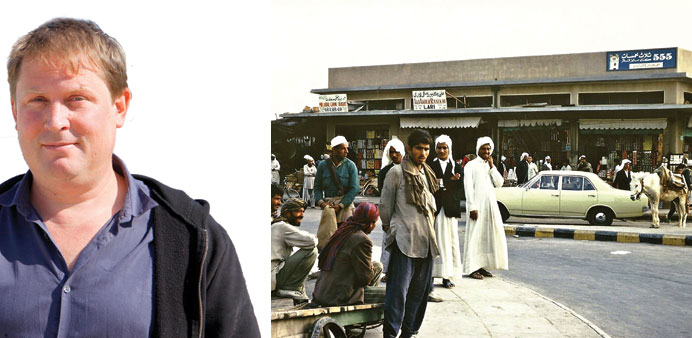
Dr Robert Carter. Right: BLAST FROM THE PAST: Souq Waqif as it was in 1967.