


Reuters/Hong Kong
Trade finance in China’s yuan currency may become a deciding factor in London’s favour as more European cities battle to capture the growing offshore yuan business outside Asia.
As a latecomer to the yuan party for a patchy two years, London’s slow pace to accumulate yuan deposits, a common parameter to evaluate the progress of a yuan centre, has raised doubts about its capacity to win market share.
Luxembourg is currently Europe’s leader in yuan bonds, funds and loans, with the largest pool of yuan deposits in the region and 40 yuan bonds listed on its stock exchange.
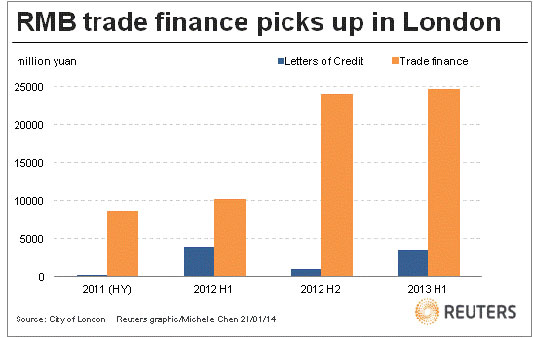
But the latest report by the City of London reveals some statistics showing the world’s biggest foreign exchange hub has taken giant strides in yuan trade finance, a subject which is at the core of expanding the “redback’s” footprint in global trade. Total trade finance denominated in yuan, including letters of credit and import/export financing, amounted to 27.9bn yuan ($4.61bn) in the first half of 2013, more than double that of a year earlier.
While that amount may be paltry compared to the monthly trade volumes of nearly 450bn yuan that pass through Hong Kong’s ports, the rate of growth shows increasing desire for global companies to adopt the yuan in international trade.
It is in line with results from global transaction services organisation SWIFT. The yuan overtook the euro in October to became the second-most used currency in trade finance, with a market share of 8.66%, compared with 1.89 in January 2012.
That rapid growth is mainly due to fast expansion of cross-border payments in yuan by companies, especially those from China, where yuan trade settlement now accounts for more than 20% of total trade.
“We see a lot of demand from clients who are interested in yuan trade finance as they do not want to take foreign exchange risks,” said a banker involved in yuan business at a Chinese bank in Hong Kong. For companies with operations in China, yuan loans taken in offshore markets are attractive as they are much cheaper than those obtained onshore, and even competitive compared to dollar loans if hedging costs are added to the latter.
Bankers said one-year offshore yuan loans could be priced as low as 3%, while those in China can easily be double that level, if not more.
Liquidity remains tight in the mainland money market after two cash squeezes the central bank engineered in June and December to discourage banks from riskier lending. The elevated funding cost is expected to continue as Beijing accelerates to reform its domestic financial market.
That in turn is likely to push more companies to raise funds outside of China by way of trade finance or bonds. Indeed, the dim sum bond market already saw a boom of issuance at the beginning of the year.
New issuance of yuan bonds in Hong Kong has amounted to 28.7 billion yuan so far this year, up 12% from January last year, according to Thomson Reuters statistics.