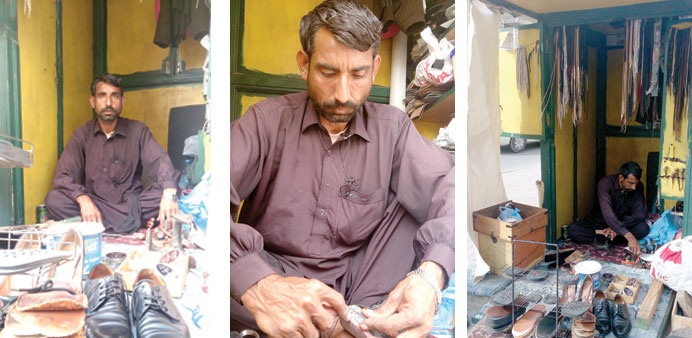
CONTENT: Muhammad Nawaz in his little cabin in Najma. LABOUR OF LOVE: Nawaz begins work for the day. He is the happiest when he sees his clients walking out with a smile.Photos by the author.
By Umer Nangiana
With his head down and eyes fixed on footwear shifting swiftly in his hands, Muhammad Nawaz keeps moving cord in and cord out, putting stitches to dozens of broken shoes all day long.
The cobbler, stationed at a busy intersection in Najma, has no time for leisure. He is following a dream, after all.
In the remote under-developed village of Pakistan’s Balochistan province from where he comes, survival comes first. Finding daily bread and butter can be a bit of a challenge. In such a scenario, even thinking of educating one’s children can be daunting.
Nawaz however, intends to put at least one of his children into school, a luxury not everyone can afford in his part of the world.
Determined to save his two daughters and two sons from the fate of ‘the shoemaker’s children going barefoot’, Nawaz left his home in Paro village, Kalat district of Balochistan, three years ago for greener pastures. He found one in Doha.
“I wanted my sons to get quality education but we have no schools in our village,” the shoemaker tells Community. “Soon I would be able to save enough money to send my younger son to school in a nearby town,” Nawaz adds, his eyes glistening.
His eldest son is 14 years old and currently, attending a seminary in his village where he is learning Qur’an. The seminary does not offer any formal education but Nawaz had no other option but to put him there. “He would become a Mualim and teach Qur’an to others,” the shoemaker says. The boy is perhaps, already too late for schooling.
His other son still has time. He is not of school-going age yet but his father is all prepared to put him into school as soon as he comes of age. The nearest school is in Sohrab town, a few kilometers from his village. It requires daily commute to and from the school for which no suitable transport is available except for bicycles — if one could afford.
With his previous dismal earnings back in his town three years ago, it was impossible for Nawaz to send his son there. Now, he “could think about it.”
The shoemaker sits in a wooden cabin behind a pile of broken shoes, damaged suitcases, and hand bags with multiple types of shoe laces hanging over his head. He keeps his tools ready under his right hand.
From stitching broken and damaged shoes and fixing rubber soles to worn out footwear — making them look like new, Nawaz does it with skill, even polishing them. He is particularly good at fixing shoes with broken soles.
“People come to me with shoes in their hands and walk away wearing them, with a smile on their faces,” Nawaz says, wearing a smile of his own just at the thought. He is proud of his work and quite content with his earnings.
“Work here is good. I earn more than a thousand riyals a month,” said Nawaz. A regular stitch to a shoe earns him QR5 and he charges QR25 to QR30 for sole-making and fixing the inners in fancy shoes. He guarantees quality and perfection to his customers.
But he has to give QR3000 to his employer at the end of every year. His customers mostly include expatriates from Bangladesh, Pakistan, India and Philippines apart from the locals.
Nawaz cuts his expenditure to the maximum, sharing a room with four other Pakistani expatriates that costs him QR200 a month. He cooks his own food and saves as much as possible to send back to his wife and children.
He gets all the raw material such as cords, laces, leather, glue, ready-made rubber and leather soles he needs from the whole sale shops in Souq Waqif. It comes cheap, he says. Almost all of the material comes from Pakistan.
He uses a particular technique of bonding a sole cut out of a special kind of rubber mat to give the shoes a longer life. “People also get it for their new shoes. It makes walking comfortable and saves the original sole from getting damaged with everyday use,” Nawaz says, while working on one such order from a client.
Random migraine bothers him sometimes. It unsettles his budget almost every other month. A visit to the doctor and the pharmacist costs him QR150 at minimum.
What causes him the killing headaches, he does not know. But he is constantly worried for the safety of his children back home in Balochistan where law and order situation is getting worse every passing day.
He cannot, of course, bring them all to Doha in his current situation. It costs a lot of money and to save that much is not possible for Nawaz. “The agents take Rs50,000 at least for a single visa and I have so many people in my family,” he says, with a choked voice.
It is for his family’s survival in the harsh economic conditions and his children’s future that Nawaz is compelled to stay away from his loved ones for extended periods of time.
He cannot go back to Pakistan to see them before a year or sometimes even one-and-a-half years. That is however, down to circumstance. He cannot afford air travel. Whenever he is able to travel, he prefers Qatar Airways over other carriers for it operates direct flights to Pakistan.
Last year, he stayed with his family for more than two months. “I went for the first Eid and returned after the second,” he says. “It is all about money. You can stay idle for as long as the savings last,” the cobbler, adds with a smile.
Why education only for boys and not girls? Nawaz says it is not possible with his resources. The girls are also learning Qur’an at home. “I cannot send the girls to far off places and there are no schools for girls nearby,” he says, a wee bit dejectedly.
Nawaz is a typical example of someone from a remote under-developed area of a volatile region, who earns livelihood for the entire family of 10 or more. Besides his immediate family, he has to provide for his brothers and sometimes, even their families.
“My brothers are in Balochistan and finding work there is not easy these days,” he says.
From where he sits, Nawaz watches dozens of workers wearing uniforms and helmets disembarking busses every evening. These busses from different government and private companies drop hundreds of workers daily at the intersection, right in front of Nawaz’s cabin.
He dreams of seeing his son amongst them one day.
He plans to continue working until his sons complete their education. For his younger son, he wants to see him disembarking the same bus wearing the uniform.
“My son would be able to join some good company when he is educated so then I would bring him to Qatar,” says the father.
Despite his earnings, Nawaz does not want him to join his profession. He does not know if and when he would be able to see his son go to school but he has a dream, and his spirits are high.
To achieve the goal he has set out for himself, he pulls the shutters down at his shop only after a full day’s labour. He is confident that one day, in the not-so-distant future, it will pay.