


|
Ukrainian police stormed protesters’ barricades in Kiev yesterday amid violent clashes where two activists were shot dead, the first fatalities in two months of anti-government protests. |
The medical centre of the protest movement said however that five activists had been killed, and some 300 wounded.
“As of now, five people have been killed. Around 300 were wounded today from midnight,” Oleg Musiy, the co-ordinator of the medical service, told pro-opposition Hromadske radio.
According to the Ukrainska Pravda news website, four of the five people found dead had gunshot wounds.
City health officials said the victims’ wounds were most likely caused by airguns.
Riot police had been firing rubber bullets on protesters, but yesterday journalists posted online photos of what looked like metal bullets.
No figures of the injured were published yesterday, but health officials had put them at more than 200 on Tuesday.
Police said yesterday that 195 officers had been hurt since the violence began Sunday and 84 of them had been hospitalised.
Pitched battles raged in the centre of the Ukrainian capital as protesters hurled stones and Molotov cocktails at police and the security forces responded with tear gas, stun grenades and rubber bullets.
The bloody clashes marked a new peak in tensions after two months of protests over the government’s failure to sign a deal for closer integration with the European Union under Russian pressure.
The epicentre of the clashes was Grushevsky Street in the city centre which has been the scene of three days of street battles between thousands of protesters and similar numbers of security forces.
Using tear gas and stun grenades, police initially pushed demonstrators back well beyond their initial lines by marching forward in military formation.
However, the protesters then regrouped, creating new barricades out of burning black tires whose rancid smoke filled the skies above Kiev and flames burned in near-apocalyptic scenes.
The protesters fought back in intense clashes, with casualties seen being loaded into ambulances.
Police for the first time started moving an armoured personnel carrier towards the protesters after storming the barricades.
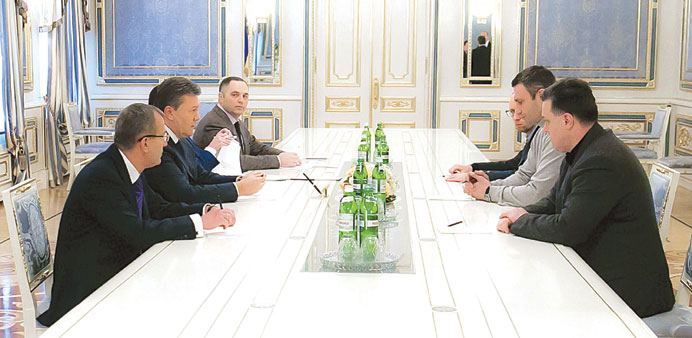
Yesterday Ukrainian President Viktor Yanukovych met with opposition leaders, including former world boxing champion Vitali Klitschko, in a meeting that has gone on for several hours but whose outcome is unclear.
Yanukovych earlier urged protesters not to follow “political radicals” and said he wanted to halt the “bloodletting”.
Showing no mood for compromise, Ukraine’s Prime Minister Mykola Azarov labelled the radical protesters behind the clashes as “terrorists”.
He then headed to the World Economic Forum in Davos.
Amid fears that the police would soon launch a new assault, the government gave the police special permission to use water cannon and more powerful stun grenades.
Shops on Kiev’s main Khreshchatyk Avenue close to the protests received orders to close for the day from the local authorities.
Meanwhile, thousands filled Independence Square in Kiev which was the main protest hub for the last two months, hoping their sheer numbers would deter further action.
The deadly violence horrified Ukrainians, who have never witnessed such scenes in their country including during the 2004 “Orange Revolution”, which was almost entirely peaceful.
Amid growing international concern, EU foreign policy chief Catherine Ashton urged “an immediate end” to the escalating violence.
European Commission president Jose Manuel Barroso warned the authorities yesterday that the EU executive would assess “possible actions” against the Ukrainian authorities (
The United States also revoked the visas of several Ukrainian nationals linked to violence against protesters in November and December last year, the US embassy said in a statement.
But Russia, which has regarded Ukraine’s pro-EU protest movement with suspicion from the start, took a different view and blamed the opposition and West for the clashes.
“Ukraine’s legitimate authorities face outside interference in its internal affairs,” Russian Deputy Foreign Minister Grigory Karasin told Interfax, referring to EU and US statements. “The extremist part of the opposition is crudely violating the country’s constitution.”
General prosecutors confirmed earlier information from the protest movement that two activists had been shot dead, one of them with wounds to the head and chest.
According to the Interfax news agency, one of the dead was a Ukrainian of Armenian origin whose family had escaped the fighting in Nagorny Karabakh in the 1990s.
The other was reportedly a Belarussian national although this has not been confirmed.
Protesters claimed they were shot by police snipers.
The medical centre of the protest movement said a third activist was killed after falling from the top of the ceremonial entrance to Dynamo Kiev stadium adjacent to the protests. They later said two others were killed.
The protest movement said on Tuesday that some 1,400 people had sought medical assistance over “bullet injuries to the face” and other wounds.
With Ukraine supposedly celebrating its annual day of unity, Yanukovych earlier prayed for the country at a ceremony to mark the occasion, the presidency said.
The government is basing its actions on a new set of laws, which ban nearly all forms of protest in the ex-Soviet country and have enraged demonstrators.
They allow for jail terms of up to five years for those who blockade public buildings and the arrest of protesters wearing masks or helmets.
Meanwhile, a prominent Ukrainian activist and journalist, Igor Lutsenko, appeared in public yesterday after being abducted from a hospital by unknown individuals and dumped in a forest outside Kiev.
He had been taken from a hospital in Kiev, beaten, and eventually left in a forest by his abductors after an ordeal lasting almost a day.
Ukrainian news website Dzerkalo Tyzhnia said that two unidentified bodies had been found in the forest outside Kiev where Lutsenko had been taken after his abduction.