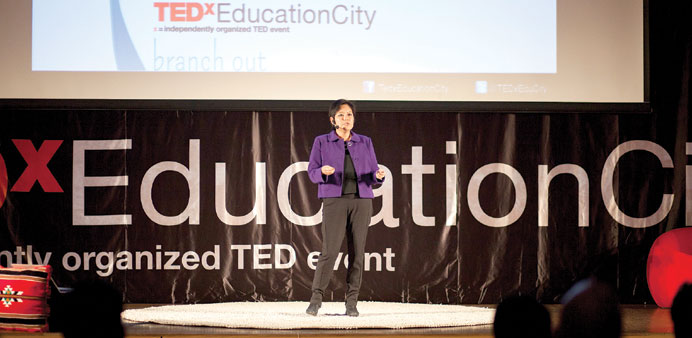
HOLDING HER OWN: Susan Pak speaking at the TEDxEducationCity conference.
By Anand Holla
The mere idea of branching out is a promising one, as it embraces change and strives for improvement. At the second edition of TEDxEducationCity conference, organised by Hamad Bin Khalifa University students on the weekend, the theme of “branch out” was heeded comprehensively, in letter and in spirit by the six speakers.
Bustling with young energy, the localised avatar of the famed TED (Technology, Entertainment, Design), which gets bright minds to give inspiring talks on “ideas worth spreading”, had an audience of 450 take continuous mental notes at the sprawling HBKU Student Centre Ballroom. The event ended with a Q&A session with the crowd.
Community cuts to the chase and gets you the lowdown on the evening.
Susan Pak
Ambling under the arc lights with a little pep in her step, the screenwriting professor at Northwestern University in Qatar demystified failure by asking us to befriend it. “The only way that I can talk about my diverse career path is, unfortunately, to talk about failure,” Susan Pak said, going on to explain how her concept of failure kept changing until she found her calling.
“When I was young, failure meant poverty. As a child of poor immigrant Korean parents in the United States, it wasn’t hard to see why. I thought; how could I go from poverty to wealth?” Pak did that by joining a law school and becoming an attorney.
For Pak, apart from failing grades and getting fired from her temporary job, failure also was watching her fellow associates “busily billing 2,000 hours a year” as she sat “helpless, hopeless and lost at my desk,” or being screamed at by her boss “about how stupid you are.” She said, “Failure was scheduling a time to cry, every night at nine and never missing a single appointment.”
Eventually, she landed a job in commercial real estate brokerage and did spectacularly well. “Now I had reached the pinnacle of success. My mother and I decided that I would stay at that job until I dropped dead.”
Turning her voice a shade grimmer, she said, “Then a decade passed. Then, really frustrating and strange things started happening. I had flexible hours and a fantastic boss, and yet I couldn’t get to work on time. Suddenly, my vision of failure started to change again, and this was the most frustrating yet.” Pak asked the audience to think what it was that they could do until 4am every day, without realising it?
“What about when you were eight? When I was in second grade, I won a contest for my self-illustrated short story. Then, I knew I wanted to be a writer. But I would not say it. At best, people would laugh at you, (saying) yeah, you and a million other people, right? So you keep it inside and deny it exists. And one day, that passion is gone,” she said.
Pak, who has been in Doha for four years now after taking the writing plunge, said that even today, when she wakes up, she can’t believe she teaches screenwriting. Her advice to realise your dream: “First; go out and get that job that you can brag about at cocktail parties. Second; pay off all your debts immediately. Third; practice your passion, every day, without fail. You don’t have to advertise it. Just do it because you must.”
Calling failure instructive and an ever-enlightening gift, Pak ended her talk with a compelling suggestion: “Plan to fail and embrace failure. Don’t be brainwashed by what you think you SHOULD do. Failure will guide you to that which you MUST do.”
Eyad Masad
If you needed a first-person account to endorse the rise and rise of Qatar, the talk by Eyad Masad, the Assistant Dean for Research and Graduate Studies at Texas A&M University at Qatar, should help.
“What’s happening in Qatar is motivating this return of brain to the Middle East, which is the opposite of the brain drain that we usually talk about,” said Masad, who was settled in the US until he moved to Doha in 2007. “Thanks to the emphasis on research and education in Qatar, we often meet highly qualified colleagues who decided to return after spending productive years in the West,” he said.
Masad’s friends in the US told him that moving to Qatar would be a “career suicide”. “You know where they are now? Most of them are here, in Qatar. In fact, my problem is how to keep them away so I can keep my job,” he joked.
But Masad isn’t blinded by optimism: “The actual challenge is to have these bright people stay here for the long-term.” To do that, Masad says we must make them think about careers, and not job and money in Qatar. “We must keep scientists, academicians and bright minds busy because regardless of how much money we throw at them, they will leave if they get bored. I guarantee money will not keep them; being busy in meaningful ways, and feeling productive will.”
To achieve success in Qatar, Masad believes we must establish a legacy and “not stop at making incremental changes to an already well-established system. We will make it successful because we cannot afford otherwise… and we are in it together.”
Omar Chatriwala
The origin of Doha News, Qatar’s first digital news service, was hidden in hashtags. Omar Chatriwala, journalist and the website’s co-founder, told the audience, “In 2009, Shabina, my partner in more ways than I can count, launched a Twitter account called @DohaNews. It had been around for a couple of years but wasn’t that popular in Qatar.” On that very social networking altar, it has 48,000 followers today.
Chatriwala said that they have been lucky to see Doha News evolve; from twitter to blog to website, and the popularity it has now attained. The real-time coverage on Twitter of the tragic Villagio fire of May 28, 2012, that killed 19, including 13 children, underlined the need to report breaking news stories in Qatar, Chatriwala said.
“People shared pictures and information with us, reached out to us, and we reached out to people who needed information. Had we been unable to communicate with our community, the story wouldn’t have been told in the depth that it was,” he said. Chatriwala, who moved to Doha from the US about seven and a half years ago, found journalism “different” here. “There is no real cultural transparency… of openness. You call somebody up and ask: Can you tell me more about this story? The answer will be no, I can’t, but next week I might be able to get you some comment, or maybe, next month.”
When you reach somebody willing to talk, they refuse to be named, he said. With the reporter forced to push his quotes under “unnamed source” tags, the story’s credibility and importance suffers, Chatriwala said. He also pointed out the vague boundary line that marks out the “culturally insensitive” stories and how doing stories against one’s advertisers is a strict no-no.
Referring to a recent study that said Internet was the foremost source of news for most of Qatar’s people, Chatriwala said, “This presents an opportunity as well… it means we have to adapt. Everybody’s connected… so you must engage and share what you know.”
Sara Al-Saadi
After showing the trailer of her documentary Bader, which has travelled to quite a few film festivals, young filmmaker Sara Al-Saadi explained why she and her friends decided to focus on education in Qatar. The 10-minute film is about how Bader, a student at an all-boys elementary school, uses poetry to overcome the challenges he faces there.
Al-Saadi said she was stunned by the school’s “dynamic environment.” “They were such smart kids, but also little devils. One kid stole my friend’s phone to save his number in it, so he could call her at night,” she said, as the crowd dissolved into laughter.
Addressing the inherent difficulties involved in building a dialogue with those concerned, Al-Saadi spoke about how one parent refused to allow his boy to be filmed since he felt that the film portrayed Qatar in a negative light.
Eventually, most of the boys they met failed their exams. “This just shows the extent of some of the problems that exist in these schools. It’s our responsibility to shed light on such issues. Not doing anything about them harms our society more than anything else. Even if some people don’t like the stories we tell, we must tell them,” she pointed out. Meanwhile, Bader, who passed his exams, became a local celebrity. Acknowledging the power of cinema, Al-Saadi said, “By branching out, doing projects outside of my comfort zone, I was able to not only grow but give someone the ability to tell their story and share their message.”
Mark Stehlik
Using the complex concept of fractal dimension to make his point meant that the computer science professor at Carnegie Mellon University in Qatar would start off throwing a lot of Mathematics at the audience.
Fractal dimension is a measure of how similar the object is to itself at different scales, or in simpler words, it tells you whether a chart resembles a one-dimensional line or a two-dimensional plane.
Referring to his decision to teach in Doha after teaching at the same university back in the US for more than two decades, Stehlik said interacting with students here has greatly enriched his personality: “Opportunities to grow and stretch always exist in your environment. It pains me to see Middle Eastern students sitting with Middle Eastern students, or western students sitting with western students. That’s wrong… not that you should stop being who you are. But you should find out how more similar these people are to you than different.”
Imploring us to burst “little bubbles of similarities” we create around ourselves, Stehlik said, “We create them because we tend to follow the path of least resistance… (we) surround ourselves with people who think, act, look, walk, and talk just like us. That doesn’t help you grow or to think.”
Stehlik pointed out that we learn the most when someone challenges us on something. “Then you need to justify it and justification is more interesting than knowledge. All this comes at a price,” he said, showing a picture of his wife and his adorable eight-month-old grandson, on the screen. Though Stehlik misses them sorely, he said staying in Qatar is still worth it “because it has stretched me in ways I cannot imagine.”
To conclude the talk, he returned to fractals. “How do you maximise your length versus your footprint?” he asked, wondering how our life’s fractal journey would look. “Do you want it to look like this,” he asked, pointing to a line, and then a square, “or that?” he asked, pointing to a multi-dimensional geometric pattern. “And THAT is absolutely within your control.”
Memoonah Zainab
Peppered with flowery poetry, young lawyer and community educator Memoonah Zainab’s talk encouraged the audience to “reinvite wisdom” into their lives through acts of service.
“What is wisdom and how to collect more of it? Some philosophers have defined wisdom as the understanding of causes. Knowing WHY things are a certain way is deeper than knowing THAT things are a certain way,” she said.
Showing a news photograph of an old man despairing over the loss of his family after an earthquake in Pakistan, Zainab said it reignited her drive to ask questions and offer help to those who need it. She said, “In our age, we all seem to know what is happening in our surroundings. But we have perhaps stopped asking why. In the process, are we losing wisdom or the road that leads us there?”
Zainab, a barrister, served her local community in UK by providing them free legal advice. “Initially, it began as a CV-enhancing experience. But I came into contact with some of society’s most vulnerable people, worked with refugees, the homeless, and victims of physical and other kinds of abuse,” she recalled, adding also of her mentoring secondary school students there. “Muhammad Ali (boxing legend) said that service to others is the rent you pay for your room here on earth. To me, this epitomises branching out. It’s about engaging in an experience that involves giving rather than taking. In return, we receive wisdom,” she said.
Zainab feels her experiences have helped her truly discover herself. “No matter how big or small, we all have many services to offer. My experiences have forced me to ask questions, about inequalities, social justice, poverty and most importantly, responsibility. To ask myself, what am I going to do about this?”