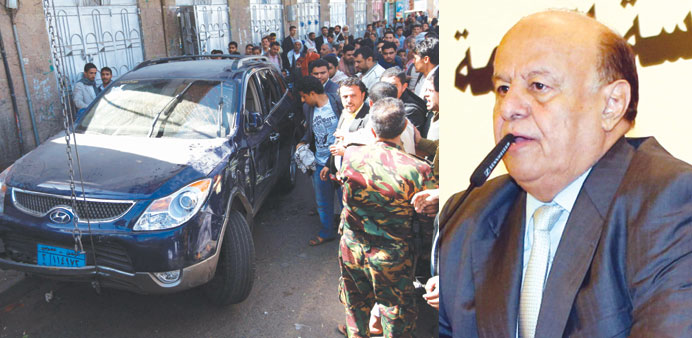
People gather next to the car of Ahmed Sharafeddin, who had been representing Houthi rebels at Yemen’s reconciliation talks, after gunmen shot him dead yesterday in Sanaa. RIGHT: Hadi speaks during the closing session of the national dialogue in Sanaa yesterday.
Reuters/Sanaa
Yemen’s political factions extended the president’s term by a year and approved a new federal system at the end of national reconciliation talks yesterday, a milestone in the troubled country’s transition to democracy.
Highlighting the security challenges facing Yemen, which is home to one of Al Qaeda’s most active branches, unknown assailants shot dead a leader of the Yemeni Shia Muslim Houthi group while he was driving to attend the final session of the talks.
Yemen has been torn by rising violence and lawlessness as the US-allied country struggles to overcome political turmoil after long-serving president Ali Abdullah Saleh stepped down following months of mass protests against his rule in 2011.
The nation’s political factions gave interim President Abd-Rabbu Mansour Hadi, whose two-year term had originally been due to end with elections in February 2014, an extra year after delays in the transition to democracy.
He will oversee a shift to a federal system intended to accommodate southern separatist demands for more autonomy. Southern separatists have been demanding to revive the state that merged with North Yemen in 1990.
The national reconciliation talks, launched in March 2013 as part of a Gulf-brokered power transfer deal, have been plagued by walkouts by politicians.
Hadi, who will head a special committee, was also tasked with the drafting of a new constitution within three months.
He was also mandated to reshuffle the cabinet and restructure the Shura Council, the consultative upper house of parliament, to give more representation to the south and to Shia rebels in the north.
Mindful of the challenges, Hadi told delegates:
“I did not take over a nation, I took over a capital where gunshots are continuous day and night, where roadblocks fill the streets. I took over an empty bank that has no wages and a divided security apparatus and army.”
“The national dialogue document (final communique) is the beginning of the road to build a new Yemen,” he said at the Movenpick Hotel on a hilltop on the outskirts of Sanaa where the sessions have been taking place.
Yemeni analyst Hatem Bamehrez said Hadi’s task was huge.
“If the dialogue took 10 months to complete, then implementation needs enough time and one year is not enough,” Bamehrez said, adding that shifting the major issues for Hadi to deal with later represented “a big danger” to the process.
Marring yesterday’s talks, Ahmed Sharafeddin, a Houthi delegate at the reconciliation talks who had served as dean of the law faculty at Sanaa University, was killed when gunmen in a speeding vehicle sprayed his car with bullets in central Sanaa, officials said.
They said he died instantly and the gunmen escaped.
It was not immediately clear who was behind the assassination, but another Houthi leader, Abdulkarim al-Khiwani, accused Sunni Muslim militants of carrying out the attack.
The Houthi group fought Sunni Salafis in northern Yemen from October until earlier this month, when a ceasefire was reached to relocate the Salafis to another city some 250km away. But clashes have continued in other parts of northern Yemen with tribesmen allied to the Salafis.
More than 210 people have been killed in the fighting that erupted in late October after the Houthis accused the Salafis of recruiting foreign militants in preparation to attack them.
The Salafis say the foreigners are students of Islamic theology.
Yesterday’s attack was the latest in a string of killings of high-profile Yemenis and foreigners. Last week an Iranian diplomat was killed in Sanaa when he resisted gunmen who were trying to kidnap him.