


Guardian News and Media/London
London’s reputation as a romantic destination for lovers of art and style will hang in the balance this Valentine’s Day, as the deadline passes for public responses to a scheme to safeguard the look and traditions of Mayfair and St James’s against the influx of rich foreign residents.
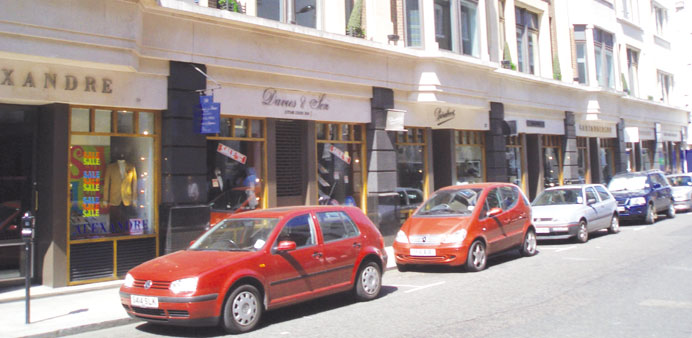
The two grand, chiefly Georgian-built areas of the capital are a big draw for tourists and daytrippers, fanning out around Cork Street, renowned for its art galleries and salesrooms, and around Savile Row, for many years the heart of Britain’s bespoke tailoring industry.
The quarter near Piccadilly and the Royal Academy of Arts has often served as a literary backdrop, featuring in the escapades of PG Wodehouse’s Bertie Wooster and, before that, in the works of Oscar Wilde and Arthur Conan Doyle.
But Mayfair and St James’s flamboyant character is shrinking due to high business rates and low commercial returns.
Alarm in the art world reached a new pitch in 2012, when seven galleries on Cork Street were given notice to leave their premises within a year.
Their landlord, the British insurance company Standard Life Investments, has since drawn up a £90mn deal with property developer Native Land for a development which would see 42 flats built above a shopping arcade.
Designed by Richard Rogers’s architectural firm, Rogers Sirk Harbour and Partners, it was approved in principle by Westminster city council last summer.
The plan does now offer some reserved space for commercial galleries, but the art dealers of Cork Street remain unsettled.
A second development on the other side of Cork Street proposed by the major Mayfair landlord Pollen Estate threatens the future of a further three galleries in 2015.
“I am an angry old man,” said veteran gallerist Leslie Waddington of Waddington Custot, who will be 80 next month. “Cork Street has been built up over the years and relies on a mix of different galleries. We are the victims of a kind of commercial fascism, where those making decisions based on profit feel they are unaccountable.”
There are thought to be 85 art dealers in Mayfair, with around 75 in St James’s, contributing more than £7.5bn a year to the economy and indirectly supporting tens of thousands of jobs.
Sir Norman Rosenthal, a former director of the Royal Academy, said that he fears for the character of central London. “The nature of these areas is changing, whether it is Savile Row or Cork Street. The point of Cork Street was that it offered quality British art, the best of the middle-of-the-road work, and that is important to the art trade and to the city.”
Recent figures point to a similar property development squeeze on creative industries in Soho and the West End, where the cost of office space for media companies has risen by 15% in the last year.
One of the seven Mayfair galleries directly affected by the Native Land development, along with French painting specialists Stoppenbach and Delestre and the bulldozed Alpha Gallery, is The Mayor Gallery, a saleroom that first established Cork Street as a centre for the art trade in 1925.
During a court battle with the developers last year, James Mayor pointed out that these galleries launched the careers of many great modern British painters. Mayor believes efforts to turn the area into a lucrative residential zone are “absurd”. “This part of Mayfair has not been residential for well over 100 years (unless you call brothels residential),” he objected last year in a high court statement.