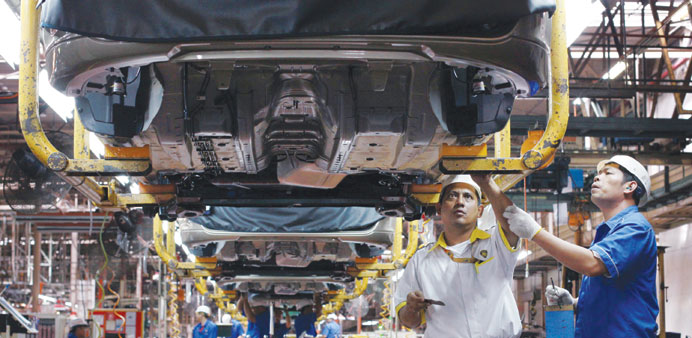
Employees at Proton Holdings work at the company’s factory in Shah Alam. Malaysia announced yesterday it would allow foreign automakers to build smaller passenger cars in the country.
AFP/Kuala Lumpur
Malaysia announced yesterday it would allow foreign automakers to build smaller passenger cars in the country, a liberalising move aimed at repositioning the country as a leader in energy-efficient vehicles.
The changes, effective immediately, will for the first time allow foreign automakers to build cars with engines of 1.8 litres or less if those cars qualify as energy-efficient.
Such projects will not need domestic investment partners and will enjoy incentives such as tax breaks, Trade Minister Mustapa Mohamed told reporters.
“The policies used to be there to protect (national car brand) Proton. But we have opened up the market,” he said.
“We believe these policies will enable Malaysia to regain our position as one of the most dynamic hubs for Southeast Asia.”
Malaysia, the region’s third-largest economy after Thailand and Indonesia, was once Southeast Asia’s automotive hub. But it has fallen behind its two rivals through decades of industry policies that coddled Proton, which was launched in 1983.
Malaysia now produces far fewer vehicles than Thailand or Indonesia.
The government had previously shielded Proton via excise and import duties of up to 150% on foreign vehicles, and other restrictions.
The policies have been blamed for contributing to sub-standard Proton models. The firm, which was state-owned until 2012, has recorded losses in recent years as its market share sank.
Consumers have also complained the policies made better-built foreign cars too expensive for many Malaysian buyers. Malaysia already allows foreign carmakers to manufacture larger vehicles in the country, after lifting foreign-equity caps on such ventures in 2010.
The reforms could be attractive to some foreign manufacturers looking for a regional production base but should not worry Malaysia’s neighbours much, said Affin Investment’s auto sector analyst Chong Lee Len.
“It’s a positive step for the market, but not quite a ‘Big Bang’,” she said.
In 2012, Thailand and Indonesia produced 2.4mn and 1.1mn cars under foreign nameplates, respectively, up 67% and 27% from the year earlier, according to the International Organisation of Motor Vehicle Manufacturers.
Neither country has a national car project. Malaysian factories produced 570,000 cars in 2012, up nearly 7%.
About three-quarters of Malaysian production were vehicles with 1.8-litre engines or smaller.
Madani Sahari, head of the trade ministry think tank Malaysia Automotive Institute, said in a briefing last week that Malaysia would focus on being an export hub due to slowing domestic sales.
Chong, however, said most manufacturers “want to build where they can sell”. Indonesia, with its fast-growing economy of 240mn people and low vehicle ownership rates compared to more affluent Malaysia, is considered by analysts to have greater upside for automakers.
Mustapa said the changes would reduce car prices in Malaysia by up to 20-30% over the next four years.