


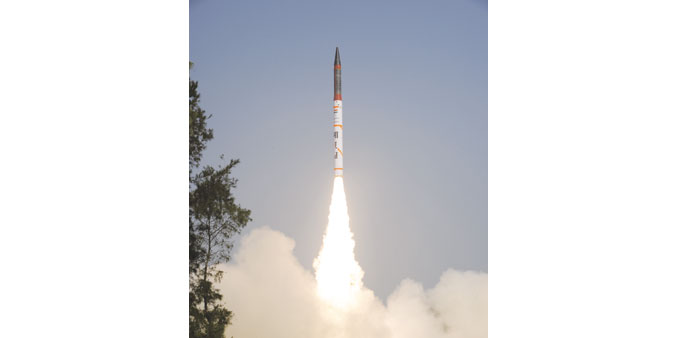
The Agni-IV missile lifts off yesterday.
India yesterday successfully tested its long-range, nuclear-capable, surface-to-surface Agni-IV missile from a military base in Odisha, an official said.
The new generation missile, with the capability to hit targets 4,000km away, was tested for its full range from the Wheeler Island off the Odisha coast near Dhamra in Bhadrak district, about 200km from the state capital Bhubaneswar.
The missile took off majestically, rose to a height of over 850km, covered the intended range in about 20 minutes, hit the target meeting all mission objectives.
“The test was a 100% success. It has met all mission requirements. It was a developmental trial by the DRDO. It was a pre-induction test,” test range director M V K V Prasad said.
The DRDO (Defence Research and Development Organisation) developed and tested the new missile.
The Agni-IV missile propelled by composite solid fuel rocket motor technology was launched from its road mobile launcher, DRDO spokesman Ravi Kumar Gupta said in a statement.
The long-range radars and Electro-Optical Tracking systems located all along the coast have tracked and monitored all the parameters throughout the flight.
Two ships located near the target point tracked the rocket and witnessed the final event.
Agni-IV is equipped with state-of-the-art avionics, fifth generation on-board computer and distributed architecture, he said.
It has the latest features to correct and guide itself for in-flight disturbances. The most accurate Ring Laser Gyro-based Inertial Navigation System and supported by Micro Navigation System, ensured the vehicle reached the target within two-digit accuracy, he said.
The re-entry heat shield withstood temperatures in the range of 4,000 degrees centigrade and made sure the avionics functioned normally with inside temperature remaining less than 50 degrees centigrade.
Agni-I, -II, -III and Prithvi are already in the arsenal of the armed forces, with a reach of over 3,000km and giving India an effective deterrence capability.
“The event is of greater significance since the system was tested in its deliverable configuration with the active participation of Strategic Force Command (SFC) personnel,” said DRDO director general Avinash Chander who commanded the launch sequence.
“The missile is now ready for induction and its serial production will now begin,” said Chander, congratulating all the team members from DRDO and SFC.
“Today’s launch takes India’s level of deterrence and its preparedness and effectiveness to newer heights,” he said.
Defence Minister A K Antony also congratulated the DRDO chief and his team on the success.
The 20m-tall missile weighs 17 tonnes and has two stages of solid propulsion. Considered to be one of its kinds in the world, the missile’s last test conducted from the same defence base on September 19, 2012, was successful.