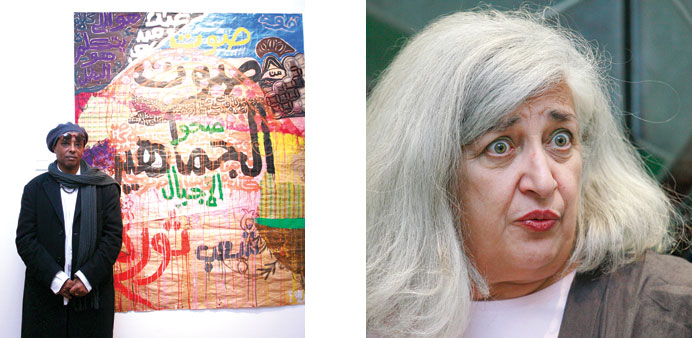
THE MAESTRO: Fathi Hassan standing next to one of his paintings on display at VCUQ. Right: MAKING A POINT: Rose Issa talking to Community.
By Anand Holla
Wrapped in a couple of jackets to beat the evening Doha chill, Fathi Hassan gazes at his mixed media paintings that glow under warm tungsten light at the gallery of Virginia Commonwealth University in Qatar.
The intricate complexities of his calligraphy is bound to instantly throw your vision out of gear, but the Italy-based Egyptian-Sudanese artist simplifies it in no time.
Hassan comes from Nubia, which is to the North of Sudan and South of Egypt, “where people speak but they don’t write what they speak,” he says, “Their conversation is based on legends, story-telling and interpretation of dreams. I repeat those themes. It’s like meditation. The more I repeat the writing and its wonderful shapes, the more it elevates me. I am not interested in the style of writing or its meaning, but in the shape of the written words and the mysteries behind them. For instance, you may be instinctually drawn to Chinese or Japanese calligraphy even if you don’t know the languages because you manage to guess things.”
His latest exhibition at VCUQ, on till February 27, continues to expand upon his obsession with the written word. Few may understand the essence of Hassan’s art better than curator, writer and producer Rose Issa, who stands next to him and nods along.
For the last 30 years, the 60-something Lebanese-Iranian has been a successful torchbearer of visual art and film from the Arab world and Iran.
Issa says, “While some powerful words question our times and raises concerns, most of the writing in the background is not readable. Hassan feels that since the Nubians cannot read or write, there’s no need for others to understand it. They have nothing to do with reading,” she says, pointing at the exhibits, “You are forced to think what could be the story behind it. Then you read your own story.”
Ever-willing to flash a smile, Hassan plays down his unique stamp that pays homage to ancient languages stubbed out by colonial domination. Though he knows that his ploy of setting up graphic symbolism against literal meaning provides a striking effect, he tries to break down its complexity.
“I don’t sit in front of a canvas or paper and wonder what to do. When I travel or meet people, my brain is picking and stashing ideas. It builds up through experiences and I can almost feel it gathering bit by bit. Everything that catches my attention, be it a story or a song, gets interwoven in my head. It’s only when I feel a well-woven pattern within me that I take to a blank canvas.”
From conversations with friends to stories of yore his grandfather told him, inspiration flows in from multiple sources.
“What I read in the newspapers, a piece of poetry or an Abdul Wahab song; my thoughts keep travelling between words and time. Somehow these thoughts and memories are translated into shapes. Painting comes effortlessly to me, the build-up takes time,” the 56-year-old explains.
Glancing at a painting of a giant lizard crawling out of the frame, titled ‘Perform’, Hassan offers his interpretation. “This captures the idea of Arab unity, you know, like all Arabs should unite and become one body. If you see the map of the Middle East, it’s like this body but it doesn’t have a head. Here, if you observe, the lizard’s head can’t be seen. In the Middle East, history tells us that when somebody tries to become the head of all, the body disappears.”
In Hassan’s paintings, drops of paint flow freely from top to bottom, and upon drying, leave behind a beautiful mess.
He explains, “In Nubian culture, it’s said that the river runs and nobody can stop it. When my paint runs, I don’t stop it. Back in the day, when I was painting on a mural at the Smithsonian museum, the director dropped by and found the running drops of paint to be wonderful. I started leaving them from then on.”
Issa believes contemporary Arab and Iranian artists made their first solid mark in the west when they began creating works that reflected their own cultural and social background, after gaining independence from colonial rule.
She says, “They didn’t want to copy the west but give voice to who they were and what they were going through. Similarly, Hassan bought a 5mX3m canvas and started to write his life story; how he moved from Egypt to Italy and what he discovered about himself and his people.” Ever since she began working with him in the early ’90s, she has counted Hassan as one of them.
“When I went to the Venice Biennale in 1988, Hassan was the only Arab artist there. I was happy to see somebody speaking my language,” she recalls. The reason behind the international success of Arab artists like Hassan, Issa reckons, is their decision to revisit their roots to find inspiration among the game changers.
“Lots of artists do copies or derivatives of others’ works. But originality alone isn’t important. It’s about creating an identity, the process of becoming unique. As a curator, I am only interested in being a catalyst for artists who reflect the concerns of the Arab world and Iran,” she says.
Referring to the compelling words and phrases hidden in Hassan’s dense calligraphy that sprawl across the gallery’s walls, Issa says, “His paintings are at times centred around words that suggest ‘shame on you’. But actually, it’s asking multiple questions like why are you doing what you are doing? Why are we having civil wars?
The curator, who, of late has started her own gallery in London that exhibits contemporary Arab art, feels life is too short to represent those who you don’t believe in.
“I receive 50 mails a day from artists all over. Many are good but they don’t move me. You don’t become an artist if you aren’t affected. So you must have something to say. When Egyptian artist Chant Avedissian paid homage to the iconography of the Arab world, it was important because we have to record and document our history. My job is to give visibility to such art,” she says.
Hassan and Issa’s thoughts converge on a lot of points, like on how artists usually develop a vision to visually express the society’s concerns before others can.
“Many artists could paint and tell stories of the unrest before the recent Arab uprising took place. There’s no way we could be quiet, and when art comes from your soul, it speaks to everybody. People saw it, and felt it. None of those works offer you an answer. But they raise questions which trigger more questions in you,” Hassan says.
This is perhaps why Issa, whose motive is to showcase the works of Middle Eastern artists to the world, finds Qatar’s flourishing art scene heartening.
“The Qatari government is investing a lot of money in art, which shows there’s a tremendous will. Qataris are some of the best clients of Christie’s and Sotheby’s, and of artists like Jeff Koons and Damien Hirst, which speaks for their international vision. But that said, when I go to the Mathaf museum, I would love to know more about Arab art and discover what the artists in Qatar and the Arab world are doing,” she says.
As for those times, when people don’t understand Issa’s life motto, she ensures they do. Four years ago, Issa was curating Hassan’s paintings in an exhibition in Beirut titled Arabicity; which referred to what makes one an Arab, or what makes an Arab tick. The Arabic translation of the word is Aruba, but the Lebanese officials didn’t allow Issa to use it for the event because of the controversial nature of the word that referred to a troubled time for the Lebanese.
“Don’t censor the title, I told them. But they asked me to write the word ‘Arabicity’ in Arabic, which didn’t make sense. I was angry. I asked Hassan to make a painting that said Aruba. In two days, he painted a massive wall that was the first thing you’d see if you entered the exhibition. They couldn’t censor the painting,” she says.
But Issa wasn’t done yet. “The authorities were impressed by it and asked Hassan to sign it. I told them: You can keep it but had you accepted my point of view in the first place, Hassan would have signed it,” she says. They eventually cut the wall and have treasured it, Hassan points out. “In art, as in life, you can always find loopholes to make your point,” Issa says.