


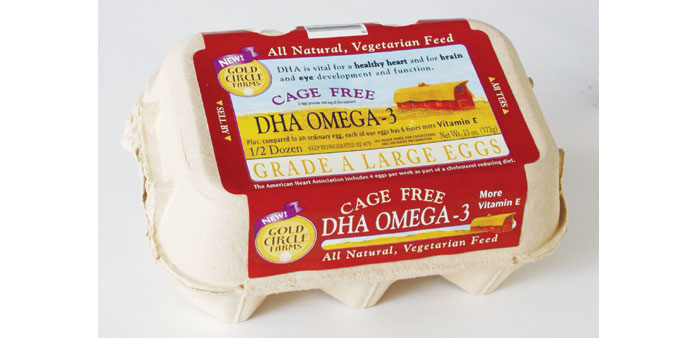
Eggs with omega-3. As junk food fights to retain market share in the face of new regulations and consumers who care much more about health, the hour of a new food industry is at hand - one that will use healthy ingredients that contribute to our nutrition.
By Marina Parisi/Santiago
Believe it or not, the waste that results from food production can contain more healthy components than the finished products themselves. That’s the conclusion of Chilean food research institute CREAS, which conducted a joint project with juice-makers Bayas del Sur in which they recovered juice production leftovers to obtain a berries-based concentrate with very high levels of antioxidants.
In fact, an entire industry is emerging around these so-called “functional foods”, and businesses have begun rescuing food waste to convert it into products with added nutritional value. There is already a patent application for the berries concentrate.
Leftovers or primary remains from food production have almost as many bioactive properties as the finished food itself - meaning they can eliminate free radicals, lower cholesterol to normal levels, boost the immune system and support healthy brain activity. The scientific community has corroborated these qualities.
This is increasingly relevant when considering that Chile creates some 50,000 tonnes of vegetable and industrial waste annually that is immediately discarded. But recovering it is not easy, says Caroline Leon, head of projects at CREAS.
Consumers are better informed today about the consequences of bad eating habits, which is a boost for the functional food trend, says Maria Elvira Zuniga from CREAS. “They have started demanding more nutritional products with an aggregate value for their health.”
Another factor is increased environmental awareness and the need to use industrial waste in a more sustainable way.
An ageing global population that is more careful and thoughtful about food will generate considerable demand for “foods that help prevent illnesses”, Zuniga says.
And functional foods will likely play a priority role here, says Gonzalo Jordan, head of the Chilean education ministry’s research office. The world’s population will reach 9.1bn by 2050, and 22% of those people will be over 60 years old and principally based in more developed countries, says Jordan, citing UN statistics.
The market for these foods has, in fact, already risen significantly. Euromonitor’s statistics point to $532bn in 2005 sales rising to more than $691bn in 2011, with projected sales of $862bn in 2015.
The pioneering additive that has become all the rage is omega-3, a fatty acid essential to the nervous system and regenerating brain cells. The body does not generate this, so it has to be ingested in foods like tuna, salmon, shellfish, algae or linseed and canola oil, among other sources. Yet Chileans hardly eat fish - five kilos a year per person, compared to 60 kilos per person in Japan - and they hardly touch linseed or canola oil.
Food entrepreneur Manuel Jose Correa, founder of Agricola Omega Tres, saw an opportunity in the 1990s when he began changing his poultry’s diet - adding fish oils and corn - to make them lay eggs rich in omega-3. The new diet initially spoiled their flavour, which meant a lot more testing until Correa had the eggs he wanted in 1997: with good taste, aroma and colour.
Then he had to persuade consumers that eggs were a healthy food to eat, no small chore because people were convinced at the time that they should avoid them because of cholesterol concerns.
“Offering someone eggs with omega-3 then was like offering cigarettes to someone with lung cancer,” Correa observes. He persisted until omega-3 became increasingly accepted across the food industry. Producers began including it in milk, butter, margarine, noodles, fruit juice and flour, among other staples.
Agricola Omega Tres sells all its production today to supermarket chains, and while its eggs are 70-100% more expensive than ordinary eggs, Correa says “the consumer is prepared to pay more for healthy food”.
As junk food fights to retain market share in the face of new regulations and consumers who care much more about health, the hour of a new food industry is at hand - one that will use healthy ingredients that contribute to our nutrition. Apparently just what the doctor ordered.- Worldcrunch/America Economia