


Most consumers of energy drinks are unaware of the ingredients found in such drinks, a study has found.
Research studies by Qatar University (QU) students have revealed important findings on various issues and topics, including energy drink consumption, food safety at Souq Waqif, infection rates of hepatitis G virus (HGV)/GB virus C (GBV-C), adolescent obesity, effect of gender and nationality on sedentary behaviour and dietary habits, nutrition and pain episodes in sickle cell anaemia patients and the presence of alloantibodies among transfusion-dependent thalassaemia patients.
The findings were part of an exhibition of senior research projects conducted by students from the biomedical sciences and human nutrition programmes in the Department of Health Sciences, College of Arts and Sciences (CAS).
Ana Fatima Imtiaz and Mariam al-Wedaei investigated patterns of energy drink consumption and found that the majority of consumers are local athletes. The study revealed that most of the consumers had no knowledge of the ingredients found in energy drinks, and suggested the need for awareness campaigns about their health risks.
In their project titled “Identification of microbial pathogens in street foods in Qatar using real time PCR”, Amal al-Zahiri and Reham Mousa found a high level of food safety practices by street vendors at Souq Waqif.
Nadima Haj Ali and Aisha Khan presented their work on infection rates and polygenetic analysis of HGV/GBV-C among blood donors in Qatar, finding no significant difference between Qataris and non-Qataris. They found the rates to be very close to those found in neighbouring countries. Their findings suggested a need for a blood screening policy on the virus to be implemented by the blood bank in Qatar.
Fatema Ahmed and Hala Alila investigated the presence of alloantibodies among transfusion-dependent thalassaemia patients.
The results showed that consistent blood transfusion leads to alloimmunisation against different red blood cell (RBC) antigens, reducing the efficacy of transfused RBC survival and increasing the dependency on transfusion.
They further found that multi-ethnicity among the blood donor pool further leads to intricacy in immune incompetency among thalassaemia patients.
Investigating the dietary behaviour among sickle cell anaemia patients in Bahrain, Zainab Ahmed found that the intake of six kinds of food - diet soda, brown and whole wheat bread, Arabic sweets, nuts, seeds and vitamin supplements - were significantly associated with pain episodes, suggesting a possible correlation between nutrition and pain episodes.
The study presented by Maria Smatti and Zahra Ali investigated the presence of Hepatitis C virus (HCV)-RNA in platelets and the impact of its response to treatment among chronic HCG-genotype 4 patients.
The results showed that measuring the viral particles in platelets would give a better estimation and predictive value for antiviral therapy.
Three student groups from the Human Nutrition Programme collaborated with the Supreme Council of Health on a large cross-sectional study, which involved a total of 1,167 students (14-20 years) from 23 independent schools.
The study by Lyan Akhal and Haya al-Ali showed obesity to be a serious problem among Qatari adolescents, with 59.9% being obese and 57% overweight compared to 40.1% and 43% of non-Qataris.
The study also showed that the waist-to-hip ratio, a well-known risk factor for non-communicable diseases, was significantly higher among females than males.
Sarab al-Azzawy, Ahlam al-Sadi and Saadah Majid studied the physical activity, sedentary behaviours and eating habits among those adolescents, showing the associations with body mass index (BMI) and waist circumference.
The results showed that the time spent on sedentary behaviour was relatively high whereas the level of physical activity was extremely low. Moreover, the combination of sedentary behaviour and the consumption of foods high in fat and sugar had a great impact on the sample group’s BMI, waist circumference and waist-to-hip ratio.
Sarah al-Adgham, Aisha Saleh and Wafa al-Sadi presented their study on the effect of gender and nationality on physical activity, sedentary behaviour and dietary habits among adolescents in Qatar. Their results showed that staircase use, walking and household activities were the most common activities.
Watching TV was very common among Qatari adolescents versus non-Qataris, and fruit, vegetable and milk consumption was higher among non-Qatari males compared to the rest of the sample.
Sarah commented that during the research, she and her colleagues acquired communication skills necessary for any and every nutritionist.
Dr Asmaa al-Thani, head of the Department of Health Sciences, said: “This event is very important to our students to exchange ideas and get feedback from experts and faculty on their projects. Students presented many contemporary topics that address important health issues that can benefit the local community. We are very proud to graduate competent and skilled students who will contribute in advancing and promoting healthcare services in Qatar.”
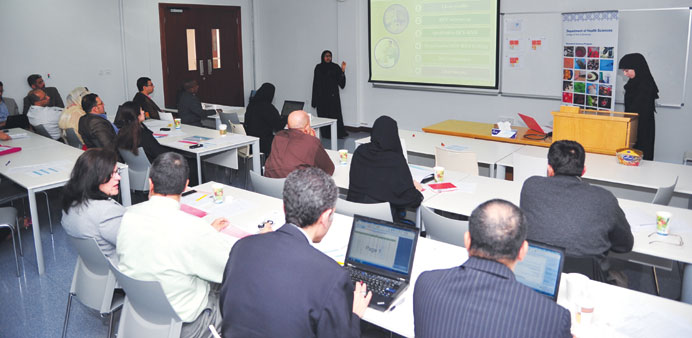
The studies covered various topics and issues.