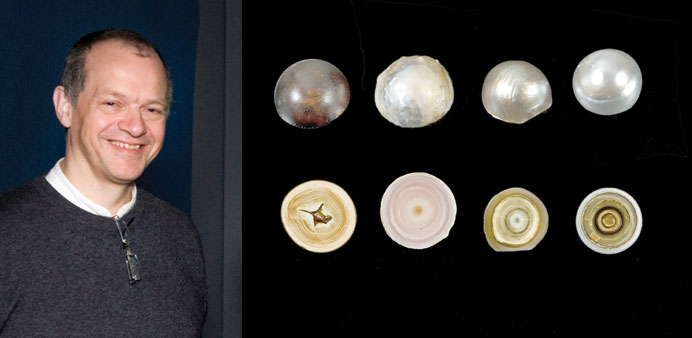
Dr Hubert Bari. RIGHT: Sections showing the layers forming the structure of pearls.
By Fran Gillespie
At the January meeting of the Qatar Natural History Group, renowned jewellery expert Dr Hubert Bari gave a presentation to an audience of more than 150 members on his favourite subject: pearls.
The director of Qatar Museum Authority’s future Pearl and Jewellery Museum, Dr Bari curated the highly successful exhibitions on pearls in Doha and London, with a forthcoming exhibition to be staged in Brazil this year as part of the Qatar-Brazil Year of Culture.
He took his listeners through the history of ideas about the formation of pearls. For centuries people believed that at full moon oysters rose to the surface of the ocean, opened their shells and received drops of rain which hardened into pearls. Some older people in Qatar still believe this, he said.
A more recent persistent legend is that a pearl forms around a grain of sand as an oyster’s way of protecting itself against an irritant. The irritant part of this is true, said Bari, but it is not grains of sand that are the problem.
For most people, the idea of pearls in all their lustrous beauty summons up images of glamour, of wealth, sultans and rajahs bedecked with ropes and turban ornaments of fat, gleaming pearls and the timeless elegance of Coco Chanel with her long, swinging pearl necklaces worn over her trademark black sweaters.
The truth about the origin of pearls could hardly provide a greater contrast: pearls are formed around the excrement of fish!
Fish such as rays, sharks, pike and salmon are infested with tapeworms, said Bari. The worms produce minute larvae, which are excreted. Oysters filter sea water through their shells and it sometimes happens that a larva becomes trapped between the oyster’s shell and its mantle: the layer of tissue that wraps around and protects the organs of the animal inside. The mantle is made up of several layers: the outer layer produces the hard material for the shell, and carries out ongoing repairs whenever the shell gets damaged. Under this is the layer that plays a vital role in protecting the animal within.
If a larva becomes trapped, it tries to leave by breaking through the mantle and in so doing it disturbs the cells producing the shelly material, known as conchiolin or nacre, and the oyster surrounds the intruder with this material, effectively embalming it.
Sometimes it becomes cemented to the inside of the shell where it forms a ‘blister’ pearl, but free-moving spherical pearls are also produced, not just by pearl oysters but by any mollusc.
“All bivalves, gastropods and cephalopods can make pearls,” explained Bari, “even the edible French land snails!”
He went on to say that not only tapeworm larvae have been found encased in nacre — one shell contained a worm 7cm long. Sponges can be encased within a pearly tomb, even tiny fish. Pearls are generally spherical, he said, because they are less uncomfortable for the oyster, which rotates them in all directions and will eventually eject them.
The speaker went on to discuss the two types of pearls: the ‘nacreous’ pearls such as are found in the Arabian Gulf, and ‘porcellaneous’ pearls. The nacre that creates pearls is actually partly made up of a material called aragonite which forms platelets.
Light passing through the platelets is split up and then reflected out again, producing the iridescent effect of pearls.
If the aragonite takes the form of needle-like crystals rather than platelets the reflected light is different from that of nacreous pearls, and these pearls are referred to as porcellaneous.
The elongated prisms of aragonite can take a fibrous form, causing the light to create beautiful flame-like effects. Such pearls come from animals found in the New World such as queen conch, abalone and melo (a large sea snail), and take many colours and shapes. Pearls from the New World were widely used in Renaissance jewellery — in fact, the huge pearls seen in portraits of the period could not have come from the Arabian Gulf, said Dr Bari, because the Gulf pearl oyster Pinctada radiata does not produce pearls of that size.
More than 90% of the pearls in use by jewellery-makers today, he went on to say, come from cultivated freshwater mussels and not from marine shellfish.
Freshwater pearls are only found in the northern hemisphere, and each cultivated mussel can be made to produce several pearls simultaneously, whereas a cultivated marine oyster can only produce one.
Finally, the speaker showed some images of the jewellery in the QMA collection that he is currently researching: Tibetan necklaces with reliquary boxes and headdresses using freshwater pearls from China or Russia, turquoise and lapis lazuli from Afghanistan, amber from the Baltic and coral from the Mediterranean. Truly, international jewellery!