


By Noimot Olayiwola/Staff Reporter
All the three new Single Male Labourer (SML) hospitals and four Primary Healthcare Centres, which are being built, will have medical commission units attached to them to carry out the compulsory medical check-up for newcomers to the country, Medical Commission Department director Dr Ibrahim al-Sharr said yesterday.
Also, the construction of a stand-alone building, which will cater to the testing of about 500 food handlers, hair dressers and barbers daily, is progressing within the Medical Commission complex in Abu Hamour. The new facility is expected to be ready by the year’s end.
The three SML hospitals, being built by the Supreme Council of Health (SHC) in Doha, Messaieed and Ras Laffan Industrial areas, are expected to be operational by 2015.
The primary healthcare centres (PHCs), also being dedicated to single workers, are situated adjacent to the three SML hospitals.
“The SCH has many projects and part of it is to build medical commission units within all those seven healthcare facilities for single male workers as well as to include our services in a number of other PHCs elsewhere in the country,” Dr al-Sharr told reporters yesterday.
He said that new medical commission units had already been opened at the Al Shahaniya and Industrial Area PHCs and another unit was expected to open in Messaimer PHC this year.
The Industrial Area unit has the capacity to test up to 500 people daily.
Another unit, under the management of Qatar Petroleum and Qatar Red Crescent, having a capacity to test up to 1,000 people per day, is coming up in Ras Laffan Industrial City.
“All these new units are in addition to facility upgrading that we have undertaken. We have already upgraded our laboratories here to a very high capacity to cope with the surge in the number of people coming into the country,” Dr al-Sharr said.
The Abu Hamour testing centre, which is the only facility that checks newcomers for infectious diseases such as tuberculosis (TB), human immunodeficiency virus (HIV) and hepatitis, presently tests up to 3,000 people a day in two non-stop shifts from 7am-8pm.
Of the 3,000, about 30% reportedly fail the tests, mostly due to TB and HIV infections.
“The new food handlers unit will allow us to be able to further scrutinise this category of workers, who must be free of any communicable disease due to the nature of their profession. And they are required to come back for testing every year,” the official explained.
“We are also working hard to improve the technical and communication skills of our staff because we are dealing with people, so it will be important to have the necessary skills in handling crowds,” he said.
The Medical Commission has about 420 staff, both administration and technical.
While stating that there was no immediate plan to relocate the Medical Commission from its location in Abu Hamour, Dr al-Sharr said the centre would continue to conduct tests for those on personal sponsorship or family visas, as well as companies that bring in large number of workers.
The PHCs in Al Wakrah, Al Shamal and Al Khor all provide testing for families, including domestic workers but with a capacity of only 50 tests per day.
The official reiterated that companies with a large number of employees needed to secure an appointment before heading to the centre with them.
Regarding overseas testing centres, he said there were presently approved testing centres in 11 countries, namely Bangladesh, Egypt, Ethiopia, Indonesia, Nepal, India, Pakistan, Philippines, Sri Lanka, Eritrea and Sudan. However, Eriteria has recently stopped sending manpower to Qatar.
The testing centres must issue a valid “fit-to-work” medical certificate to Qatar visa applicants ahead of their arrival in the country.
However, Dr al-Sharr said the joint initiative between the commission and the Ministry of Interior was being fine-tuned to ensure that visa applicants passed the medical check-up before their visa was issued.
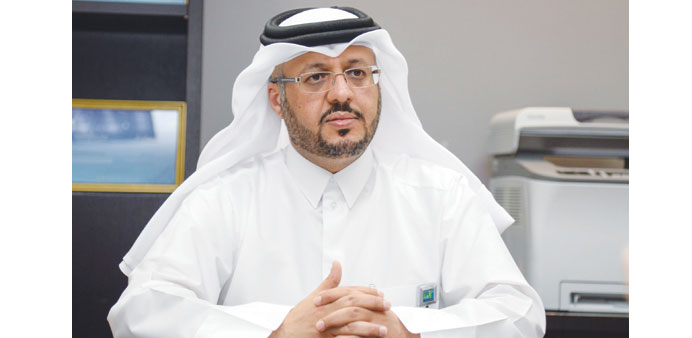
Dr al-Sharr briefing the media yesterday.