


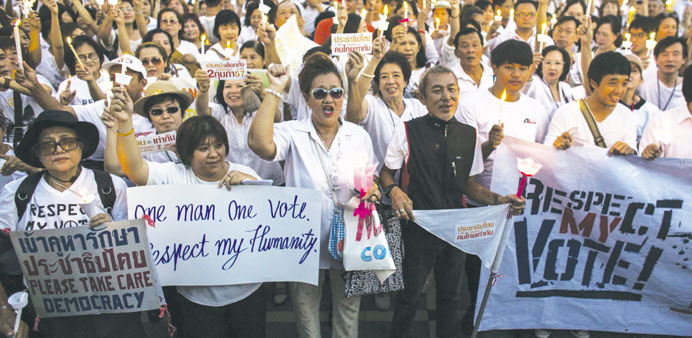
People hold candles as they shout slogans during an anti-violence campaign in central Bangkok yesterday.
AFP/Bangkok
Thai anti-government protesters began closing key roads in Bangkok yesterday, a day ahead of their planned “shutdown” of the capital as they step up efforts to topple the government and halt upcoming elections.
Politically turbulent Thailand has been shaken by weeks of opposition rallies against Prime Minister Yingluck Shinawatra and her divisive former premier brother Thaksin, which have caused the government to call snap February 2 polls.
Demonstrators, who have vowed to disrupt the vote, began fanning out to seven locations across the city, occupying two major intersections in Bangkok’s shopping district ahead of today’s attempt to choke off transport into the capital.
“We will fight regardless of whether we win or lose. We will not compromise or accept negotiation. In this fight, there can be no draws and no win-win scenarios, only one side will win,” protest leader Suthep Thaugsuban told crowds at a rally late yesterday.
Yingluck called the elections in a bid to dampen tensions in the kingdom after weeks of protest against her government.
But the political temperature has continued to rise, with the opposition Democrat Party opting to boycott polls, raising fears of prolonged deadlock.
The impasse has revived fears of a judicial or military ousting of the government, in a country which has seen 18 actual or attempted coups since 1932.
Thailand’s army chief has repeatedly refused to rule out another coup, while dozens of ruling party MPs face impeachment — and a potential five-year ban — in connection with a bid to make the upper house fully elected.
The country has been gripped by a saga of political instability and occasional unrest since Thaksin was ousted from power by royalist generals seven years ago.
The billionaire tycoon-turned-politician, who lives abroad to avoid a jail term for corruption, has large electoral support particularly in his northern Thai heartlands where he is adored for a swathe of popular policies implemented by his and subsequent allied governments.
But he is detested among the country’s elites and by many in the Bangkok middle class and Thai south, who see him as authoritarian and accuse him of buying votes.
The protesters want an appointed “people’s council” to run the country and oversee vaguely defined electoral reforms before new elections are held in around a year to 18 months.
“We hope everything will change in a good way tomorrow. The change we want to see is for this government to stop being corrupt or they should resign,” said Komol, a protester who gave only one name.
Authorities have voiced fears of further violence during the shutdown and say they are ready to declare a state of emergency if there is fresh unrest, and roughly 20,000 police and soldiers will be deployed for security.
Eight people, including a policeman, have been killed and dozens injured in street violence since the latest protests began in late October.
The civil strife is the worst since 2010, when more than 90 people were killed in street clashes between pro-Thaksin “Red Shirt” protesters and the military.
The demonstrators say they will stop officials going to work and cut off power to key state offices.
Suthep, a former Democrat MP, will make a tour of some of the seven planned protest sites in marches through the city today.
Deputy national police chief Reungsak Jaritkate said there were 12 hospitals, 28 hotels, 24 schools and five fire stations within the areas affected.
Schools will close because of fears for students’ safety, while the US embassy has advised stockpiling a two-week supply of food, water and medicine.
“Prime Minister Yingluck has ordered all police and military personnel to exercise utmost restraint and not to use all kinds of weapons in handling the protesters,” said deputy prime minister Niwattumrong Boonsongpaisan, one of several people to hold the position, at a press briefing yesterday.